Skip to content

Posts tagged ‘work’

Your Creative Intentions: The Monday Post ~ May 5, 2014

Jennifer Louden quote

A regular creative practice — a daily practice, if possible — is key to staying in touch with how you make meaning. Key to living, not postponing. (Let’s all agree to give up on “someday.”)

What are your plans for creative practice this week? Given the specifics of your schedule, decide on a realistic intention or practice plan — and ink that time in your calendar. The scheduling part is important, because as you know, if you try to “fit it in” around the edges, it generally won’t happen. An intention as simple as “I will write for 20 minutes every morning after breakfast” or “I will sketch a new still life on Wednesday evening” is what it’s all about. If appropriate, use time estimates to containerize your task, which can make a daunting project feel more accessible.

Share your intentions or goals as a comment to this post, and let us know how things went with your creative plans for last week, if you posted to last week’s Monday Post. We use a broad brush in defining creativity, so don’t be shy. We also often include well-being practices that support creativity, such as exercise and journaling.

Putting your intentions on “paper” helps you get clear on what you want to do — and sharing those intentions with this community leverages the motivation of an accountability group. Join us!

:::::::

If you’re an artist or writer with little ones, The Creative Mother’s Guide: Six Creative Practices for the Early Years is the essential survival guide written just for you. Concrete strategies for becoming more creative without adding stress and guilt. Filled with the wisdom of 13 insightful creative mothers; written by a certified creativity coach and mother of five. “Highly recommended.” ~Eric Maisel. 35 pages/$11.98. Available for download here.

Your Creative Intentions: The Monday Post ~ April 28, 2014

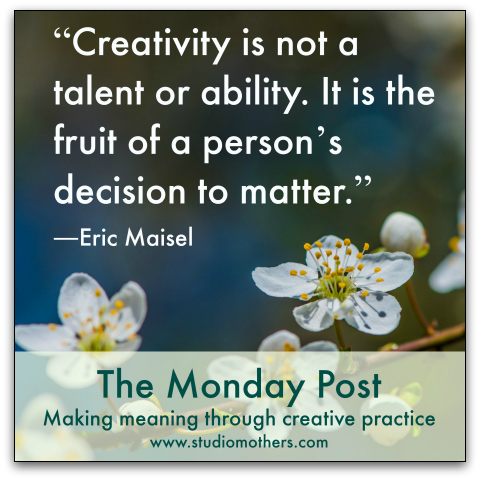
Eric Maisel quote

A regular creative practice — a daily practice, if possible — is key to staying in touch with how you make meaning. Key to living, not postponing. (Let’s all agree to give up on “someday.”)

What are your plans for creative practice this week? Given the specifics of your schedule, decide on a realistic intention or practice plan — and ink that time in your calendar. The scheduling part is important, because as you know, if you try to “fit it in” around the edges, it generally won’t happen. An intention as simple as “I will write for 20 minutes every morning after breakfast” or “I will sketch a new still life on Wednesday evening” is what it’s all about. If appropriate, use time estimates to containerize your task, which can make a daunting project feel more accessible.

Share your intentions or goals as a comment to this post, and let us know how things went with your creative plans for last week, if you posted to last week’s Monday Post. We use a broad brush in defining creativity, so don’t be shy. We also often include well-being practices that support creativity, such as exercise and journaling.

Putting your intentions on “paper” helps you get clear on what you want to do — and sharing those intentions with this community leverages the motivation of an accountability group. Join us!

:::::::

If you’re an artist or writer with little ones, The Creative Mother’s Guide: Six Creative Practices for the Early Years is the essential survival guide written just for you. Concrete strategies for becoming more creative without adding stress and guilt. Filled with the wisdom of 13 insightful creative mothers; written by a certified creativity coach and mother of five. “Highly recommended.” ~Eric Maisel. 35 pages/$11.98. Available for download here.

Your Creative Intentions: The Monday Post ~ April 21, 2014

Pablo Picasso quote

A regular creative practice — a daily practice, if possible — is key to staying in touch with how you make meaning. Key to living, not postponing. (Let’s all agree to give up on “someday.”)

What are your plans for creative practice this week? Given the specifics of your schedule, decide on a realistic intention or practice plan — and ink that time in your calendar. The scheduling part is important, because as you know, if you try to “fit it in” around the edges, it generally won’t happen. An intention as simple as “I will write for 20 minutes every morning after breakfast” or “I will sketch a new still life on Wednesday evening” is what it’s all about. If appropriate, use time estimates to containerize your task, which can make a daunting project feel more accessible.

Share your intentions or goals as a comment to this post, and let us know how things went with your creative plans for last week, if you posted to last week’s Monday Post. We use a broad brush in defining creativity, so don’t be shy. We also often include well-being practices that support creativity, such as exercise and journaling.

Putting your intentions on “paper” helps you get clear on what you want to do — and sharing those intentions with this community leverages the motivation of an accountability group. Join us!

:::::::

If you’re an artist or writer with little ones, The Creative Mother’s Guide: Six Creative Practices for the Early Years is the essential survival guide written just for you. Concrete strategies for becoming more creative without adding stress and guilt. Filled with the wisdom of 13 insightful creative mothers; written by a certified creativity coach and mother of five. “Highly recommended.” ~Eric Maisel. 35 pages/$11.98. Available for download here.

Your Creative Intentions: The Monday Post ~ April 14, 2014

Sarah Breathnach quote

A regular creative practice — a daily practice, if possible — is key to staying in touch with how you make meaning. Key to living, not postponing. (Let’s all agree to give up on “someday.”)

What are your plans for creative practice this week? Given the specifics of your schedule, decide on a realistic intention or practice plan — and ink that time in your calendar. The scheduling part is important, because as you know, if you try to “fit it in” around the edges, it generally won’t happen. An intention as simple as “I will write for 20 minutes every morning after breakfast” or “I will sketch a new still life on Wednesday evening” is what it’s all about. If appropriate, use time estimates to containerize your task, which can make a daunting project feel more accessible.

Share your intentions or goals as a comment to this post, and let us know how things went with your creative plans for last week, if you posted to last week’s Monday Post. We use a broad brush in defining creativity, so don’t be shy. We also often include well-being practices that support creativity, such as exercise and journaling.

Putting your intentions on “paper” helps you get clear on what you want to do — and sharing those intentions with this community leverages the motivation of an accountability group. Join us!

:::::::

If you’re an artist or writer with little ones, The Creative Mother’s Guide: Six Creative Practices for the Early Years is the essential survival guide written just for you. Concrete strategies for becoming more creative without adding stress and guilt. Filled with the wisdom of 13 insightful creative mothers; written by a certified creativity coach and mother of five. “Highly recommended.” ~Eric Maisel. 35 pages/$11.98. Available for download here.

Your Creative Intentions: The Monday Post ~ April 7, 2014

Lucille Ball

A regular creative practice — a daily practice, if possible — is key to staying in touch with how you make meaning. Key to living, not postponing. (Let’s all agree to give up on “someday.”)

What are your plans for creative practice this week? Given the specifics of your schedule, decide on a realistic intention or practice plan — and ink that time in your calendar. The scheduling part is important, because as you know, if you try to “fit it in” around the edges, it generally won’t happen. An intention as simple as “I will write for 20 minutes every morning after breakfast” or “I will sketch a new still life on Wednesday evening” is what it’s all about. If appropriate, use time estimates to containerize your task, which can make a daunting project feel more accessible.

Share your intentions or goals as a comment to this post, and let us know how things went with your creative plans for last week, if you posted to last week’s Monday Post. We use a broad brush in defining creativity, so don’t be shy. We also often include well-being practices that support creativity, such as exercise and journaling.

Putting your intentions on “paper” helps you get clear on what you want to do — and sharing those intentions with this community leverages the motivation of an accountability group. Join us!

:::::::

If you’re an artist or writer with little ones, The Creative Mother’s Guide: Six Creative Practices for the Early Years is the essential survival guide written just for you. Concrete strategies for becoming more creative without adding stress and guilt. Filled with the wisdom of 13 insightful creative mothers; written by a certified creativity coach and mother of five. “Highly recommended.” ~Eric Maisel. 35 pages/$11.98. Available for download here.

Your Creative Intentions: The Monday Post ~ March 31, 2014

Patti Digh quote

A regular creative practice — a daily practice, if possible — is key to staying in touch with how you make meaning. Key to living, not postponing. (Let’s all agree to give up on “someday.”)

What are your plans for creative practice this week? Given the specifics of your schedule, decide on a realistic intention or practice plan — and ink that time in your calendar. The scheduling part is important, because as you know, if you try to “fit it in” around the edges, it generally won’t happen. An intention as simple as “I will write for 20 minutes every morning after breakfast” or “I will sketch a new still life on Wednesday evening” is what it’s all about. If appropriate, use time estimates to containerize your task, which can make a daunting project feel more accessible.

Share your intentions or goals as a comment to this post, and let us know how things went with your creative plans for last week, if you posted to last week’s Monday Post. We use a broad brush in defining creativity, so don’t be shy. We also often include well-being practices that support creativity, such as exercise and journaling.

Putting your intentions on “paper” helps you get clear on what you want to do — and sharing those intentions with this community leverages the motivation of an accountability group. Join us!

:::::::

If you’re an artist or writer with little ones, The Creative Mother’s Guide: Six Creative Practices for the Early Years is the essential survival guide written just for you. Concrete strategies for becoming more creative without adding stress and guilt. Filled with the wisdom of 13 insightful creative mothers; written by a certified creativity coach and mother of five. “Highly recommended.” ~Eric Maisel. 35 pages/$11.98. Available for download here.

Your Creative Intentions: The Monday Post ~ March 24, 2014

Danielle LaPorte quote

A regular creative practice — a daily practice, if possible — is key to staying in touch with how you make meaning. Key to living, not postponing. (Let’s all agree to give up on “someday.”)

What are your plans for creative practice this week? Given the specifics of your schedule, decide on a realistic intention or practice plan — and ink that time in your calendar. The scheduling part is important, because as you know, if you try to “fit it in” around the edges, it generally won’t happen. An intention as simple as “I will write for 20 minutes every morning after breakfast” or “I will sketch a new still life on Wednesday evening” is what it’s all about. If appropriate, use time estimates to containerize your task, which can make a daunting project feel more accessible.

Share your intentions or goals as a comment to this post, and let us know how things went with your creative plans for last week, if you posted to last week’s Monday Post. We use a broad brush in defining creativity, so don’t be shy. We also often include well-being practices that support creativity, such as exercise and journaling.

Putting your intentions on “paper” helps you get clear on what you want to do — and sharing those intentions with this community leverages the motivation of an accountability group. Join us!

:::::::

If you’re an artist or writer with little ones, The Creative Mother’s Guide: Six Creative Practices for the Early Years is the essential survival guide written just for you. Concrete strategies for becoming more creative without adding stress and guilt. Filled with the wisdom of 13 insightful creative mothers; written by a certified creativity coach and mother of five. “Highly recommended.” ~Eric Maisel. 35 pages/$11.98. Available for download here.

Meme of the Week

Baudelaire meme

Happy Friday.

:::::

Kelly: Disappointments and Moving Forward


Those Brave Girls…I tell ya, sometimes they really hit the nail on the head. Remember my Surrendering My Superpowers post? Where I told you I was applying for a full-time faculty position? I was a finalist for that faculty position, and I was really hopeful; I felt really good about my chances. Well, I had my final interview with our campus president on Tuesday. This morning, I learned that I was not her choice. Disappointed? Most certainly. Grateful that I still have a job I enjoy anyway? Definitely. When I got back to my office after meeting with the dean this morning, just trying to wrap my head around the fact that I would still be sitting at the same desk when Fall term starts, I tried to come out of the fog by absentmindedly checking my email. And here was my Daily Truth from the Brave Girls Club:

Dear Fantastic Girl,

Just when you think you have things figured out, even in ONE part of your life….life throws you a curveball.

This is a place where you have a wonderful opportunity…many wonderful opportunities, actually. You get to decide right here, right now…what you will do next. You get to test those amazing skills you’ve been learning about concerning the power of your choice.

You have several choices ahead of you when unexpected things happen. Read more

Kelly: When I Grow Up, I Want To…

I was doing some major studio cleaning and reorganizing this Sunday when I came back across the cards the girls made me for Mother’s Day. I keep a box in my studio of cards they make me since, more often than not, they make them sitting right there next to me…their little fingers covered with oil pastels and markers while they say “No peeking, Mama!” But these particular cards were made at school. They were those “My Mom…..” fill-in-the-blank kinds of things, like “My Mom has blond hair and green eyes.” I mentioned my eye-opening moment those cards brought me back in this post. What was the eye opening moment?

On Sarah’s card, one particular line read, “My Mom does not like to fish.” Sure enough, I hate to fish. I have no patience for fishing. If I don’t get a nibble within the first two minutes, I’m done. On that same line, Olivia’s read, “My Mom does not like to have fun so much.” Ouch. Big ouch. Given all the special fun stuff I try to do with them, that one really hurt. When I asked Livvie what she meant, she said, “Well, you’re always working, Mama, so you don’t get to play with us as much as Daddy does.” Amazing the clarity of children. When I looked at it from her perspective, she was exactly right. I don’t get to “play” with them as much as Daddy does, at least not during the week. DH leaves the house at 6:30 am every morning, before the girls are even up, so I have the morning duty of getting everyone fed, dressed and to school and work. Guess there’s not a whole lot of “fun” in that. DH picks them up from school about 4 pm every afternoon, so when they get home, they spend about 15 minutes on homework before they get to play, take a swim in the alien pod pool, ride their bikes around the backyard, etc. I don’t get home until at least 6 pm or 6:30 pm on the nights I’m not teaching. Teaching nights, it’s closer to bedtime. But even at 6 pm or 6:30 pm, that’s just in time to get dinner on the table, review a little homework, take a bath, and then read a book before bed. That’s one thing I’m diligent about: Mama gets to read the bedtime book and put them to bed every night, and we have our little bedtime lullaby that only Mama sings.

I know this isn’t unusual for working moms, but that doesn’t make it any less painful. I’ve mentioned here before that I’ve been keeping an eye out for full-time faculty openings for a while now. A full-time faculty position (as opposed to a full-time administrative position combined with part-time teaching) would definitely give me a lot more time. There are a few positions opening up in the fall, and I submitted my application last week. Even though I know a change is needed (no news to my supervisors as I’ve already shared this news with them), I have to admit I submitted that application with mixed emotions. I enjoy teaching, I truly do. Yet I also truly enjoy my current role in Student Life and Leadership Development. I think what I’d miss most if I am able to move into a faculty position is “leading” something. I’ve been in a leadership role for so long that that would be a difficult transition for me. Interesting thing about that, though, is that I’d have no hesitation leaving the formal work force all together, with my only “leadership role” being that of full-time mom and artist, but that’s not an option for us financially.

These particular positions are also new to the college. With our change to a four-year state college, we’re now approaching college-prep classes a little differently, and that will be the focus of these positions. Whereas our “normal” faculty positions require 15 classroom hours and 15 office hours per week each fall and spring term, these positions require 16 classroom hours (since prep classes are four credit hours each) and 16 lab tutoring hours. The 30 vs. 32 hours isn’t the issue as much as the fact that with the new positions, those 16 non-classroom hours are dedicated to tutoring instead of office hours, leaving class prep and grading to whenever you can fit it in. The carrot to balance that? Summers off. My other concern is the flexibility I might lose. Currently, as an administrator, I have ample annual leave and sick leave, so when I need to take a day off to go on a field trip with the girls, visit their school for an awards program, or take a couple days off for an arts festival or retreat, that’s easily done. That’s not so easily done in a faculty position. There is no annual leave or sick leave because you have summers off. These are all things I need to figure out and all questions I’ll have to ask should I be granted an interview. While summers off would definitely be a wonderful thing, are they worth the pay cut and very little flexibility the rest of the year? All things I need to work through.

All I know for sure is that Mama definitely does like to have fun and having more time to do that would be nice. I’ve been trying to look at things objectively. Now, I work some long hours but I have a lot of flexibility. Should I make a switch, I’d have fewer work nights and work weekends away from home coupled with summers off, but less flexibility during the school year and a pay cut. I can think of a lot of things I’d like to do with summers off, like have much more time to create art and expand my Purple Cottage ideas and retreats, which could potentially make up for or even surpass filling in for the pay cut I’d be taking, yet would I then be limited to doing those types of things during the summer, particularly the retreats, because I’d lose flexibility during the fall and spring? You see my conundrum? I realize I’m putting the cart before the horse here, but for my sanity, I need to work through these things before the horse gets rigged up. So, oh wise ones out there, what’s your take? If you were in my shoes facing a decision like this, what would you want to be when you grew up, since I guess that is exactly what I’m talking about here. 🙂

[Cross-posted from Artful Happiness]

The Fixed-Schedule Effect: Secret Keys to Life?

My husband often forwards me tidbits from the interwebs that he knows I’ll find interesting. Last week he sent me an article about time management that really blew my mind. In some ways I think it’s the paradigm shift I’ve been looking for, as I often feel lost in the vortex of caring for young children and stepping between motherhood and work.

The answer to feeling overwhelmed and overbooked is NOT throwing more time at your workload — it’s about prioritizing and working in a more condensed framework. It’s about working smarter, not working MORE. Just what busy mothers need, right? We can’t add more hours to our day, but we can use what we have more efficiently WITHOUT running around like maniacs.

This article was truly an eye-opener for me. There’s even discussion of synthesizing parenthood, domestic life, and work. Here’s an excerpt (although I do hope you read the whole thing):

I must emphasize that I’m not some laid-back lifestyle entrepreneur who monitors an automated business from a hammock in Aruba. I have a normal job (I’m a postdoc) and a lot on my plate. This past summer, for example, I completed my PhD in computer science at MIT. Simultaneous with writing my dissertation I finished the manuscript for my third book, which was handed in a month after my PhD defense and will be published by Random House in the summer of 2010. During this past year, I also managed to maintain my blog, Study Hacks, which enjoys over 50,000 unique visitors a month, and publish over a half-dozen peer-reviewed academic papers.

Put another way: I’m no slacker. But with only a few exceptions, all of this work took place between 8:30 and 5:30, only on weekdays. (My exercise, which I do every day, is also included in this block, as is an hour of dog walking. I really like my post-5:30 free time to be completely free.)

I call this approach fixed-scheduled productivity, and it’s something I’ve been following and preaching since early 2008. The idea is simple:

Fix your ideal schedule, then work backwards to make everything fit — ruthlessly culling obligations, turning people down, becoming hard to reach, and shedding marginally useful tasks along the way.

The beneficial effects of this strategy on your sense of control, stress levels, and amount of important work accomplished, is profound.

<snip>

Michael Simmons’ [business] expanded quickly in the years following college graduation. Around the time I was reading The 4-Hour Work Week, I started to discuss the possibility that Simmons tone down the hours. It was his company, I argued, so why not take advantage of this fact to craft an awesome life.

Among the specific topics we discussed, I remember suggesting that Simmons cut down the time spent on e-mail and social networks.

“This isn’t optional for me,” he explained. “Any of these contacts could turn into a important partner or sale.”

But then Simmons’ daughter, Halle, was born.

Simmons’ work schedule reduced from 10 to 12 hours days to 3 to 5 hour days. He took care of the baby in the morning, then worked in the afternoon while his wife, and company co-founder, took over the childcare responsibilities. Evenings were family together time.

Halle forced Simmons into the type of constrained schedule that he had previously declared impossible. And yet the business didn’t flounder.

“The baby turns ’shoulds’ into ‘musts’,” Simmons explained to me. “In the past I used to put off key decisions, or saying ‘no’, because I didn’t want to deal with the discomfort. Now I have no choice. I have to make the decisions because my time has been slashed in half.”

“Since out daughter was born about a year ago, our business has more than doubled.”

The Fixed-Schedule Effect

Collins, Saunders, and Simmons all share a similar discovery. When they constrained their schedule to the point where non-essential work was eliminated and colleagues and clients had to retrain their expectations, they discovered two surprising results.

First, the essentials — be it making sales calls, or focusing on the core research behind a book — are what really matter, and the non-essentials — be it random e-mail conversations, or managing an overhaul to your blog template — are more disposable than many believe.

Second, by focusing only the essentials, they’ll receive more attention than when your schedule was unbounded. The paradoxic effect, as with Collins’ bestsellers, or Saunders and Simmons’ fast-growing businesses, you achieve more results.

Living the Fixed-Scheduled Lifestyle

The steps to adopting fixed-schedule productivity are straightforward:

  1. Choose a work schedule that you think provides the ideal balance of effort and relaxation.
  2. Do whatever it takes to avoid violating this schedule.

This sounds simple. But of course it’s not. Satisfying rule 2 is non-trivial. If you took your current projects, obligations, and work habits, you’d probably fall well short of satisfying your ideal schedule.

Here’s a simple truth that you must confront when considering fixed-schedule productivity: sticking to your ideal schedule will require drastic actions. For example, you may have to:

  • Dramatically cut back on the number of projects you are working on.
  • Ruthlessly cull inefficient habits from your daily schedule.
  • Risk mildly annoying or upsetting some people in exchange for large gains in time freedom.
  • Stop procrastinating.

In the abstract, these are all hard goals to accomplish. But when you’re focused on a specific goal — “I refuse to work past 5:30 on weekdays!” — you’d be surprised by how much easier it becomes to deploy these strategies in your daily life.

 
Read the full article here. Really, it’s worth the read!

I’ve already begun applying these principles to my work life, and I see how powerful this approach can be. Knowing that I need to tie up all loose ends by a certain time (various intervals throughout the day) really helps me stay focused. It’s kind of like applying the urgency of NaNoWriMo to your regular schedule. Do it now; there’s a deadline; stay focused. When you know there really are only 6 hours to get a project completed (rather than telling yourself you’ll work a second shift to get it done) you don’t waste time on Facebook or comparison shopping prices for Seventh Generation Diapers online. And in the end, what do you get? A finished project AND an evening to spend doing whatever you want to do. Suddenly there is time for creativity, reading, whatever. Sounds so simple, I know, but I can’t tell you how much I DON’T do that when left to my own instincts.

Can you see ways of applying these principles to the domestic side of life? Obviously, children aren’t going to observe a “fixed” schedule, no matter how much we might want them to, but there must be ways to apply the “container” approach in a way that makes the domestic scene feel less overwhelming. Your thoughts?
Miranda: Those pesky little transitions

As most mothers are painfully aware, transitions can be difficult for children — and mamas. I’m not talking about those big transitions like starting school, or moving — I’m talking specifically about those little daily leaps from one activity or focus to the next.

I’m hoping that my dear Studio Mothers community can help me with a particularly sticky transition that crops up in my schedule tree times a week. On the days that I work, my sitter leaves the house at about 4:40. I’m usually working frantically right up until the last possible moment. Then I emerge from my work space and greet my little guys (who I have likely seen at several intervals during the day).

Here’s the thing: Ironically, I almost dread this moment. I’m happy to see my little boys, and they’re happy to see me. We share hugs. But the transition is hard. I’m still in work brain, and I have a hard time switching gears. The boys are hyped up because the sitter is leaving and Mom is taking over. It’s a transition. And the big question looms: What do we do NOW? There is often a full hour or more before I need to start dinner. We usually just spend that time hanging out in the playroom, if we don’t have to get in the car to drive an older sibling somewhere. But that hour always feels awkward. I feel like I should be doing something really cool with the kids during that time. Craft projects are pretty much impossible right now, however, as the older of the two boys is 4.5 and the youngest is 18 months. We can’t yet play a board game or do anything particularly structured. I also often feel anxious about preparing dinner; will my little one “allow” me to cook? Or will he be hanging on my leg, crying for my attention, making me wish we’d just ordered pizza again?

I would really like to develop some kind of ritual for easing back into the mom role. Maybe that means stopping work five minutes earlier and getting myself sorted out and mentally prepared. Maybe it means some kind of “thing” that I do with the boys — something that I can look forward to, and they can look forward to — that will ease the transition. Maybe I need to plan that pre-dinner hour in advance, so that I feel like we’re using the time to the fullest.

One thing is for sure: I need to learn to wrap up any loose ends BEFORE the end of my work day. If I try to sneak back onto my laptop, or check mail/facebook/twitter on my iPhone, I always feel guilty and/or disaster ensues. I don’t WANT to do that. So I’m not going to do that anymore. (Stake in ground. You are all my witnesses.)

Do you have any thoughts about ways to make that time the BEST hour of the day — something I really look forward to — rather than something I feel ambivalent about? I’m hoping that if I turn this hour into what I hope it can be, dinner preparation will be easier too, because the boys will feel like they had my full attention before I start cooking. The whole evening will probably flow more smoothly if I get things off to a good start at 4:40.

Any ideas?