Skip to content

Posts tagged ‘writing’

Michelle: Dreaming in 2010

Hello, my name is Michelle Norton and I’m about to become a full-time freelance writer.

I had to practice that. In front of a mirror for about 24 hours but then I sucked it up and went to my current boss to tell her I was quitting.

Background
I’m a web designer and a single mom. Back when I went through my divorce, about nine years ago now, I quickly finished college and took the first job that came up. I put everything aside to care for my infant daughter. I went from housewife on welfare to single mom secretary in six months. And boy did it blow all kinds of bad things.

Between job changes, a looming house short sale, medical debt greater than what I make in a year, and pay cuts, 2009 has been a crazy year. This is the year that I became really sick and yet it was also the year that for the first time the opportunity to follow my dreams arose out of the ashes my past.

What I Do
As I said, I’m a full time web designer for a non-profit. I also do web design on the side and write. I never stopped writing in my spare time but it rarely got me anywhere. Most writing gigs were payed out in trade or some very low income. Some time in 2004 I started writing my own gaming modules for local conventions. People seemed like them. It really sparked the will to do more in me. In 2008 I had my first short story published by Transmitter magazine. People seemed to like that too.

What Started This
There’s one more thing I do with my free time, as copious it is not. That’s ML for NaNoWriMo. That is, I am one of the Municipal Liaisons for Denver for National Novel Writing Month. As something I really enjoy it has brought friendship and fun into my life. One of the guys who participates asked me to write a guest post on it for his blog. That went live in October 2009.

And then things got a little crazy.

Suddenly I was making money writing content. Enough to make me think I might be able to quit some day. Then I got sick.

Kidney stones aren’t fun. However, being homebound for a few days with nothing better to do than write showed me that I could support myself. I made back the money I was losing by staying home (I was out of sick days at work) and then some. By December I made the decision. I was going to quit my job and start freelancing full time. All my experience and a degree (I have a degree in Creative Writing) were finally paying off. I gave my boss notice.

So I am now one month away from leaving my full time job. I won’t have health insurance (that’s a whole ‘nother story), my daughter is excited to be able to come home after school instead of around six or seven at night and I’ll be working from home.

Am I scared to make the jump? Oh yes! But I’m committed to do it.

Another mother writer’s NaNoWriMo win

Stephanie Stambaugh, a blogger and writer living in Colorado, is a friend of Studio Mothers via Twitter. I had noted that Stephanie — also a mother of two — successfully completed NaNoWriMo, and I asked her how she pulled off that feat. Stephanie recently posted a blog-post response, which you may enjoy: Finally, My Post-NaNoWriMo Debriefing. Stephanie’s process actually involved her oldest child, and was facilitated by the younger one. I love the concept of working with your children around, rather than working around your children, as in, circumventing an obstracle. The more we can blend creativity and motherhood the more likely we are to feel “whole”; less compartmentalized. This strategy wouldn’t quite translate to parenting toddlers, but at least it gives the mothers of little ones something to look forward to.

An excerpt from Stephanie’s post:

Over the course of the writing month and over the past few weeks I have been asked by numerous people, “How’d you do it? How did you find time to write a novel?” First, It would be easy enough to answer those questions by simply saying I made time to write it because that’s what writers do, they give up their ideas of being in the so called “real world” to sit and hold words in their mind’s eye and in the palm of their hands for hours on end. That’s our job and so that’s what I did, to a point.

What I actually did was give myself permission to do what I wanted to do instead of sabotaging myself by that nagging voice that plagues all writers. You know what it says? It screams out daily at you too, right? It says, ”What’s the point? I’ve got better things to do, don’t I? Besides, it’ll never be published anyway.” Now I am not saying that voice wasn’t lurking out there just outside my door, waiting for me to invite it in. What I am saying is that I nodded my head to its shrill little demanding attitude and then told it politely to go to hell. I made a conscience choice not to let the dirty bugger into my office on November 1st and now that it is December 14th it won’t ever show its sick little face here again if it knows what’s good for it.

But there was also three other things that helped me “do it.” The first was that I had the greatest motivation any writer can have and that motivation was from my teenage son who did NaNoWriMo right along with me. I did not have to force him to do it as I am lucky enough to have given birth to not just one but two kiddos who have a wonderful passion for stories. But when my oldest said he wanted to do NaNoWriMo with me, it gave me more backbone than I knew I had because I stood a little taller and prouder just by his commitment to do it.

Secondly, I could not have done it without the support of my youngest child who kept busy for hours writing his own comic books and playing quietly until his brother and I were finished writing for the day. Then right along with him was my husband who actually didn’t knock on my office door for once. I think he saw that determined look in my eye and actually liked it or maybe he just feared it too like the way the dirty little nagging voice of doubt feared it.

Read the full post here. Congratulations on your accomplishment, Stephanie! We look forward to hearing more from you in future.

Applause

Our long-time blogmate Brittany Vandeputte was recently published in the Petigru Review! I stole the following from Brittany’s blog:

Yesterday I received my two free author copies of The Petigru Review. It felt good to hold a big chunk of a book in my hands, flip to the table on contents, and see my name listed three times. The $15 I made in “royalties” felt good, too. It brought the total profits from my writing to date up to $115. What a lucrative career choice I’ve made for myself…

Obviously I’m not in it for the money. It’s more the satisfaction of knowing someone else read my writing and thought other people would like it, too. That feels good. And it also feels good to be published in a literary journal named for James L. Petigru, SC stateman, who famously said “South Carolina is too small to be a republic, and too large to be an insane asylum.” I love my adopted state, but as a born and bred Tarheel, I do snicker (quietly) to myself whenever I hear that quote.

I had hoped that I could brag that it was now available on amazon.com, but it isn’t yet. It is, however, available at a local bookstore, Fiction Addiction.

I’m only doing my due dilligence by pointing out that it would fill a stocking nicely and would most certainly impress all your book-loving friends with its sophisticated, artsy, literary-journalness. Plus, I have it on good authority that you might even persuade one of the contibutors to autograph your copy. 🙂

Brava, Brittany! We’re so proud!

Help a writer out: No Haikus

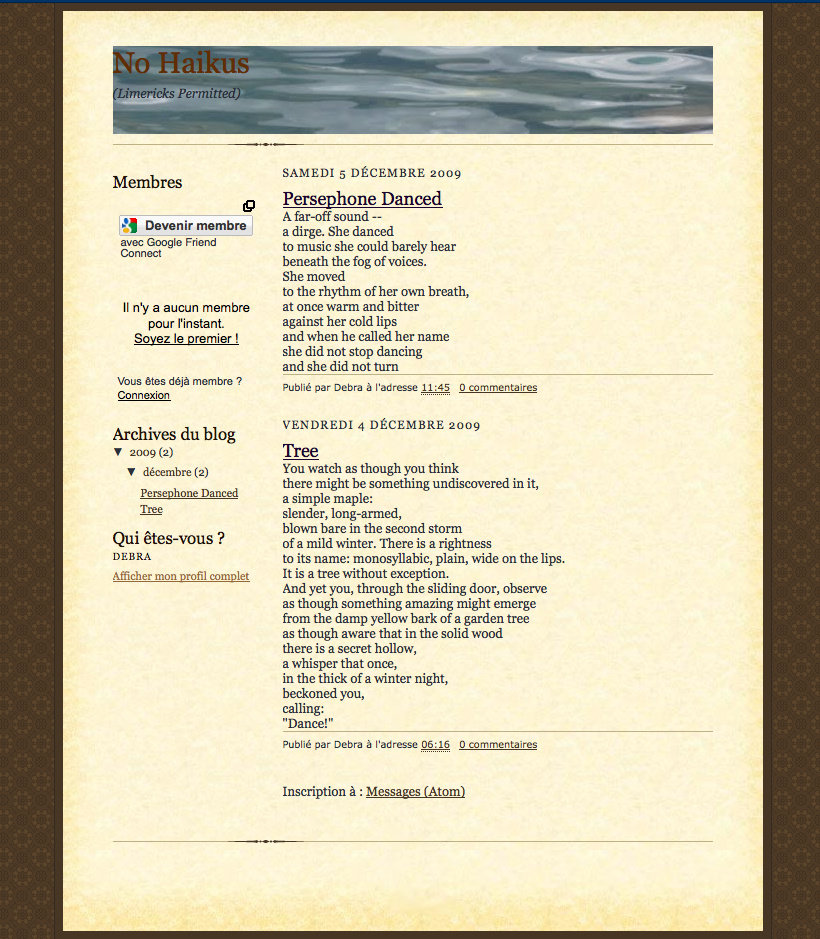
Our friend Debra Bellon, a writer and filmmaker who lives in Toulouse, has a two-year-old son and a brand-new baby girl. Debra has been creatively percolating during the past couple of years, as many of us do while we’re otherwise occupied caring for little ones. To that end, Debra just launched a new blog site for her poetry: No Haikus. Debra says, “I’m going to see if I can write a poem a day, with each poem using a word from the last, if that makes any sense.” She has asked for support and encouragement from the Studio Mothers community — so please visit Debra’s blog from time to time. You know how having an audience helps to keep us honest and committed!

Félicitations, Debra! We much look forward to seeing more of your work.

Cathy: No Nanowrimo win here

crossposted from musings in mayhem

I am happy to have taken part in NaNoWriMo this year for the first time. It put me into a good lead on a companion book to my first novel, and now both need some serious editing. I lost my momentum between lots of doctor appointments for my whole family, getting quite ill myself and caring for sick kids, then my back went out as we leaned toward Thanksgiving, and I got hung up in word count rather than having fun enjoying writing well.

That last part was what killed the project for me. Not the whole project, I am happy to continue work on this particular piece, but I want to go about it in the way that is familiar to me. I am an editing nightmare to some, but I’ll tell you, that is what I really enjoy about writing as I write, the scribbles and rewording, the back-typing and rewording, the considering of the scene from an entirely different angle, etc. It’s what I enjoy about the middle of breadmaking, too: the kneading, the punching it into form.

I have just a few days left to try to make it to 50,000 words. I am at 19,201 and have my family home, no one at work, no one at school or at senior exercise programs until the thirtieth. I don’t think reaching 50,000 is my personal goal anymore. A children’s novel is typically about 30,000 and I don’t want to just write crap for filler for a contest that has lost meaning for me in it’s final goal. I’ve also lost my thread plotwise and feel like I’m wasting precious word count time doing what I actually love about writing and my process in it. That is indicative that it’s time for me to move on and refocus without the contest looming.

For now, for me, this year 19,201 is a fantastic stopping point. Now I can sink my teeth back into the edits of the first novel and then run right into edits on the second I started because of Nano.

Does this then make me a loser if I am not a Nano winner? Certainly not. I have 19,201 words written that I didn’t have before I started NaNoWriMo. That’s a big win in my book. I’ve never written 19,000 words toward one thing in three weeks time in my whole life, nevermind with a houseful of sickies and also school days off throughout the month.

I may not have hit 50,000, but I did a lot more than I would have if I hadn’t tried.

What IS NaNoWriMo, anyway?

Courtesy Inky Elbows — thanks, Debbie!

NaNoWriMo: Productivity…?

NaNoWriMo Day 9 - Productive

Courtesy Inky Elbows — a great site for all procrastinating writers!

Cathy: An update on the progress or not of my nano novel

crossposted from my personal blog

Life happens,
doctors happen,
and this past week, a lot of doctor appointments happened and other sundry bits of attending to sick self, sick kids, etc. So in the interest of pediatrics, Nanowrimo fell somewhat behind and has been having trouble catching back up. also, I really got walloped by news of Brother Blue passing away.

Nanowrimo is an excellent tool to get yourself writing if you call yourself a writer but don’t find yourself doing much of it. It’s an excellent jumpstart, you feel inspired, and even if you don’t, you push to meet that 1667 words per diem minimum. But once you fall behind, it becomes really hard to scramble. but I figured out a a few little secrets today:

1. I don’t have to write 1667 words per day.

2. But it works a heck of a lot better if I do. Otherwise I’m playing a deceitful game of catch-up – which is really very much like swimming against the riptide during hurricane season.

3. Nanowrimo becomes an obsession. Possibly a very unhealthy obsession. I sat in the pediatrics office for six hours on Wednesday thinking not so much of my kids and their various stages of this long, non-h1n1 flu we’ve had, but of how I could be writing instead of sitting in this waiting room, exam room, phlebotomy department, radiology department because when I took my daughter to the hospital the previous week, they didn’t run all the tests they now had to run during Nanowrimo. The boys were with me, too for their wellness appointments, etc, vaccines, etc. I was barely concerned, except when C was crying from getting stuck with a needle for bloodwork or having a big loud machine shoot light boxes all over her leg and hips, while mommy wore a big lead apron. Nano becomes unhealthy when your spouse and you are sitting right next to each other all night long on separate computers not saying a word to each other until he does, and you get annoyed that he’s interrupting your train of thought, but more importantly, your word count. It becomes an obsession when every time your toddler wanders over and whines and pulls to be on your lap, you act like it’s the end of the world because you can’t finish your train of thought or your word count. Same with the preteen mom-mom-momming in your ear and poking you in the arm or the teen mom-mom-momming you on the cellphone until you realize in a half-attention moment you allowed him to sleep over someone’s dad’s house and you don’t even know where he lives, because you were still typing when he was asking and you just wanted him off the phone.

4. But Nanowrimo is important, because you will write a novel in thirty days, whether you make the word count or not, and you will have another manuscript to edit and eventually shop with the other one, because you now can market it to agents as a series of sorts….and you will have two books at the end of this! And at the end of this, you’ll pay better attention to your spouse and your kids and yourself for that matter, and to the fact that maybe the sun is in fact shining outside and oh, yea, there’s an outside…..

5. I don’t have to write the parts in the order in which they come chronologically, but in the order in which they travel through my bleeding brain.

6. Ok that’s more than a few things, but I also figured out it is much better to write about what you know than have to research about something for a novel you’re trying to write in thirty days. Set it in a country you’ve been to, and forget about wildlife, unless of course, it has become a central theme in the book….

On Balancing Life and Writing

10-bannerOK, so many of this blog’s readers are too busy with NaNoWriMo to do much blog surfing — or anything else besides keeping chaos at bay while trying to bang out the daily word count. This month, the word “balance” is probably not in your vocabulary. That said, if you can find a minute or two between carpools or diaper changes — or while on your lunch break at the office — it’s worth your time to check out the collection of pieces on balancing life and writing featured this month at WOW, Women On Writing. As is often the case, the useful nuggets in this content can be applied to most any creative pursuit.

Here’s a tasty sound bite from Christina Katz: “Who says you have to choose between writing and family? You don’t! If I can do it, so can you!” Definitely read WOW’s terrific interview with Christina Katz, aka the Writer Mama.

Enjoy — and then, get back to work!

Alison: 5 Ways to Be a Writer When You’re Not Writing

I recently made the acquaintance of blogger and writer Alison Wells via Twitter, which just goes to show you that Twitter is NOT the useless waste of time that some people think it is.

Alison, who lives in Ireland, describes herself this way: “I am a full-time mother of four young children. Writing is the space place at the eye of the storm. I wrote my first poem at eight and have been writing since. A non-fiction piece ‘The Flask’ was included in the latest RTE’s Sunday Miscellany anthology. My short story ‘Bog Body’ was recently published in the Sunday Tribune‘s new writing slot and goes forward for the Hennessy Literary awards, winner to be announced April 2010!”

Alison generously contributed this cross-post from her own blog, which is a timely post for all NaNoWriMo participants. Welcome to Studio Mothers, Alison!

5 Ways to Be a Writer When You’re Not Writing

You may burn to be a writer, you may understand that it is your true calling and be prepared to put in the hours tapping away on the keyboard or scribbling with your pen but depending on your work situation and personal/family circumstances, there may be stretches of time when you are not able to be physically present with your manuscript. It’s still possible to be in your writing head and to progress with your story or piece even when away from it.

j0442488

When you're not writing, get into your writing mind

1: Let things simmer (incubation 1)

Psychological research has identified incubation as one of the key elements in creativity. Incubation is defined as ‘a process of unconscious recombination of thought elements that were stimulated through conscious work at one point in time, resulting in novel ideas at some later point in time’ [2]. Seabrook Rachel, Dienes Zoltan (2003). Incubation in Problem Solving as a context Effect (Wiki)

Incubation is the period between your conscious and practical outlining of your piece and the point where you come up with the hook or the usual slant on your proposed story. It’s the time when all your ideas mingle and coalesce and form unusual associations.

Writer Louise Wise recently commented on my blog Once I’m in my writer’s head my best writing has come from cooking the family dinner, wiping a 5 year old’s runny nose and mopping up a grazed knee! Somehow in between all that I’ve written a lovey dovey scene! Multi tasking? No sweat!!

casserole

Let things simmer

Sometimes when you are finding it difficult to begin or to progress with your writing you may just need to give your ideas time to incubate. While going about your daily chores, travelling, listening to music etc you can still orient your mind towards your writing project and with a sort of Zen wait and watch approach be receptive to new ideas rising to the surface of consciousness. By placing the elements of your story into a pot and letting it simmer you may find resolutions to your sticky writing problems, you may find an exchange between characters rising fully formed from the stew or a plot angle from a real news story attaching itself successfully to a stuck place in your novel.

2: Get the pot really hot: Engage in a cultural activity (incubation 2)

One writer I know makes it a policy to set aside time for regular cultural trips to museums, art galleries, music recitals, readings, and dance shows. Exposing yourself to a hotch potch of creative ideas allows you to come at stories from different angles, to experience them through a number of senses, to see the world upside down and back to front. Benedict Carey in the New York Times recently wrote on How Nonsense Sharpens the Intellect. The article outlines psychological research which shows that the human brain strives for order. Exposing it to the bizarre makes it work harder to make sense of the world and preserve narrative cohesion by identifying patterns. Thus ‘disorientation begets creative thinking’. So while you are immersing yourself in a flood of fascinating ideas, your brain will be working to find a common thread and the juxtaposition of unusual ideas may result in a unique story or piece of writing.

Record your dreams when you wake3: Remember and record your dreams (incubation 3)

We all dream, whether we remember or not. Freud made a career out of the interpretation of dreams as part of his psychotherapeutic technique. It is true that our dreams may carry many of our conscious and unconscious concerns. Dream interpretation also suggests that many aspects of our dreams can be symbolic. For example a dream of a bath, can mean a tub, or a vessel that carries something important. I am not convinced that we can be absolutely reductionist about our dreams. Any analysis should be done broadly. I believe that our dreams are our subconscious efforts at creating narrative out of our experiences, fragments of memories, subliminal cues, peripheral inputs. We are programmed to make sense of things, to tell stories and our dreams do that while we sleep.

It is the narrative genius of dreams – making sense out of the utterly bizarre – that makes it so worthwhile to try to recall and record them. It’s not often possible to do this and if we are woken suddenly our dreams often retreat out of reach. However I did, for a time, keep a dream notebook and with practice was able to write down many dreams.

There are, of course, many common themes, what may be called Archetypal stories, and these may as Jung suggested be common universal concerns. As a novelist we aspire to make explicit these universal stories. Our dreams can present us with unusual paths through our personal material that can give us an original voice when dealing with those themes.

4: Pay attention and notice difference

Decide to take notice (or notes) of things. I have spoken about this before but compared to children, for example, we take so much for granted, we are rushed, preoccupied etc and don’t take the time to notice the small details surrounding us, the details that can make a reader catch their breath with delight.

Psychology also tells us that we are attracted to people who are similar to ourselves, we are also programmed to gather evidence to support our own theories of life and notice environmental cues that feed into our preoccupations. For example if you are buying a house a drive around the neighbourhood will have you noticing all the For Sale signs. If you are into cars, you might take note of what is parked in the driveways. We need to make an effort to see things differently, to pay attention to the kinds of people we normally disregard, to take an interest in a different aspect of a scene, to watch or read something we might normally never consider.

This puts me in mind of an entertaining BBC comedy quiz show called Have I Got News For You. One of the quiz rounds is the fill in the missing word round. Phrases are taken from a guest publication. The guest publications chosen are a esoteric and ecletic mix including Welding and Metal Fabrication Monthly, Barbed Wire Collector, Hairdressers Journal International, Vacuum Cleaner Collectors Club Newsletter. While some examples are hilarious, these publications go to show that there are so many specialized interests out there, some you may never have imagined. What kind of people are interested in these sorts of things, what sort of lives do they lead? Aspire to see difference where ever you go.

j0438607

Inspiration at the washing line

5: Finally, find inspiration at the washing line (Inspiration 1)

/in the car wash/emptying the dishwasher/having a shower

I don’t think there is a reason I chose washing related examples but it’s at moments of mindless activity where our garrulous consciousness coasts into automatic and goes quiet  that the subconscious gets a chance to speak its mind. I knew many years ago that I wanted to be a writer but I couldn’t for the life of me figure out what to write about. It’s true to say that the experience of years provides material. It strengthens associations and references that lend depth to writing. However I have discovered since I decided to just BE a writer that you can write about absolutely anything. And it’s at the washing line that all the phrases, news items, emotions, characters merge together and instantaneously throw out several fascinating ideas.

Why the washing line? It’s peaceful. I am momentarily (and I mean momentarily) away from the clamour of the children. It’s usually pleasant, uplifting weather (the reason I’m hanging out the washing in the first place). There may be a fresh breeze or bird song. The action of hanging out the washing is repetitive and soothing and requires little concentrated brain power. It is here that the fruits of all that incubation are realised, I become inspired and I find my way through. I trace the narrative thread of the line until a story falls from the bright blue sky. A man with an obsession with weeding is an emotional tyrant who bullies his wife. A pigeon’s coo reminds me of a time and a place and first love. A jokey remark made to one of the children becomes a possible children’s picture book story.

I am a writer in my head, in my dreams, in my outlook, in the middle of my chores. I nearly trip over the washing basket as I run back inside to find a pen to pen the ideas in and prevent them from getting away. So don’t sweat when you can’t be writing, get into your writing head, feed your subconscious and let it do the work for you.
Wearing away the edges of illusion

wishstudio banner 3WishStudio is at it again with this beautiful, personal post on motherhood and creativity — with dreamy photographs by the author, Christina Rosalie Sbarro. I post an excerpt here, but do go read the entire post.

Before my sons, my life was full of busyness, and creativity was often pushed to the margins as my days became filled with commuting, commitments, consumption. I worried a lot about how things appeared, and about security and control. Living with two small boys has gradually worn away the edges of these illusions. I am learning that there is no such thing as control (the very fact that they are in my life at all proves this) or security for that matter. My sons teach me, with their buoyant little boy hearts, that the only moment we have is now.

This is the only one.

I used to squander my time. I pushed my creative self to the side because there was always time to go back and pick up the dropped stitches, staying up until 3am to pursue an illusive story. If I worked long hours at my job and felt drained, I could refill on the weekends with slow-start mornings and evenings listening to jazz in cafes or people watching in town. Because I had so much time, I often missed the value of each moment. I easily spent entire nights watching crappy television shows because there would always be another night; but more often than not these distractions became habits, and writing happened much less than it happens now.

Don’t miss Christina’s evocative work here, either. A treat. And if WishStudio isn’t on your regular blog itinerary, be sure to add this inspiring resource.

Amanda Craig on motherhood and creativity

amanda-craig-01I came across a worthwhile blog post from Amanda Craig, British writer and journalist, about writing and motherhood. Interesting (or depressing?) to note that she doesn’t think it really gets any easier as the kids get older. An excerpt:

To write properly demands unbroken concentration, and solitude. You can just about manage a couple of hours early in the morning when they are sleeping in, but it’s in many ways worse that when they were very little and needed constant 24 hour attention. Teenagers get into scrapes, and need rescuing from the place where they’ve lost their Oyster card/mobile etc. They probably are less resilient than my generation, but when I think what that cost me in terms of fearfulness (catching an international aeroplane every three months aged twelve, alone, and having your passport stolen or getting on a flight diverted to another country are two of my least pleasant memories) then it’s something I’d rather not put them through. I don’t believe in that  nonsense about what doesn’t destroy you makes you stronger.

So, no woman novelist of my acquaintance works at fiction during the holidays. It’s the same reason that you never find women with children going on those tempting-sounding writer’s retreats in places like Hawthornden Castle or Lake Como. Though, let me tell you, we need them rather more than the chaps and childless women who do go there, get served hot and cold repasts and bond.

It may be hard going, but Craig has done it, nonetheless. She has published six books and a number of short stories, at least some number of which she completed after having kids. Read the full post here.

I can’t resist including this passage from the author’s bio page:

…I continued to rewrite my first novel, which was a comedy about a spoilt, snobbish young woman discovering Italy and love. Along the way, I won a couple of prizes for my journalism (Young Journalist of the Year and the Catherine Pakenham award)  each of which had the effect not of advancing my career but getting me fired from staff jobs I desperately needed. I led a very hand-to-mouth existence, cycling everywhere, reading newspapers in libraries and shopping in street markets. The Pakenham prize brought me to the attention of a well-known literary agent who asked to see my novel. I sent it to her, and she promptly lost it. Unfortunately, it was my only copy as I could not afford the photocopying costs.

So I sat down to write it all over again, and that novel became Foreign Bodies which was bought by Hutchinson, and published in 1990 to disastrous reviews. The second, A Private Place, was published in 1991. Its slightly more positive reception led to me becoming a critic on various national newspapers including The Independent. Since then, I have continued to combine writing fiction with reviewing it.

Can you imagine, an agent LOSES the ONLY copy of your manuscript, and you have to write the whole damn thing all over again? OH. MY. GOD.

You’ll also find an interesting blog post on this page, the second one down, entitled “What is the point of keeping on writing?” There are a few other goodies at Craig’s site. Enjoy.