Skip to content

Posts tagged ‘time management’

Your Creative Intentions: The Monday Post ~ September 2, 2013

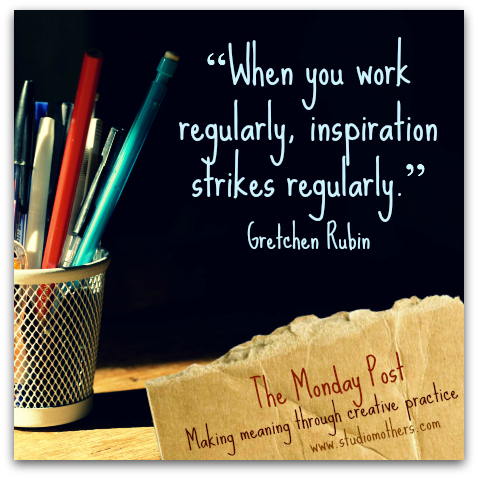
Gretchen Rubin

Commit to a regular creativity practice. Regularity — a daily practice, if possible — is key to staying in touch with how you make meaning.

What are your plans for creative practice this week? Given the specifics of your schedule, decide on a realistic intention or practice plan — and ink that time in your calendar. The scheduling part is important, because as you know, if you try to “fit it in” around the edges, it generally won’t happen. An intention as simple as “I will write for 20 minutes every morning after breakfast” or “I will sketch a new still life on Wednesday evening” is what it’s all about. If appropriate, use time estimates to containerize your task, which can make a daunting project feel more accessible.

Share your intentions or goals as a comment to this post, and let us know how things went with your creative plans for last week, if you posted to last week’s Monday Post. We use a broad brush in defining creativity, so don’t be shy. We also often include well-being practices that support creativity, such as exercise and journaling.

Putting your intentions on “paper” helps you get clear on what you want to do — and sharing those intentions with this community leverages the motivation of an accountability group. Join us!

:::::::

If you’re an artist or writer with little ones, The Creative Mother’s Guide: Six Creative Practices for the Early Years is the essential survival guide written just for you. Concrete strategies for becoming more creative without adding stress and guilt. Filled with the wisdom of 13 insightful creative mothers; written by a certified creativity coach and mother of five. “Highly recommended.” ~Eric Maisel. 35 pages/$11.98. Available for download here.

Your Creative Intentions: The Monday Post ~ August 26, 2013

Monday_Post_Keri_Smith

Commit to a regular creativity practice. Regularity — a daily practice, if possible — is key to staying in touch with how you make meaning.

What are your plans for creative practice this week? Given the specifics of your schedule, decide on a realistic intention or practice plan — and ink that time in your calendar. The scheduling part is important, because as you know, if you try to “fit it in” around the edges, it generally won’t happen. An intention as simple as “I will write for 20 minutes every morning after breakfast” or “I will sketch a new still life on Wednesday evening” is what it’s all about. If appropriate, use time estimates to containerize your task, which can make a daunting project feel more accessible.

Share your intentions or goals as a comment to this post, and let us know how things went with your creative plans for last week, if you posted to last week’s Monday Post. We use a broad brush in defining creativity, so don’t be shy. We also often include well-being practices that support creativity, such as exercise and journaling.

Putting your intentions on “paper” helps you get clear on what you want to do — and sharing those intentions with this community leverages the motivation of an accountability group. Join us!

:::::::

If you’re an artist or writer with little ones, The Creative Mother’s Guide: Six Creative Practices for the Early Years is the essential survival guide written just for you. Concrete strategies for becoming more creative without adding stress and guilt. Filled with the wisdom of 13 insightful creative mothers; written by a certified creativity coach and mother of five. “Highly recommended.” ~Eric Maisel. 35 pages/$11.98. Available for download here.

Your Creative Intentions: The Monday Post ~ August 19, 2013

Osho quote

Commit to a regular creativity practice. Regularity — a daily practice, if possible — is key to staying in touch with how you make meaning.

What are your plans for creative practice this week? Given the specifics of your schedule, decide on a realistic intention or practice plan — and ink that time in your calendar. The scheduling part is important, because as you know, if you try to “fit it in” around the edges, it generally won’t happen. An intention as simple as “I will write for 20 minutes every morning after breakfast” or “I will sketch a new still life on Wednesday evening” is what it’s all about. If appropriate, use time estimates to containerize your task, which can make a daunting project feel more accessible.

Share your intentions or goals as a comment to this post, and let us know how things went with your creative plans for last week, if you posted to last week’s Monday Post. We use a broad brush in defining creativity, so don’t be shy. We also often include well-being practices that support creativity, such as exercise and journaling.

Putting your intentions on “paper” helps you get clear on what you want to do — and sharing those intentions with this community leverages the motivation of an accountability group. Join us!

:::::::

If you’re an artist or writer with little ones, The Creative Mother’s Guide: Six Creative Practices for the Early Years is the essential survival guide written just for you. Concrete strategies for becoming more creative without adding stress and guilt. Filled with the wisdom of 13 insightful creative mothers; written by a certified creativity coach and mother of five. “Highly recommended.” ~Eric Maisel. 35 pages/$11.98. Available for download here.

Your Creative Intentions: The Monday Post ~ August 12, 2013

Oscar Wilde

Commit to a regular creativity practice. Regularity — a daily practice, if possible — is key to staying in touch with how you make meaning.

What are your plans for creative practice this week? Given the specifics of your schedule, decide on a realistic intention or practice plan — and ink that time in your calendar. The scheduling part is important, because as you know, if you try to “fit it in” around the edges, it generally won’t happen. An intention as simple as “I will write for 20 minutes every morning after breakfast” or “I will sketch a new still life on Wednesday evening” is what it’s all about. If appropriate, use time estimates to containerize your task, which can make a daunting project feel more accessible.

Share your intentions or goals as a comment to this post, and let us know how things went with your creative plans for last week, if you posted to last week’s Monday Post. We use a broad brush in defining creativity, so don’t be shy. We also often include well-being practices that support creativity, such as exercise and journaling.

Putting your intentions on “paper” helps you get clear on what you want to do — and sharing those intentions with this community leverages the motivation of an accountability group. Join us!

:::::::

If you’re an artist or writer with little ones, The Creative Mother’s Guide: Six Creative Practices for the Early Years is the essential survival guide written just for you. Concrete strategies for becoming more creative without adding stress and guilt. Filled with the wisdom of 13 insightful creative mothers; written by a certified creativity coach and mother of five. “Highly recommended.” ~Eric Maisel. 35 pages/$11.98. Available for download here.

Your Creative Intentions: The Monday Post ~ August 5, 2013

Osho quote

Commit to a regular creativity practice. Regularity — a daily practice, if possible — is key to staying in touch with how you make meaning.

What are your plans for creative practice this week? Given the specifics of your schedule, decide on a realistic intention or practice plan — and ink that time in your calendar. The scheduling part is important, because as you know, if you try to “fit it in” around the edges, it generally won’t happen. An intention as simple as “I will write for 20 minutes every morning after breakfast” or “I will sketch a new still life on Wednesday evening” is what it’s all about. If appropriate, use time estimates to containerize your task, which can make a daunting project feel more accessible.

Share your intentions or goals as a comment to this post, and let us know how things went with your creative plans for last week, if you posted to last week’s Monday Post. We use a broad brush in defining creativity, so don’t be shy. We also often include well-being practices that support creativity, such as exercise and journaling.

Putting your intentions on “paper” helps you get clear on what you want to do — and sharing those intentions with this community leverages the motivation of an accountability group. Join us!

:::::::

If you’re an artist or writer with little ones, The Creative Mother’s Guide: Six Creative Practices for the Early Years is the essential survival guide written just for you. Concrete strategies for becoming more creative without adding stress and guilt. Filled with the wisdom of 13 insightful creative mothers; written by a certified creativity coach and mother of five. “Highly recommended.” ~Eric Maisel. 35 pages/$11.98. Available for download here.

Your Creative Intentions: The Monday Post ~ July 29, 2013

Flaubert quote

Commit to a regular creativity practice. Regularity — a daily practice, if possible — is key to staying in touch with how you make meaning.

What are your plans for creative practice this week? Given the specifics of your schedule, decide on a realistic intention or practice plan — and ink that time in your calendar. The scheduling part is important, because as you know, if you try to “fit it in” around the edges, it generally won’t happen. An intention as simple as “I will write for 20 minutes every morning after breakfast” or “I will sketch a new still life on Wednesday evening” is what it’s all about. If appropriate, use time estimates to containerize your task, which can make a daunting project feel more accessible.

Share your intentions or goals as a comment to this post, and let us know how things went with your creative plans for last week, if you posted to last week’s Monday Post. We use a broad brush in defining creativity, so don’t be shy. We also often include well-being practices that support creativity, such as exercise and journaling.

Putting your intentions on “paper” helps you get clear on what you want to do — and sharing those intentions with this community leverages the motivation of an accountability group. Join us!

:::::::

If you’re an artist or writer with little ones, The Creative Mother’s Guide: Six Creative Practices for the Early Years is the essential survival guide written just for you. Concrete strategies for becoming more creative without adding stress and guilt. Filled with the wisdom of 13 insightful creative mothers; written by a certified creativity coach and mother of five. “Highly recommended.” ~Eric Maisel. 35 pages/$11.98. Available for download here.

Your Creative Intentions: The Monday Post ~ July 22, 2013

Friedrich Nietzsche quote

Commit to a regular creativity practice. Regularity — a daily practice, if possible — is key to staying in touch with how you make meaning.

What are your plans for creative practice this week? Given the specifics of your schedule, decide on a realistic intention or practice plan — and ink that time in your calendar. The scheduling part is important, because as you know, if you try to “fit it in” around the edges, it generally won’t happen. An intention as simple as “I will write for 20 minutes every morning after breakfast” or “I will sketch a new still life on Wednesday evening” is what it’s all about. If appropriate, use time estimates to containerize your task, which can make a daunting project feel more accessible.

Share your intentions or goals as a comment to this post, and let us know how things went with your creative plans for last week, if you posted to last week’s Monday Post. We use a broad brush in defining creativity, so don’t be shy. We also often include well-being practices that support creativity, such as exercise and journaling.

Putting your intentions on “paper” helps you get clear on what you want to do — and sharing those intentions with this community leverages the motivation of an accountability group. Join us!

:::::::

If you’re an artist or writer with little ones, The Creative Mother’s Guide: Six Creative Practices for the Early Years is the essential survival guide written just for you. Concrete strategies for becoming more creative without adding stress and guilt. Filled with the wisdom of 13 insightful creative mothers; written by a certified creativity coach and mother of five. “Highly recommended.” ~Eric Maisel. 35 pages/$11.98. Available for download here.

Your Creative Intentions: The Monday Post ~ July 15, 2013

John Cleese

Commit to a regular creativity practice. Regularity — a daily practice, if possible — is key to staying in touch with how you make meaning.

What are your plans for creative practice this week? Given the specifics of your schedule, decide on a realistic intention or practice plan — and ink that time in your calendar. The scheduling part is important, because as you know, if you try to “fit it in” around the edges, it generally won’t happen. An intention as simple as “I will write for 20 minutes every morning after breakfast” or “I will sketch a new still life on Wednesday evening” is what it’s all about. If appropriate, use time estimates to containerize your task, which can make a daunting project feel more accessible.

Share your intentions or goals as a comment to this post, and let us know how things went with your creative plans for last week, if you posted to last week’s Monday Post. We use a broad brush in defining creativity, so don’t be shy. We also often include well-being practices that support creativity, such as exercise and journaling.

Putting your intentions on “paper” helps you get clear on what you want to do — and sharing those intentions with this community leverages the motivation of an accountability group. Join us!

:::::::

If you’re an artist or writer with little ones, The Creative Mother’s Guide: Six Creative Practices for the Early Years is the essential survival guide written just for you. Concrete strategies for becoming more creative without adding stress and guilt. Filled with the wisdom of 13 insightful creative mothers; written by a certified creativity coach and mother of five. “Highly recommended.” ~Eric Maisel. 35 pages/$11.98. Available for download here.

Making Creative Hay Outside

Enjoy this seasonal reprint from the archives!

If it’s summertime in your part of the world — or if you live in a mild climate and enjoy fair weather more often than not — think about using outside resources to your creative advantage. When younger kids are out of school, making outdoor time a regular part of your routine can yield many benefits. We often end up spending time indoors just because it seems easier than setting up camp outside. But don’t let the force of habit inhibit your summertime fun and creativity.

If you have a yard of your own, make the most of this bonus. If you have a fenced-off space — even a small one — so much the better. Many mothers are able to sit on a lawn chair and write, read, or sketch while their kids play safely nearby. You can peruse that stack of magazines you haven’t read yet — any reading material that is easy to put down as needed. Outdoor time is also a great opportunity to take photographs of your kids or the world around you.

To stack the odds in your favor, use this four-pronged approach to outdoor (and indoor) downtime:

  1. Make sure everyone is well fed, watered, and toileted.
  2. Spend some time totally focused on the kids.
  3. When the kids seem engaged or playing independently after having some Mommy face time, turn to your creative work.
  4. Try to remain flexible. There will be days when the kids don’t want you staring at a notebook for even 30 seconds, and there will be other days when they’re happily immersed in their own worlds for 30 minutes. Go with the flow.

If your inventory of outdoor toys seems insufficient, yard sales and consignment shops are great places to pick up a few more. You might also send an e-mail to friends with older children to ask if they have anything hiding in their garages or attics that they no longer want.

Many toddlers and young children love to play with water. Consider filling a small kiddie pool with a few inches of water and a bunch of bath or beach toys — often good for at least 30 minutes of interest. For other outdoor play activities, do a bit of google searching and jot down the ideas you like best.

Food always seems to be more fun outdoors, too. Whether it’s just a snack in the backyard or a full-on picnic basket in the middle of a field, eating outside makes everyone happy.

When you’re headed to the park and your kids are old enough to play safely without constant supervision and won’t walk in front of the swings, don’t forget to bring a notepad, sketchbook, or something else to spend time with while you keep one eye on the children. You may find that it’s worth going out of your way to visit a playground that is fully enclosed and is equipped with a good amount of safe climbing structures to keep your kids entertained.

While you don’t want your kids to feel like you’re constantly on standby, waiting to bolt off to your own thing, you do want to be prepared to squeeze in some creative work when the opportunity arises. Over time, you’ll find the middle way that feels best for your and your family.

What works for you? Share your experience!

Your Creative Intentions: The Monday Post ~ July 8, 2013

Chuck Close quote

Commit to a regular creativity practice. Regularity — a daily practice, if possible — is key to staying in touch with how you make meaning.

What are your plans for creative practice this week? Given the specifics of your schedule, decide on a realistic intention or practice plan — and ink that time in your calendar. The scheduling part is important, because as you know, if you try to “fit it in” around the edges, it generally won’t happen. An intention as simple as “I will write for 20 minutes every morning after breakfast” or “I will sketch a new still life on Wednesday evening” is what it’s all about. If appropriate, use time estimates to containerize your task, which can make a daunting project feel more accessible.

Share your intentions or goals as a comment to this post, and let us know how things went with your creative plans for last week, if you posted to last week’s Monday Post. We use a broad brush in defining creativity, so don’t be shy. We also often include well-being practices that support creativity, such as exercise and journaling.

Putting your intentions on “paper” helps you get clear on what you want to do — and sharing those intentions with this community leverages the motivation of an accountability group. Join us!

:::::::

If you’re an artist or writer with little ones, The Creative Mother’s Guide: Six Creative Practices for the Early Years is the essential survival guide written just for you. Concrete strategies for becoming more creative without adding stress and guilt. Filled with the wisdom of 13 insightful creative mothers; written by a certified creativity coach and mother of five. “Highly recommended.” ~Eric Maisel. 35 pages/$11.98. Available for download here.

How to Do One Thing this Summer

kids' summer schedule planningIn the Northern Hemisphere, it’s warm and the days are long. The kids are out of school. We hope for leisurely days, hours spent outside, lots of reading, cooking on the grill, and hopefully a bit of actual time off — whether that means a staycation, an exotic getaway, or something in between.

Unfortunately, we still have to get crap done maintain some level of productivity.

If, like me, you work from a home office and have cobbled together a variety of childcare options for the next two months, your schedule may be turned on its head. Those with fulltime jobs outside the house must also navigate seasonal schedule changes. With the load of juggling that summer requires, it can seem near impossible to get through even a few things on your daily task list — despite the extra hours of sunshine. On top of your workload, you still have to maintain a vague semblance of functionality on the home front, keep everyone fed and clothed, and serve as cruise director. So we shoehorn the necessities into as few hours as possible in order to get the kids to the pool or go for a hike or spend some time working in the garden.

As you already know — all too well — when there’s a time crunch, the first thing to go is the stuff that matters only to you. Creative work, personal practices, personal care. The things you care about but that no one else particularly notices. There may be an indirect effect, as in, if you’re doing your creative work and meditating every morning you’re nicer to be around (as opposed to when you skip those things for too many days in a row and you morph into a raving lunatic get a little grouchy). But on the whole, these are the things that directly impact only one person when ignored: you.

morning freedom reminderDecide on One Thing that you’re going to focus on during the next two months. This could be a creative practice, such as writing or drawing for 30 minutes every day, or it could be that you’d like to complete a specific project during this timeframe. You might decide that your One Thing is a midsummer artist’s date; four hours on a Saturday afternoon to visit a museum by yourself, browse in a bookstore, or sit outside with an iced soy latte while you journal. Maybe you want to save one evening every week to enjoy that pile of magazines that never get read. Or you might be pulled to the self-care category: Perhaps you’d like to do yoga at home every morning. Whatever it is, pick One Thing that is important only to you, and claim it.

Can you pick more than One Thing? Of course. But One Thing, if chosen wisely, is accessible and doesn’t spawn overwhelm. Set yourself up for success. Make your One Thing something that is exciting and doable; realistic while pushing yourself just enough to feel your muscles stretching and strengthening. (I don’t recommend committing to write an 80K-word novel this summer, for example, unless your kids go to overnight camp for two months and you’re barring the door at a remote cabin. You get the idea.)

What’s my One Thing? At present my creative practice is rock solid (I haven’t missed my 500-word daily quota in more than six months), so I chose something that supports “focus,” one of my three words for 2013. I decided to enjoy my mornings and evenings without the distraction of social media and e-mail. This means no facebook, twitter, instagram, pinterest, or e-mail before 9:00 am or after 7:00 pm. Not on my iPhone, not on my laptop. When I adhere to this boundary, I avoid getting sucked into the vortex and have more time for things that matter. Social media is a amazing tool for connectivity — and I manage social media accounts for several clients, so actually get paid to be on facebook, ha ha — but on the personal front, idle social media usage that too easily too easily turns into an hour of wasted time. So the ban is essential — framed as something positive (which it is) as opposed to deprivation.

evening freedom reminderThe three steps to ensure that you do your One Thing:

  1. Put a stake in the ground: Write your One Thing in your calendar or daily schedule, as appropriate. If you have a project goal, decide how much time you’re going to devote to this work on a daily or weekly basis and add it to your calendar as you would an appointment.
  2. Create accountability: Since you already know how easy it is to skip out on what matters only to you, accountability is essential. Share your One Thing here as a comment. Then come back at the end of August and tell us how it went.
  3. Establish reminders: Write down your One Thing on sticky notes and place them in obvious locations around your house. Use reminders on your phone. Or use an app just for this purpose. I’m using the app Intention, which allows you to create visual reminders to keep you on track (the images that accompany this post are from the app; available for iPhone and iPad). The combination of intention with positive visuals is powerful. (For the record, I’m not a paid spokesperson.)

So pick your One Thing, follow the three steps, and enjoy the next two months.

I look forward to seeing what you chose for your One Thing, and supporting you in your success!

:::::
Your Creative Intentions: The Monday Post ~ July 1, 2013

Albert Einstein

Commit to a regular creativity practice. Regularity — a daily practice, if possible — is key to staying in touch with how you make meaning.

What are your plans for creative practice this week? Given the specifics of your schedule, decide on a realistic intention or practice plan — and ink that time in your calendar. The scheduling part is important, because as you know, if you try to “fit it in” around the edges, it generally won’t happen. An intention as simple as “I will write for 20 minutes every morning after breakfast” or “I will sketch a new still life on Wednesday evening” is what it’s all about. If appropriate, use time estimates to containerize your task, which can make a daunting project feel more accessible.

Share your intentions or goals as a comment to this post, and let us know how things went with your creative plans for last week, if you posted to last week’s Monday Post. We use a broad brush in defining creativity, so don’t be shy. We also often include well-being practices that support creativity, such as exercise and journaling.

Putting your intentions on “paper” helps you get clear on what you want to do — and sharing those intentions with this community leverages the motivation of an accountability group. Join us!

:::::::

If you’re an artist or writer with little ones, The Creative Mother’s Guide: Six Creative Practices for the Early Years is the essential survival guide written just for you. Concrete strategies for becoming more creative without adding stress and guilt. Filled with the wisdom of 13 insightful creative mothers; written by a certified creativity coach and mother of five. “Highly recommended.” ~Eric Maisel. 35 pages/$11.98. Available for download here.