Skip to content

Posts tagged ‘schedule’

The Fixed-Schedule Effect: Secret Keys to Life?

My husband often forwards me tidbits from the interwebs that he knows I’ll find interesting. Last week he sent me an article about time management that really blew my mind. In some ways I think it’s the paradigm shift I’ve been looking for, as I often feel lost in the vortex of caring for young children and stepping between motherhood and work.

The answer to feeling overwhelmed and overbooked is NOT throwing more time at your workload — it’s about prioritizing and working in a more condensed framework. It’s about working smarter, not working MORE. Just what busy mothers need, right? We can’t add more hours to our day, but we can use what we have more efficiently WITHOUT running around like maniacs.

This article was truly an eye-opener for me. There’s even discussion of synthesizing parenthood, domestic life, and work. Here’s an excerpt (although I do hope you read the whole thing):

I must emphasize that I’m not some laid-back lifestyle entrepreneur who monitors an automated business from a hammock in Aruba. I have a normal job (I’m a postdoc) and a lot on my plate. This past summer, for example, I completed my PhD in computer science at MIT. Simultaneous with writing my dissertation I finished the manuscript for my third book, which was handed in a month after my PhD defense and will be published by Random House in the summer of 2010. During this past year, I also managed to maintain my blog, Study Hacks, which enjoys over 50,000 unique visitors a month, and publish over a half-dozen peer-reviewed academic papers.

Put another way: I’m no slacker. But with only a few exceptions, all of this work took place between 8:30 and 5:30, only on weekdays. (My exercise, which I do every day, is also included in this block, as is an hour of dog walking. I really like my post-5:30 free time to be completely free.)

I call this approach fixed-scheduled productivity, and it’s something I’ve been following and preaching since early 2008. The idea is simple:

Fix your ideal schedule, then work backwards to make everything fit — ruthlessly culling obligations, turning people down, becoming hard to reach, and shedding marginally useful tasks along the way.

The beneficial effects of this strategy on your sense of control, stress levels, and amount of important work accomplished, is profound.

<snip>

Michael Simmons’ [business] expanded quickly in the years following college graduation. Around the time I was reading The 4-Hour Work Week, I started to discuss the possibility that Simmons tone down the hours. It was his company, I argued, so why not take advantage of this fact to craft an awesome life.

Among the specific topics we discussed, I remember suggesting that Simmons cut down the time spent on e-mail and social networks.

“This isn’t optional for me,” he explained. “Any of these contacts could turn into a important partner or sale.”

But then Simmons’ daughter, Halle, was born.

Simmons’ work schedule reduced from 10 to 12 hours days to 3 to 5 hour days. He took care of the baby in the morning, then worked in the afternoon while his wife, and company co-founder, took over the childcare responsibilities. Evenings were family together time.

Halle forced Simmons into the type of constrained schedule that he had previously declared impossible. And yet the business didn’t flounder.

“The baby turns ’shoulds’ into ‘musts’,” Simmons explained to me. “In the past I used to put off key decisions, or saying ‘no’, because I didn’t want to deal with the discomfort. Now I have no choice. I have to make the decisions because my time has been slashed in half.”

“Since out daughter was born about a year ago, our business has more than doubled.”

The Fixed-Schedule Effect

Collins, Saunders, and Simmons all share a similar discovery. When they constrained their schedule to the point where non-essential work was eliminated and colleagues and clients had to retrain their expectations, they discovered two surprising results.

First, the essentials — be it making sales calls, or focusing on the core research behind a book — are what really matter, and the non-essentials — be it random e-mail conversations, or managing an overhaul to your blog template — are more disposable than many believe.

Second, by focusing only the essentials, they’ll receive more attention than when your schedule was unbounded. The paradoxic effect, as with Collins’ bestsellers, or Saunders and Simmons’ fast-growing businesses, you achieve more results.

Living the Fixed-Scheduled Lifestyle

The steps to adopting fixed-schedule productivity are straightforward:

  1. Choose a work schedule that you think provides the ideal balance of effort and relaxation.
  2. Do whatever it takes to avoid violating this schedule.

This sounds simple. But of course it’s not. Satisfying rule 2 is non-trivial. If you took your current projects, obligations, and work habits, you’d probably fall well short of satisfying your ideal schedule.

Here’s a simple truth that you must confront when considering fixed-schedule productivity: sticking to your ideal schedule will require drastic actions. For example, you may have to:

  • Dramatically cut back on the number of projects you are working on.
  • Ruthlessly cull inefficient habits from your daily schedule.
  • Risk mildly annoying or upsetting some people in exchange for large gains in time freedom.
  • Stop procrastinating.

In the abstract, these are all hard goals to accomplish. But when you’re focused on a specific goal — “I refuse to work past 5:30 on weekdays!” — you’d be surprised by how much easier it becomes to deploy these strategies in your daily life.

 
Read the full article here. Really, it’s worth the read!

I’ve already begun applying these principles to my work life, and I see how powerful this approach can be. Knowing that I need to tie up all loose ends by a certain time (various intervals throughout the day) really helps me stay focused. It’s kind of like applying the urgency of NaNoWriMo to your regular schedule. Do it now; there’s a deadline; stay focused. When you know there really are only 6 hours to get a project completed (rather than telling yourself you’ll work a second shift to get it done) you don’t waste time on Facebook or comparison shopping prices for Seventh Generation Diapers online. And in the end, what do you get? A finished project AND an evening to spend doing whatever you want to do. Suddenly there is time for creativity, reading, whatever. Sounds so simple, I know, but I can’t tell you how much I DON’T do that when left to my own instincts.

Can you see ways of applying these principles to the domestic side of life? Obviously, children aren’t going to observe a “fixed” schedule, no matter how much we might want them to, but there must be ways to apply the “container” approach in a way that makes the domestic scene feel less overwhelming. Your thoughts?

Kelly: Right Where I Need to Be

Cross posted from my personal blog.

Sometimes I think it takes almost walking away from something to realize that what you currently have is truly a pretty good thing. That’s the lesson I learned last week. As I’ve shared with you guys here recently, I’d applied for a new job, still with the College but a little different focus than what I’m doing now. The process took a looooonnnnnnggggg time. However, I’m now done.  🙂  The results? I was one of two finalists for the position at the campus I was most interested in, but the Campus President there selected my competition. This Thursday, I’m scheduled to have my final interview for the position here on my campus. But I won’t be having that interview. Why? Well, since this process has taken so long, it’s given me the opportunity to really think things through, and I realized that I’ve got a darn good gig right where I am. I realized that I was far more attracted to the opportunity to once again work with a former colleague and supervisor than I was to the actual position itself, so I have officially pulled my name out of the hat.

I truly do enjoy my job (College-wide Coordinator of Student Life and Leadership Development for those of you who don’t know). Sure, there are the occasional rough spots, as all jobs have, but I know that I have a positive impact on the students that I work with, and I know that when they take the time to really listen, I’m teaching them very important life skills, while oftentimes having a darn good time in the process. More importantly, I have a heck of a lot of freedom and flexibility in my current role.  That freedom and flexibility gives me the opportunity to do what’s most important when necessary: spend time with my girls. I can go on field trips with them, visit them at school for special programs, take a day off with them when needed without the world coming to an end. Moments after I met with my Campus President to tell her my decision, I felt the weight of the world lift off my shoulders. That’s when you know you’ve done the right thing.

All that said, I received another little knock from the universe here recently that also helped steer my path. Stay tuned. I’ll tell you what that was a little later this week. So, give it some thought. Maybe you are right where you need to be at this moment too.

Alison: 5 Ways to Be a Writer When You’re Not Writing

I recently made the acquaintance of blogger and writer Alison Wells via Twitter, which just goes to show you that Twitter is NOT the useless waste of time that some people think it is.

Alison, who lives in Ireland, describes herself this way: “I am a full-time mother of four young children. Writing is the space place at the eye of the storm. I wrote my first poem at eight and have been writing since. A non-fiction piece ‘The Flask’ was included in the latest RTE’s Sunday Miscellany anthology. My short story ‘Bog Body’ was recently published in the Sunday Tribune‘s new writing slot and goes forward for the Hennessy Literary awards, winner to be announced April 2010!”

Alison generously contributed this cross-post from her own blog, which is a timely post for all NaNoWriMo participants. Welcome to Studio Mothers, Alison!

5 Ways to Be a Writer When You’re Not Writing

You may burn to be a writer, you may understand that it is your true calling and be prepared to put in the hours tapping away on the keyboard or scribbling with your pen but depending on your work situation and personal/family circumstances, there may be stretches of time when you are not able to be physically present with your manuscript. It’s still possible to be in your writing head and to progress with your story or piece even when away from it.

j0442488

When you're not writing, get into your writing mind

1: Let things simmer (incubation 1)

Psychological research has identified incubation as one of the key elements in creativity. Incubation is defined as ‘a process of unconscious recombination of thought elements that were stimulated through conscious work at one point in time, resulting in novel ideas at some later point in time’ [2]. Seabrook Rachel, Dienes Zoltan (2003). Incubation in Problem Solving as a context Effect (Wiki)

Incubation is the period between your conscious and practical outlining of your piece and the point where you come up with the hook or the usual slant on your proposed story. It’s the time when all your ideas mingle and coalesce and form unusual associations.

Writer Louise Wise recently commented on my blog Once I’m in my writer’s head my best writing has come from cooking the family dinner, wiping a 5 year old’s runny nose and mopping up a grazed knee! Somehow in between all that I’ve written a lovey dovey scene! Multi tasking? No sweat!!

casserole

Let things simmer

Sometimes when you are finding it difficult to begin or to progress with your writing you may just need to give your ideas time to incubate. While going about your daily chores, travelling, listening to music etc you can still orient your mind towards your writing project and with a sort of Zen wait and watch approach be receptive to new ideas rising to the surface of consciousness. By placing the elements of your story into a pot and letting it simmer you may find resolutions to your sticky writing problems, you may find an exchange between characters rising fully formed from the stew or a plot angle from a real news story attaching itself successfully to a stuck place in your novel.

2: Get the pot really hot: Engage in a cultural activity (incubation 2)

One writer I know makes it a policy to set aside time for regular cultural trips to museums, art galleries, music recitals, readings, and dance shows. Exposing yourself to a hotch potch of creative ideas allows you to come at stories from different angles, to experience them through a number of senses, to see the world upside down and back to front. Benedict Carey in the New York Times recently wrote on How Nonsense Sharpens the Intellect. The article outlines psychological research which shows that the human brain strives for order. Exposing it to the bizarre makes it work harder to make sense of the world and preserve narrative cohesion by identifying patterns. Thus ‘disorientation begets creative thinking’. So while you are immersing yourself in a flood of fascinating ideas, your brain will be working to find a common thread and the juxtaposition of unusual ideas may result in a unique story or piece of writing.

Record your dreams when you wake3: Remember and record your dreams (incubation 3)

We all dream, whether we remember or not. Freud made a career out of the interpretation of dreams as part of his psychotherapeutic technique. It is true that our dreams may carry many of our conscious and unconscious concerns. Dream interpretation also suggests that many aspects of our dreams can be symbolic. For example a dream of a bath, can mean a tub, or a vessel that carries something important. I am not convinced that we can be absolutely reductionist about our dreams. Any analysis should be done broadly. I believe that our dreams are our subconscious efforts at creating narrative out of our experiences, fragments of memories, subliminal cues, peripheral inputs. We are programmed to make sense of things, to tell stories and our dreams do that while we sleep.

It is the narrative genius of dreams – making sense out of the utterly bizarre – that makes it so worthwhile to try to recall and record them. It’s not often possible to do this and if we are woken suddenly our dreams often retreat out of reach. However I did, for a time, keep a dream notebook and with practice was able to write down many dreams.

There are, of course, many common themes, what may be called Archetypal stories, and these may as Jung suggested be common universal concerns. As a novelist we aspire to make explicit these universal stories. Our dreams can present us with unusual paths through our personal material that can give us an original voice when dealing with those themes.

4: Pay attention and notice difference

Decide to take notice (or notes) of things. I have spoken about this before but compared to children, for example, we take so much for granted, we are rushed, preoccupied etc and don’t take the time to notice the small details surrounding us, the details that can make a reader catch their breath with delight.

Psychology also tells us that we are attracted to people who are similar to ourselves, we are also programmed to gather evidence to support our own theories of life and notice environmental cues that feed into our preoccupations. For example if you are buying a house a drive around the neighbourhood will have you noticing all the For Sale signs. If you are into cars, you might take note of what is parked in the driveways. We need to make an effort to see things differently, to pay attention to the kinds of people we normally disregard, to take an interest in a different aspect of a scene, to watch or read something we might normally never consider.

This puts me in mind of an entertaining BBC comedy quiz show called Have I Got News For You. One of the quiz rounds is the fill in the missing word round. Phrases are taken from a guest publication. The guest publications chosen are a esoteric and ecletic mix including Welding and Metal Fabrication Monthly, Barbed Wire Collector, Hairdressers Journal International, Vacuum Cleaner Collectors Club Newsletter. While some examples are hilarious, these publications go to show that there are so many specialized interests out there, some you may never have imagined. What kind of people are interested in these sorts of things, what sort of lives do they lead? Aspire to see difference where ever you go.

j0438607

Inspiration at the washing line

5: Finally, find inspiration at the washing line (Inspiration 1)

/in the car wash/emptying the dishwasher/having a shower

I don’t think there is a reason I chose washing related examples but it’s at moments of mindless activity where our garrulous consciousness coasts into automatic and goes quiet  that the subconscious gets a chance to speak its mind. I knew many years ago that I wanted to be a writer but I couldn’t for the life of me figure out what to write about. It’s true to say that the experience of years provides material. It strengthens associations and references that lend depth to writing. However I have discovered since I decided to just BE a writer that you can write about absolutely anything. And it’s at the washing line that all the phrases, news items, emotions, characters merge together and instantaneously throw out several fascinating ideas.

Why the washing line? It’s peaceful. I am momentarily (and I mean momentarily) away from the clamour of the children. It’s usually pleasant, uplifting weather (the reason I’m hanging out the washing in the first place). There may be a fresh breeze or bird song. The action of hanging out the washing is repetitive and soothing and requires little concentrated brain power. It is here that the fruits of all that incubation are realised, I become inspired and I find my way through. I trace the narrative thread of the line until a story falls from the bright blue sky. A man with an obsession with weeding is an emotional tyrant who bullies his wife. A pigeon’s coo reminds me of a time and a place and first love. A jokey remark made to one of the children becomes a possible children’s picture book story.

I am a writer in my head, in my dreams, in my outlook, in the middle of my chores. I nearly trip over the washing basket as I run back inside to find a pen to pen the ideas in and prevent them from getting away. So don’t sweat when you can’t be writing, get into your writing head, feed your subconscious and let it do the work for you.

Amanda Craig on motherhood and creativity

amanda-craig-01I came across a worthwhile blog post from Amanda Craig, British writer and journalist, about writing and motherhood. Interesting (or depressing?) to note that she doesn’t think it really gets any easier as the kids get older. An excerpt:

To write properly demands unbroken concentration, and solitude. You can just about manage a couple of hours early in the morning when they are sleeping in, but it’s in many ways worse that when they were very little and needed constant 24 hour attention. Teenagers get into scrapes, and need rescuing from the place where they’ve lost their Oyster card/mobile etc. They probably are less resilient than my generation, but when I think what that cost me in terms of fearfulness (catching an international aeroplane every three months aged twelve, alone, and having your passport stolen or getting on a flight diverted to another country are two of my least pleasant memories) then it’s something I’d rather not put them through. I don’t believe in that  nonsense about what doesn’t destroy you makes you stronger.

So, no woman novelist of my acquaintance works at fiction during the holidays. It’s the same reason that you never find women with children going on those tempting-sounding writer’s retreats in places like Hawthornden Castle or Lake Como. Though, let me tell you, we need them rather more than the chaps and childless women who do go there, get served hot and cold repasts and bond.

It may be hard going, but Craig has done it, nonetheless. She has published six books and a number of short stories, at least some number of which she completed after having kids. Read the full post here.

I can’t resist including this passage from the author’s bio page:

…I continued to rewrite my first novel, which was a comedy about a spoilt, snobbish young woman discovering Italy and love. Along the way, I won a couple of prizes for my journalism (Young Journalist of the Year and the Catherine Pakenham award)  each of which had the effect not of advancing my career but getting me fired from staff jobs I desperately needed. I led a very hand-to-mouth existence, cycling everywhere, reading newspapers in libraries and shopping in street markets. The Pakenham prize brought me to the attention of a well-known literary agent who asked to see my novel. I sent it to her, and she promptly lost it. Unfortunately, it was my only copy as I could not afford the photocopying costs.

So I sat down to write it all over again, and that novel became Foreign Bodies which was bought by Hutchinson, and published in 1990 to disastrous reviews. The second, A Private Place, was published in 1991. Its slightly more positive reception led to me becoming a critic on various national newspapers including The Independent. Since then, I have continued to combine writing fiction with reviewing it.

Can you imagine, an agent LOSES the ONLY copy of your manuscript, and you have to write the whole damn thing all over again? OH. MY. GOD.

You’ll also find an interesting blog post on this page, the second one down, entitled “What is the point of keeping on writing?” There are a few other goodies at Craig’s site. Enjoy.

Miranda: Yeah, I’m writing, but OUCH

26421546_0cccf04d2eWhat lengths will you go to in order to protect your creative time?

I’ve come to depend on my Saturday morning “me time.” My husband and I split the weekend mornings; he gets Sunday. This means I can either sleep in on Saturdays or get up early and start writing — or a combination of the two. But I have from whenever I get up until 10:00 or even 11:00 (if I push it) all to myself, assuming that I don’t have to leave the house to go do something. Like pick kids up from sleepovers.

Sleepovers. A few weeks ago I came to realize that my Saturday morning time was increasingly being sacrificed to pickups for one of my older kids after a Friday night sleepover. Sleepover pickup time seems to be 10:00 by default. This means I need to leave the house by 9:45 in most instances — so I have to start showering/getting dressed by 9:15. If my husband and I were up late the night before and I want to sleep in a little, maybe I get out of bed at 8:00. So, up at 8:00, make coffee….by the time I’m happily ensconced back in bed with my coffee and laptop, I might have an hour left before having to stop. Now, an hour is nothing to sneeze at, but it’s a whole lot less than nearly THREE hours. And without question, once I’m up and have joined the family, that’s it. There’s no going back to my morning hidey-hole. What’s a mama to do?

I started telling my older kids that they had to nail-down pickup time BEFORE dropoff. Either they needed to know that I could pick them up at 11:00 or later, or they had to arrange for a ride home. If neither option was feasible, and the sleepover couldn’t be moved to our house, then no sleepover. I figured that this was only one of the two weekend nights anyway, so it couldn’t be too problematic.

My new edict took hold. Things were going well. I started remembering to remind the kids about pickup plans before I agreed to take them anywhere on Friday nights. More time to self = happier me.

Then, this weekend, my mother came down to babysit while my husband and I went to the David Gray concert in Boston. As we were leaving — late — my daughter asked if she could sleepover at a friend’s house. She needed a dropoff, however, and it was out of our way. No go. But then Grandma volunteered to take her, with the two little ones in tow. Fine. Daughter was happy and packed her stuff in a rush. Just as we were all heading out the door at the same time, I remembered: “What about tomorrow? Are you going to need a ride before 11:00?” Oh. Daughter wasn’t sure. She made a few calls. No, she had to be picked up by 10:00 because the host had a soccer game, and the other girl who was also sleeping over was unable to give my daughter a ride.

I thought about my morning, and how I was so looking forward to getting back to my manuscript. I thought about what I’d just said to Cathy about how your family won’t take your creative commitment seriously unless YOU take it seriously. I want to finish this book, and I need to treat my work LIKE MY WORK.

I told my daughter I couldn’t pick her up at 10:00.

She was sweet, and didn’t give me a guilt trip. “It’s OK,” she said. “I’m going to have a busy weekend NEXT weekend.”

I felt like crap. Really, was it such a big deal to cut my morning a little short? I couldn’t do it. “It’s fine, I’ll just get you in the morning,” I said (a little reluctantly). “No, Momma,” she said. “It’s fine.” She headed back to her room, and I let it go. We left, while I fell into maternal self-flagellation. Isn’t it a mother’s JOB to drive her kids all over the place? Was it really fair to deprive my daughter of a fun night with her friends, just because I selfishly wanted MORE time to myself?

I don’t know the answers to those questions, and I don’t know if I want to know. But my daughter didn’t go, and I used my morning time effectively. I kind of owed it to my daughter to do that, didn’t I?

What would YOU have done?

Some of our readers are contemplating (or have already committed to) NaNoWriMo. What are you going to do to protect the amount of time required for churning out 1,600 words a day? Sure, most people here (even non-writers!) could churn out 1,600 words in a single day. But EVERY day, for THIRTY days?

Despite the sheer terror mild panic, I’m thinking of running “bandit” on the NaNoWriMo road race. I can’t commit officially, because I want to work on my current fiction project and NoNoWriMo rules specify that all projects MUST be from scratch. I’m also more than a little intimidated by the 1,600 daily benchmark. Even just committing to 500 words a day might be a struggle for me. Once I get going, I’m fine, but finding the sit-in-your-seat-and-get-started window, every day, is pas evident.

Stepping up your game, and making sure that YOU are clear on your commitment and that you then communicate that commitment to your family, are essential steps. What else can we do to create — and protect — our time?

[Photo courtesy Shawn Allen under a Creative Commons license.]

Mom Bloggers Club: Timing is everything

mombloggersclubaprilbannerfallNo offense, Mom Bloggers Club, but the recent post on My Favorite Writing Habits and Approaches left a few rather gaping holes.

This part was reasonable enough: “To develop your writing and/or passion, first make your presence with it a priority. It is simple. Make time and space for it.”

But this is all that the author has to offer for making that time and space:

TIME
Find the ideal pocket of time in your usual routine. Whether you develop a little bit of it daily or focus on it once every week, find the spot that is just right; one that flows with your energy.

Use this as a “rock” in your flow. Allow other things to move around it; keep it your priority.

I prefer mornings when the energy is fresh and it is more likely to be nice and quiet so that I can really be with my self and am not as easily distracted.

SPACE
Set up a space customized for developing your passion; one that is attractive to you and draws you in. Place all the essential tools customized for you and this project within easy reach. Make it so that it prompts your creative flow and feels great to be in.

Visit it every day, a few times. Even if just for a check in. Allow it to serve as a keystone to always keep you connected.

Uhm….what about the kids who are climbing up onto your lap with peanut-butter fingers, impaling their thumbs on your stapler and trying to electrocute themselves by sucking on the end of your PC’s power cord?

I think the topics of time and space merit more exposition. For content geared specifically to mothers, we need HELP. Well, I do, anyway. Perhaps, given that this post was directed toward bloggers, not “writers,” I’m being too harsh. I probably shouldn’t critique ANY attempt to be helpful. I’m sure the author has the best of intentions, and judging from the comments, there were those who found inspiration in the post. But considering that this piece was featured in the Mom Bloggers newsletter, I think there is room for a little more exploration.

Glossing over this terrain only adds to my existing frustration. There are mothers who want desperately to express themselves creatively — mothers who are crying in the frozen food aisle right this second, because they are so painfully separated from the creative part of themselves and can’t figure out how to reconcile the dichotomous pieces of their lives — and this kind of advice doesn’t really apply to them. When you have very young children at home — and limited resources — I don’t think that it’s as easy as finding a pocket of time in your usual routine (let alone a pocket that actually optimizes your biorhythms), and setting up some space for your work. Isn’t that the whole reason why this blog — our blog — has the following that it has? This stuff isn’t easy or simple, even though we wish it were. Maybe, for some women, it isn’t so complicated. Those are probably the women who have FINISHED their novels, too.

<sigh….>

Writing with the family around

From Mom Bloggers Club, a post by Rosemary O’Brien on writing from the domestic trenches: “Writing with the Family Around“:

I don’t know why, but I have a difficult time writing even a blog post when my family is around. Maybe it’s because when they come home from school and work, I may as well hang up my keyboard and give up until they go to sleep. If it’s not breaking up a dispute about a ball that magically flew threw the air and knocked something over in a house where balls are not allowed to be thrown, then it’s to stop and feed someone because they are “staaaaaaaarrrrrrrving!” even if they had a snack and it’s almost time for dinner (that I have to stop and make).

That is why I look forward to bedtime. It is when I creep back to my computer, which I left on, and create with abandon. I find I am more productive at night for some reason. Mornings rarely only happen for me because my kids need to get to school. It seems to be a law in this country. Before I had them, I woke up at 9 and began writing at 9:30 with my jammies on and a strong cup of coffee in my hand. At that point, I skimmed and answered simple emails, deleted files and was not required to speak to anyone about anything unless I wanted to. It was not until early afternoon when my writing would come alive and I would write with abandon. Some of my best work was written during this time. In fact, this is when my first novel was produced and found a publisher.

Read Rosemary’s full post here, and check out Mom Bloggers Club while you’re at it. I joined about a year and a half ago — and the newsletter often has an interesting tidbit or two.

Many of this blog’s readers rely on evening time for creativity (definitely works for Kristine) but by the end of the day, others among us feel less like Edith Wharton and more like dog meat. Of course, our schedules and rhythms adapt with the ever-changing needs of our children as the grow — and start sleeping, or stop sleeping.

In my own experience, I’ve found that my little ones are now reliably asleep by 8:30 every night — but my older ones are often just waking up at that time, in terms of being interested in interaction. On Saturday night, I stayed up until 4:00 a.m. talking with my oldest son, who will be leaving for college in a matter of weeks. I hadn’t intended to stay up that late, of course, but the conversation — important conversation — just happened. Some things can’t be rescheduled. Did I note the irony that I finally had the baby tucked up in his crib, weaned and sleeping through the night — but the firstborn had me up all until all hours? I sure did, but still managed to feel like a kid in a candy store. Now, if only I could steal some of those wee hours for my writing….

Brittany: Bringing Plans to Fruition

I’ve made a couple attempts to write a blog on here recently, and they just didn’t pan out. The last few months have been an odd combination of being at a complete creative standstill while still running 90-miles an hour with my hair on fire. I haven’t had time to breathe, much less blog. Luckily, the creative standstill has passed, and like Bethany, I too have been gifted with the idea for my next novel.

I say “gifted,” because I’m not exactly sure where the idea came from. One minute I was sitting in the car, and the next, it was uncoiling itself in my head, much like a spider spinning a web. This circles around to this, this connects to that. It was amazing and exhilarating, and felt a little bit like being touched by the divine.

I’ve been frustrated with my current novel, How Home Improvement Saved My Marriage, because it’s a little absurdist, and doesn’t really fit into any of the various categories of women’s lit.  The agents and publishers who’ve seen it couldn’t relate to it. But then again, I didn’t write it for them. I wrote it for women like me, who live in the suburbs, shop at Walmart, have never seen a pair of Jimmy Choos in person, and would rather wear a scuffed pair of Keds anyway. The book is like my zaniest mom friend. The one you hope and pray gets a sitter on Bunco night because she’ll fill you in on all the neighborhood gossip and then say something incredibly funny that will make you laugh harder than you have for days. It needs to be out there, dancing on a table with a lampshade on its head, and not collecting dust in my file cabinet. So I decided I’d send it out to one last publisher, and if they didn’t accept it, I was just going to publish the book myself.

Since I’d come to a final decision about my book, my creative brain was a blank slate, so to speak. I was thinking about writing a romance novel (again, just to see if I could do it), and was asking myself what situation might make a good story. I was thinking about the kinds of characters that would interest me, and the image of a girl with hair “the color of a wheat penny” popped into my head. She was a healer/midwife in turn-of-the-20th-century Appalachia, who has her whole way of life turned on its head when a brand new graduate of Harvard Medical School decides to open up his practice on her side of Bear Wallow Mountain. I was trying to think about what big event might bring two antagonists together (because I didn’t have a BIG event in my previous novel), and I suddenly remembered family stories about a terrible flood in the region. And so popped up my new idea.

In 1916, Ivy Lyda (name subject to change) lives on Bear Wallow Mountain and tends to the sick there. Her grandmother was Cherokee and taught her all manner of folk remedies. She’s well respected in her neck of the woods until the arrogant (but intoxicatingly handsome) doctor John Emerson arrives  During the summer, a horrible (hundred-year) flood wrecks havoc in the mountains and forces them to work together even as their lives are put in danger.

By a very odd coincidence, shortly before I was struck with inspiration, I took a time-killing Facebook quiz to learn the name of my Guardian Angel. My result: Uriel.

Uriel is considered one of the wisest Archangels because of his intellectual information, practical solutions and creative insight, but he is very subtle. You may not even realize he has answered your prayer until you’ve suddenly come up with a brilliant new idea. Uriel is the tallest and his eyes can see trough the eternity. All this considered, Uriel’s area of expertise is divine magic, problem solving, spiritual understanding, studies, alchemy, weather, earth changes and writing. Considered to be the Archangel who helps with earthquakes, floods, fires, hurricanes, tornadoes, natural disaster and earth changes, call on Uriel to avert such events or to heal and recover in their aftermath.

I hope to get started on the writing soon. I’ve arranged for childcare for the boys Tuesdays, Wednesdays, and Thursdays from 9-1 until the second week of July. I’m going to take my time outlining and really make the plot as tight as I can first. It will make it that much easier in the fall when I must concentrate my writing into two mornings per week (with invariable interruptions).

It’s exciting to have a plan again.

Mary: December Thoughts

I should be writing Christmas cards, but frankly I’d much rather be here in my darkened study, whiling away the time spinning words around. It was a long, sort of difficult day, with my six-year-old boy having a bad cough, and so not being able to romp around in the snow outside.

It kept us quite house-bound. We did a lot of playing, some arguing, some movie-watching, some running around like crazy people, and generally climbed the walls until bedtime.

Now I relax here in this comfortable seat and relish the silence. Funny how such life, such energy and immersion can be so stimulating and exhausting at once. I love these small people so dearly, and yet breathe a small sigh of relief once the house is quiet for the evening, and I can once again write in peace, with no interruptions, with no noise, no questions or incessant tappings on the shoulder.

I think about the new year coming, and hope that I can get some good work done – that this new year brings a snap of newly starched sheets to my rather burdensome creation, this book, this relentlessly unmade, rumpled bed of a project.

I know I speak harshly of it, for which I do apologize, book. I do love thee. But you are becoming heavy on my back — although I suppose that is my perception of you, and not at all a reflection of you personally. I think, actually, I’m putting all these feelings on myself.

For one thing, it is NOT good practice to give myself deadlines. It just makes me feel all the more despondent when I don’t meet them. For example, I was bragging talking to my friends and acquaintances about how I thought it would be completed by the end of this year. HA.

(Isn’t it funny how life always deals out a blow after one has been bragging? “Oh, yeah? Take that!” says Life, as it fills up your glass with a dose of humility, plopping in a tablet of irony, for good measure. And you are sorely humbled. And also sort of embarrassed. And wanting to just slink away home with a blanket over your head, for a nice cup of tea and some good old fashioned self-pity. What? You don’t do that? Ah. Well. ANYWAY).

In essence, I hope the new year brings all good things – a hope, I suppose, all people around the world have. But, what of this new year? What if it doesn’t deliver? What if I simply don’t have the time to finish? What if I am constantly bombarded with interruptions, with parenting, with the day-to-day happenings that constitute a bustling and living household?

If I am to make any headway on this project, I fear I must schedule — a thing I really hesitate doing, because it’s another sort of added pressure. But if I don’t, if I just let the whole thing go where it wants to, I’m afraid that I won’t get enough done. So, here is a tentative schedule, tied up with a nice red ribbon, just in time for Christmas:

Writing times:

6:30 a.m.: I can get in about a half an hour to 45 minutes, if I start this early. It might be worth it. If I could just get out of bed.

1:00 p.m.: When Liv naps, I write. ON THE BOOK. Write for one hour, or until she wakes up.

8:00 p.m. -10:00 p.m.: After everyone is in bed, write – blogs, book, whatever I am inspired to do.

Of course, there are always those days when I’ll have more time, and also some days less. But this might be a good, basic plan for those “regular” days, when we are all running on our daily rhythm, and buzzing about knowing where we are going, and when we are getting there.

It seems like it might work out. It’s worth a try.

D’ya hear that, book? I’m with you on this. I’m on your side. I want you to be whole, complete, happy, read, loved. I am your partner, your hand to hold, your wooer, your teammate — your mother, for God’s sake. Don’t abandon me, not yet. Stick with me through this frisky, wild-eyed new year.

Let’s make it a good one.

Cathy: I miss my kids

K, hanging -- what you don't see are the 10 HS girls just outside the frame

This whole juggling creativity and kids thing is swinging the pendulum in the opposite direction lately. I am, if not actively writing in my manuscript, doing some research re: astronomy and observatories online, albeit while also hopping blogs, etc. I have been regularly contributing to the weekly contest, to keep me on my toes creatively, and writing a blog per week, which usually means I am analyzing how the writing process is going for the manuscript. I have been accused by my family of spending more time with the computer than anyone else does.

My young teen has started becoming more interested in hanging out in a neighborhood clique after school than in playing video games. That is fantastic in my book, except that I don’t see as much of him. When he comes home, he zips upstairs to shower before dinner, do homework, and after dinner, he disappears upstairs again. I knew this was coming, as I remember doing the same at the same age, but he’s really adept at it. I think he’s in the room with me, so I start talking, while doing something else, of course. I turn to check if he’s listening, and he’s become invisible!

On fishing trip -- S draws instead

On fishing trip -- S draws instead

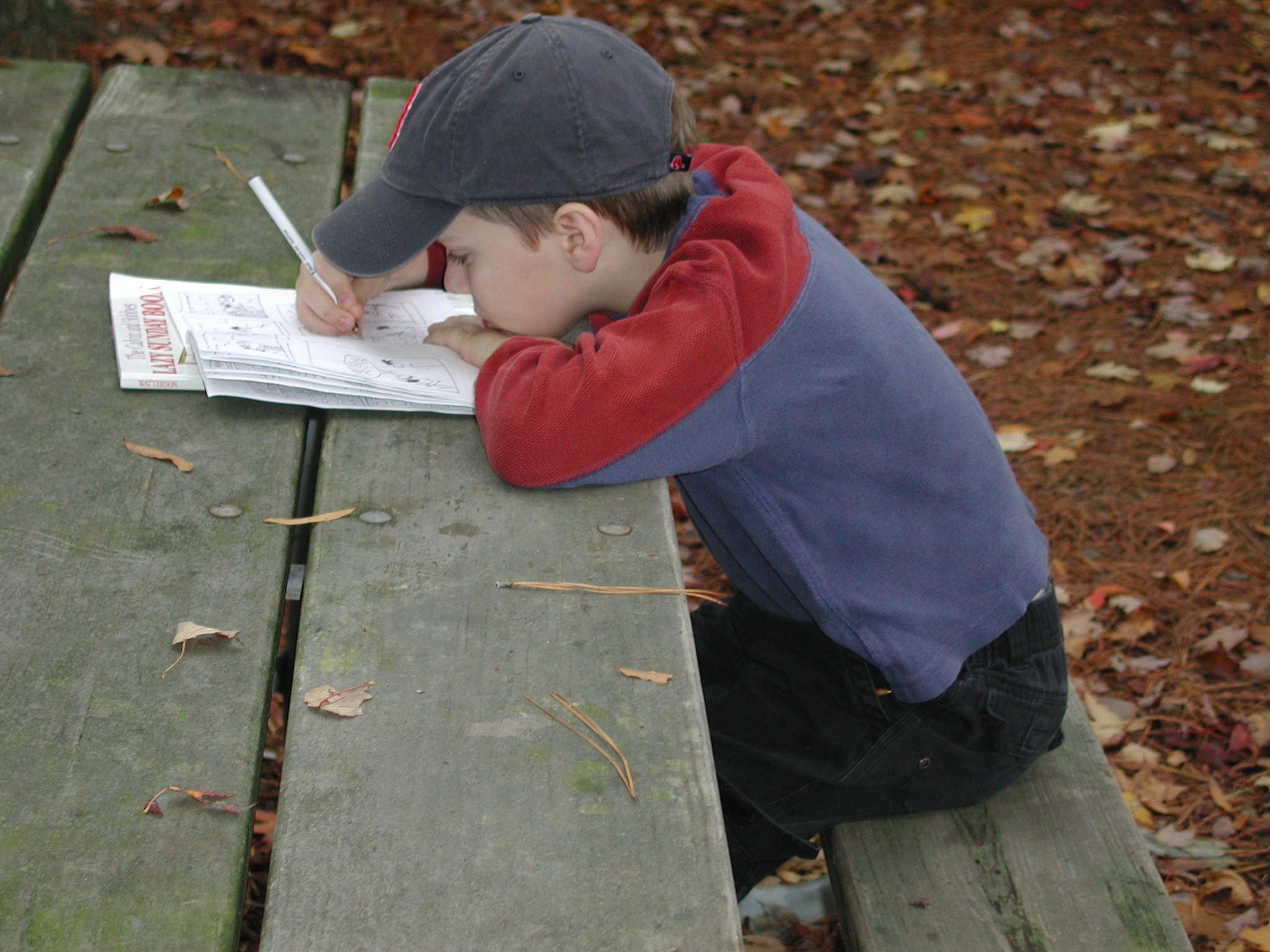
S, the 10-year-old, is on a bender lately, too, secluding himself to draw comics of space adventures. Now part of this is because he keeps losing TV and video game privileges until his room is clean and stays that way. I will not spend another valuable weekend afternoon on that project again.

Baby C is generally in my arms while I’m typing away at the PC, but I can’t help feeling like I could be doing more with her. Yes, I do play with her, too, but you know, she’ll probably be typing soon herself at this rate. I’ve also started leaving her home with her grandma more often lately so I can accomplish more of the errands than I can by bringing her along. That in and out of the baby seat business and strollering her here and there is exhausting and time consuming, Therefore, I can double or better errand capacity without her, as I’m no longer nursing exclusively and she can eat food and drink juice.

Baby C -- naptime, not on me

Baby C -- naptime, not on me

It’s nice that it has been relatively quiet for writing, and I’ve been accomplishing more as an independent person. However, I can’t help feeling like I need to be with my kids more than I have been lately.

So, my plans for the weekend, most likely past as you read this, is to amp up some indie time with each and some family fun. Friday night, I am taking S without taking anyone else to a special needs kids event at a local zoo, maybe get to pet some of the animals. Saturday, I am making Honey take S on a fishing trip in the morning with dads/stepdads and their aspies, while I take K to a café for some face time while, hopefully, Baby C naps. Sat. afternoon, we’re getting together with some of the families from our aspie group, so S gets ‘peer interaction,’ K gets to hang with some friends, and frankly, so do we, as parents. Sunday, I think we’ll have a relatively lazy day at home. I want to talk the guys into playing a game or doing a puzzle all together. But Honey still needs to mow that lawn! I’ll comment an update if my plans went off without a hitch or derailed.

When Monday rolls back around, I will get back to my writing better, refreshed by the love of my family. Right — as long as the usual chaos doesn’t overtake us.

What are you doing tonight at 10:04?

Are you one of the many mothers who make the most of the evening hours after all the kids are in bed? Maximizing the later hours of the day may in fact be an excellent strategy, according to the results of a new research study. Forget the early bird; the most likely time of day for a creative breakthrough is 10:04 p.m. As reported by the UK’s Daily Mail:

Early to bed, early to rise, makes you healthy, wealthy and wise.

So goes the old proverb, but research now suggests that if you want to be the wisest, you really need to stay up — well, until 10.04 pm at least.

This is supposedly the best time for a eureka moment, according to research. [A]round a quarter of us feel we formulate our most cunning plans when we are burning the midnight oil, the survey of 1,426 adults found.

By contrast, despite what many managers may believe, daytime in the office is not conducive to blue-sky thinking. The afternoon…is when an overwhelming 98% of those polled say they feel most ‘uninspired’.

The creativity drought just gets worse over the nine to five working day, hitting rock bottom at 4.33 pm.

When asked about methods they use to get their creative juices flowing, 44% said they took a shower.

Unfortunately for mankind, even when we do get a stroke of genius more than half of our ideas are lost forever.

When inspiration strikes, 58% of us fail to write the idea down immediately and forget it….Women were better than men at jotting down their best ideas for posterity.

A third of over-35s chose to scribble the thought on the back of their hand, perhaps having learnt from experience how forgetful they are. The findings echo an Italian study in 2006 that found those who stay up late have the most original ideas.

Night owls came up with the most creative thoughts — perhaps because they are more likely to be unconventional and bohemian than early birds — according to the research by the Catholic University of the Sacred Heart in Milan.

So, if you like to stay up late and squeeze in a bit of creative time, take a look at the clock when you hit your groove. It might just be 10:04. Oh, and if you have a great idea, write it down — preferrably on a piece of paper!

Miranda: Getting my #%^&* together

It’s been a long time since I last posted a personal entry. Regular readers of this blog will know that I spent the last two months under an intense pile of client projects and had little bandwidth to do anything else. I have finally — and gratefully — emerged from under the mountain. I should now be able to get all of my work done on my two full workdays each week plus an hour or two of client e-mail and quick projects on the other three weekdays.

It’s time to take a little inventory and get back to my two main priorities: family life and finishing my nonfiction book.

The Current Condition

What’s my current landscape? We’ve settled into some kind of new routine and I’ve adapted to my preschooler’s pickup schedule. I have to leave every day at 11:30 to get him — but my husband takes him to school, so I don’t have to do both legs. The pickup takes 45 minutes in total, which does eat into my two workdays. But I try to use some of that car time for phone calls.

All five kids are in good places at the moment; no real issues or crises. That said, the 5-month-old doesn’t yet sleep more than three or four hours at a stretch during the night, which obviously means that I’m a little tired, but I’m usually able to just deal with it. I do have to pay some attention to my oldest son’s college application process and all that that involves. Toilet training with the 3.5-year-old is not going well at all (in fact we’ve regressed) but my husband and I are launching a new strategy this weekend (putting him back in underwear and then totally laying off the pressure, rather than keeping him in pull-ups and laying on the pressure), which we’ll commit to for a month. But nothing is going on beyond the usual parenting agenda. In fact, the household is in a pretty happy place right now. My husband and I are in a great place and we’ve had a nice long run without blended family conflict. In fact, there have been some very positive developments on the domestic front.

I’m also trying to up my fitness level — running at least twice a week and hoping to get back to my 4-6 mile runs three to four times a week before too long. I’m making progress. Yesterday I had a terrific run and really felt strong the whole time.

Our house is still on the market, but showings are infrequent and I’m able to keep my perspective. I no longer agonize over what will happen if we stay and how much I want to move; things are workable where we are and I will just make the best of it. At some point I realized that I have to get on with it and not wait for the house issue to be resolved; in this economy it could easily take us another year or longer to sell.

The only other significant time drain at the moment is the election. We’re an avidly political family and I  have to get my evening fix of political shows on cable. I often multitask with the laptop during this time, but I do look forward to enjoying other schedule options post-election.

So, not much to complain about. Guess I’ll have to rely on Cathy’s 24 ways to avoid your manuscript if I need an excuse to procrastinate. But of course, I don’t need any more excuses. It’s time to finish the book and get on with my stew pot of other creative projects.

The Plan

My nonfiction proposal is being shopped by an agent, but as I’ve said here before, if we have no takers I will self-publish. I can’t let the manuscript languish while waiting to sell it. If I end up selling the thing when it’s already near completion, and the editor wants to make substantive changes (as would be expected with a nonfiction ms), I’ll cross that bridge when I come to it. Time to commit to the work with a concrete roadmap.

On Monday I made some calculations. My manuscript is currently 53K words long. I estimate that I need another 40K-50K to finish. Seeing as I’m working from a fairly comprehensive outline, the writing comes quickly when I’m actually writing (or, I should say, quickly for me — compared to writing fiction). I can probably count on writing 1,000 words in four hours. I’ll round that up to five hours just to have some margin for the remaining research, etc. Now comes the sticky part.

If I spend five hours a week on my book, I will finish the first draft in a year. If I double that and eke out 2,000 words a week, I will finish by the end of April. That’s a little more appetizing, wouldn’t you say?

Where am I going to get 10 hours a week? At first glance it’s hard to see, but I know it’s really a matter of priorities. How is it that I can be so committed to keeping this blog going, for example, but not show the same level of commitment with my manuscript? Since we started the weekly creativity contest, I’ve never missed posting the Wednesday winner post, even though it sometimes takes well more than an hour of work the night prior or early that morning. Tomorrow I will post our 20th Breakfast interview — a weekly project that sometimes takes three hours of work or more. But I would never miss that deadline, even if I’m up until well past midnight staging the post.

As my cousin Charlotte rightly pointed out over coffee on Tuesday, the blog involves a lot of other people, and I hold myself accountable. That’s why I am able to stay up late at night preparing a post when it wouldn’t occur to me to spend those same hours on my manuscript. True, I can also rationalize the time investment with the knowledge that the content of this blog as well as the creative social network it provides are both intrinsic parts of my book. I have no intention of cutting back on the blog, but I need to keep my eyes on the real goal: finishing my book.

While 5 hours a week seems do-able, the year-off finish line is a real party killer. A 6-month timeframe is much cheerier, but I don’t know if I’m going to have 10 hours for writing every week. I spent some time going back and forth, trying to decide which way I should commit. Charlotte suggested starting with the 5 hours for a few weeks to see how it goes, which was a practical suggestion, but seemed to rub my Superwoman instincts the wrong way (yes, I should know better). But I agreed with Charlotte in that I didn’t want to set myself up for failure by setting the bar to high.

It occurred to me that my son’s Montessori school has a schedule arrangement that I really like. Instead of having a straight pickup time (say, noon) we have a pickup window: 11:45 to noon. I have 15 minutes within which I can arrive and not be late. Every day, I appreciate that I can vary my arrival time within those 15 minutes and still be right on time. Why not apply the same forgiving structure to my ms goal? This “range” makes sense to me and allows me some wiggle room within a demanding and unpredictable schedule.

So, I have now committed to writing 5 to 10 hours every week. If I only manage 5, I have still succeeded. If I make it to 10 or more, I am simply moving that much more quickly toward my goal. I will be tracking time and wordcount to monitor my progress; adjustments will be made as needed. Each Sunday I will map out where those hours are going to come from, and add them to my Outlook calendar as I would any other appointment.

There it is. I have a plan, and I’m sticking to it. Gotta go — I have 2 hours of manuscript time to complete today. 🙂