Skip to content

Your Creative Intentions: The Monday Post ~ September 10, 2012

“There are no wrong turns, only unexpected paths.”
~Mark Nepo


This is the moment to deepen, or commit to, your regular creativity practice. Regularity — a daily practice, if at all possible — is one of the best ways to stay in touch with how you make meaning.

What are your plans for creative practice this week? Given the specifics of your schedule, decide on a realistic intention or practice plan — and ink that time in your calendar. The scheduling part is important, because as you know, if you try to “fit it in” around the edges, it generally won’t happen. An intention as simple as “I will write for 20 minutes every morning after breakfast” or “I will sketch a new still life on Wednesday evening” is what it’s all about.

Share your intentions or goals as a comment to this post, and let us know how things went with your creative plans for last week, if you posted to last week’s Monday Post. We use a broad brush in defining creativity, so don’t be shy. We also often include well-being practices that support creativity, such as exercise and journaling.

Putting your intentions on “paper” helps you get clear on what you want to do — and sharing those intentions with this community is a great way to leverage the motivation of an accountability group. Join us!

:::::::

If you’re an artist or writer with little ones, The Creative Mother’s Guide: Six Creative Practices for the Early Years is the essential survival guide written just for you. Concrete strategies for becoming more creative without adding stress and guilt. Filled with the wisdom of 13 insightful creative mothers; written by a certified creativity coach and mother of five. “Highly recommended.” ~Eric Maisel. 35 pages/$11.98. Available for download here.

The Early Morning Creative Practice: Start Your Day With What Matters Most

Back in April, I wrote about my morning centering practice. This practice has evolved in several key ways in the past six months. Now, for the first time ever, I feel that I am truly and consistently walking the talk when it comes to my personal creativity.

It’s no secret that successful people make the very most of early morning hours. Whether you have a day job, a family, and/or wear 14 other hats, the first hours of the day are often your only shot at having time to yourself without interruption and distraction. As soon as your kids are sleeping through the night, you can start leveraging this opportunity.

For me, getting up early means 4:00 am.

Of course, there’s no such thing as a free lunch. Getting up early requires going to bed on time (9:00 – 9:15 pm over here). It also requires a fairly consistent schedule, as it’s difficult to get up at 4:00 on Monday morning after getting up at 7:00 on Saturday and Sunday. So I get up for writing practice at 5:00 on weekends. That means I’m not up late or out on the town on weekends. Is that a sacrifice? Maybe. But it doesn’t feel like one at the moment.

For me, getting up early is built on the foundation of exercise and eating right. I’ve been a vegetarian for many years, and as you may have read here before, I’ve long felt that wheat products are not my friend. I don’t have celiac disease, but I find that eating wheat (even whole grain) stimulates strong cravings and makes me feel hungry — and tired. (This book was quite affirming.) Today I am nearly vegan and totally wheat free. I eat a very low-carb diet and eat lightly at dinner. I don’t eat after 7:00 pm, ever. By eating lightly and going to bed a little bit hungry, I wake up full of energy and ready to launch into my writing practice. Bonus: I just took off a stubborn 10 pounds.

As you might imagine, the fact that I need to be in bed by 9:00 in order to get 7 hours of sleep has an impact on my marriage. My husband likes screen time in the evening, and I prefer to read, so this isn’t a huge issue. I try to make sure that we connect over dinner and on the weekends. Sometimes he comes to bed at the same time I do. We also share our daily morning meditation practice, which to my mind is more valuable than sitting next to each other in front of the TV half comatose for a couple of hours in the evening.

It won’t always be this way. Writing is important to me, and right now, this is what it takes to be a serious player. Play-ah! No more excuses. (As I’m sure you know, there are always 18,489 “good” excuses.)

Yeah, great, but what does that really LOOK like?

My morning practice starts at 4:00 am and ends at 8:15 am when I leave the house with my two youngest children. I started the 4:00 wake-up over the summer and have now incorporated the school routine. Here’s what my morning practice looks like, woven into the regular flow of home life:

  • 4:00: out of bed, make tea, settle into office
  • Read the day’s page in The Daily Writer
  • Writing practice: 500-word minimum (this helps me focus on output rather than falling into editing)
  • 5:20: join my husband upstairs for 20 minutes of meditation
  • Do three vinyasas (sun salutations)
  • 5:45: back in office, read the day’s entry in Mark Nepo’s Mark Nepo’s The Book of Awakening
  • Draw an Osho Zen Tarot or Faerie Tarot card
  • Record last night’s dream(s) in my dream journal, if I remember anything
  • 6:15: stop to ensure that daughter is awake, make breakfast for her, eat a few spoonfuls of peanut butter if I haven’t already, husband leaves
  • Make lunch for daughter and two younger sons (daughter catches school bus at 6:48)
  • At some point here, the two little ones wake up; feed them breakfast
  • Unload dishwasher and tidy kitchen
  • At kitchen table, finish morning pages/intention journaling if not already complete
  • Review my list of personal goals and intentions for the year
  • Plan the day (in planner, assigning a time and a duration for each task, or adding them to the “batch task” block)
  • Dress self and youngest son, brush teeth, make bed, put in a load of laundry if time, make sure we’re all ready to leave the house
  • 8:15 heard little boys out of the house for bus/school run

Note that the writing practice comes FIRST. That way, if a wee one wakes up exceptionally early, it’s still already done. If I have to scrap the centering part of my practice (mediation, journaling, etc.) then so be it. But the writing practice isn’t threatened. Usually, it all falls into place, with a little juggling between the aforementioned time slots. Everyone gets off to school and work in good stead, and the house is (gasp!) clean and tidy.

I understand that a routine like this might seem baffling — or totally unappealing. But for me, it’s a completely sustainable loop. Those four hours and fifteen minutes are routine now. It’s a routine that is grounded in my macro level intentions and priorities. I can’t overstate what it means to me to have a daily writing practice that absolutely happens every day. Seven days a week. I’m in touch with my creative work every day, all day, because it’s always fresh, always percolating. Without this morning anchor, the demands of my editorial business, my coaching practice, my studio storefront, and my family/domestic life eat up every available moment.

Interested in what an early morning creative practice could do for you? My last post on this topic included some ideas for developing your own morning centering practice. Add the creative session, mix well, and enjoy.

And hey: If you’re up at 4:00 am eastern time, know that you and I are creative buds.

What think?

::::

Your Creative Intentions: The Monday Post ~ September 3, 2012

“We are what we repeatedly do. Excellence, then, is not an act, but a habit.”
~Aristotle

sunflower intentions

This is the moment to deepen, or commit to, your regular creativity practice. Regularity — a daily practice, if at all possible — is one of the best ways to stay in touch with how you make meaning.

What are your plans for creative practice this week? Given the specifics of your schedule, decide on a realistic intention or practice plan — and ink that time in your calendar. The scheduling part is important, because as you know, if you try to “fit it in” around the edges, it generally won’t happen. An intention as simple as “I will write for 20 minutes every morning after breakfast” or “I will sketch a new still life on Wednesday evening” is what it’s all about.

Share your intentions or goals as a comment to this post, and let us know how things went with your creative plans for last week, if you posted to last week’s Monday Post. We use a broad brush in defining creativity, so don’t be shy. We also often include well-being practices that support creativity, such as exercise and journaling.

Putting your intentions on “paper” helps you get clear on what you want to do — and sharing those intentions with this community is a great way to leverage the motivation of an accountability group. Join us!

:::::::

If you’re an artist or writer with little ones, The Creative Mother’s Guide: Six Creative Practices for the Early Years is the essential survival guide written just for you. Concrete strategies for becoming more creative without adding stress and guilt. Filled with the wisdom of 13 insightful creative mothers; written by a certified creativity coach and mother of five. “Highly recommended.” ~Eric Maisel. 35 pages/$5.99. Available for download here.

The Artist at Work: Do You Welcome the Family, or Bar the Door?

The Daily WriterI enjoy starting my daily morning writing practice by reading a page in Fred White’s daybook The Daily Writer: 366 Meditations to Cultivate a Productive and Meaningful Writing Life. Today’s entry was particularly relevant to our scope here at Studio Mothers, whatever your medium. Here’s the excerpt:

August 30: Dealing with Family Interference

Writers mostly work at home, and that can pose a problem, especially if the writer has children. To ensure against quarrels or having the kids or the spouse feel neglected, the writer in the family needs to negotiate (not mandate like some dictator) ground rules. Another approach is to open your study to the kids. Introduce them to your work, explain your project to them in ways they’ll both understand and appreciate. You might even invite them to hang around and watch you working (about as unexciting as can be imagined for most children); it makes them feel more a part of you and gain more of an internal understanding of why you need to work uninterrupted. The opposite approach, making your study off limits, giving it the impression of being The Forbidden Zone, might prove just as effective superficially, but doesn’t do much to foster family togetherness.

Perhaps the best way to handle family interference is to let them interfere in the sense of making them feel welcome in your inner sanctum. There’s a memorable photograph of JFK at work in the Oval Office with four-year-old John-John frolicking at his feet. Children can better intuit how best to behave around a working parent once they feel that they’re included rather than excluded.

How about you? Do you include your children and/or your spouse in your creative work? What’s best for you and your family?

Your Creative Intentions: The Monday Post ~ August 27, 2012

“Creativity is a type of learning process where the teacher and the pupil are located in the same individual.”
~Arthur Koestler


This is the moment to deepen, or commit to, your regular creativity practice. Regularity — a daily practice, if at all possible — is one of the best ways to stay in touch with how you make meaning.

What are your plans for creative practice this week? Given the specifics of your schedule, decide on a realistic intention or practice plan — and ink that time in your calendar. The scheduling part is important, because as you know, if you try to “fit it in” around the edges, it generally won’t happen. An intention as simple as “I will write for 20 minutes every morning after breakfast” or “I will sketch a new still life on Wednesday evening” is what it’s all about.

Share your intentions or goals as a comment to this post, and let us know how things went with your creative plans for last week, if you posted to last week’s Monday Post. We use a broad brush in defining creativity, so don’t be shy. We also often include well-being practices that support creativity, such as exercise and journaling.

Putting your intentions on “paper” helps you get clear on what you want to do — and sharing those intentions with this community is a great way to leverage the motivation of an accountability group. Join us!

:::::::

If you’re an artist or writer with little ones, The Creative Mother’s Guide: Six Creative Practices for the Early Years is the essential survival guide written just for you. Concrete strategies for becoming more creative without adding stress and guilt. Filled with the wisdom of 13 insightful creative mothers; written by a certified creativity coach and mother of five. “Highly recommended.” ~Eric Maisel. 35 pages/$5.99. Available for download here.

Christine: Fearing the Blank Page

Christine Brandel is a Studio Mothers contributor. She also blogs at A Hot Piece of Glass.

I treated myself to a nice, new journal the other day. I’ve been wanting to try art journaling for a long time, and I can never seem to get started. So many choices, I was always overwhelmed! What type of paper? Should I bind the journal myself, or purchase one? What should I write about? What if I can’t really draw? But I admired so many artists’ pages and secretly wished I could express myself in the same media… I blog, so journaling in and of itself isn’t really a problem, but facing that blank page was terrifying!

Surfing on Amazon the other day, I looked through my wishlist and found that I had placed a Moleskin watercolor art journal on the list a couple of years ago. Impulsively, I put it in my shopping cart, added a copy of Harry Potter and the Sorcerer’s Stone (to read to my kids!), and checked out. The journal and the rest of my order arrived yesterday, and this morning, I removed the shrink wrap, fully intending to dive in immediately.

Instead, I find myself thinking about the journal rather than creating in it. I’m trying to decide what (if any) particular subject matter I want this journal to be about — a travel story about our epic family road trip to Miami in June? Or a journal about my recent return to riding horses, and all the emotion and significance that brings forth? Or a journal about my everyday life here with my family? Or, I know! How about a journal with a theme of inspirational quotes and images that are inspired by them? The options are endless!

Probably the best course of action is to just open the journal and go for it. I tend to like heavily text-based journaling, so I’m thinking I am going to choose a favorite quote as the subject for my first page, and break out my paints and pens and get on with it. I know I want to write about horses and riding, and it only occurred to me today that I can use images of the horses I ride — I don’t have to be able to draw them to include them! What a relief that is! 😉 Once I get started, I know things will roll along; it’s making that very first mark on the first page of my heretofore untouched journal book that strikes fear into the hearts of not-so-confident new art journalers like me. I know I also have to quit thinking in terms of “wasting” my materials or somehow “ruining” my journal book. It doesn’t have to be perfect, it just has to be mine. I can’t wait to get started!

How do you handle the “fear of the blank page”?

Your Creative Intentions: Monday Post ~ August 20, 2012

“Creativity is piercing the mundane to find the marvelous.”
~Bill Moyers


This is the moment to deepen, or commit to, your regular creativity practice. Regularity — a daily practice, if at all possible — is one of the best ways to stay in touch with how you make meaning.

What are your plans for creative practice this week? Given the specifics of your schedule, decide on a realistic intention or practice plan — and ink that time in your calendar. The scheduling part is important, because as you know, if you try to “fit it in” around the edges, it generally won’t happen. An intention as simple as “I will write for 20 minutes every morning after breakfast” or “I will sketch a new still life on Wednesday evening” is what it’s all about.

Share your intentions or goals as a comment to this post, and let us know how things went with your creative plans for last week, if you posted to last week’s Monday Post. We use a broad brush in defining creativity, so don’t be shy. We also often include well-being practices that support creativity, such as exercise and journaling.

Putting your intentions on “paper” helps you get clear on what you want to do — and sharing those intentions with this community is a great way to leverage the motivation of an accountability group. Join us!

:::::::

If you’re an artist or writer with little ones, The Creative Mother’s Guide: Six Creative Practices for the Early Years is the essential survival guide written just for you. Concrete strategies for becoming more creative without adding stress and guilt. Filled with the wisdom of 13 insightful creative mothers; written by a certified creativity coach and mother of five. “Highly recommended.” ~Eric Maisel. 35 pages/$5.99. Available for download here.

Miranda: For the Love of Books, Before and After

During August, I’ll be sharing a few choice tidbits from the archives. Enjoy!

Warning. This post contains an unusually intense degree of navel-gazing and otherwise raving on and on about one’s home library, books, and related minutiae. If you find such material nauseating, turn away now. 

Recently, I posted this on Facebook:

I’m staging a serious overhaul of the home library/office today, with Mom’s help. The question is — and please don’t cringe, fellow bibliophiles — shelve the books by author last name, or by jacket color? I know, I know….but I peruse and admire many design blogs and must admit that books shelved by color look fabulous. Although I’m not sure I can bring myself to mix genres…..help!

I was amused by the considerable volume of responses. People feel VERY strongly about how to organize their books — as well they should. This is serious business, people!

rainbowWhen I first heard of organizing books by color, I thought the premise was among the most ridiculous things I’d ever heard of. Not to mention sacrilegious. The whole idea sounded like “book as prop,” in the way that a professional decorator might buy small decorative things for a client’s room simply because they look nice against the wallpaper; nothing whatsoever to do with the item’s meaning or symbolism or its emotional value to the owner. Just “stuff.” Books, of course, are not “stuff.” Ew.

But over time, I came across more instances of books organized by color that really looked beautiful. Not just a stack of three yellow books next to a yellow vase, but shelves organized wholesale by color. Still, how would you ever find anything if you didn’t organize all of your books by genre and then by author last name?

When we moved into our new home, I was thrilled to unpack my books and various possessions into our new library. I very vaguely segregated the books by nonfiction and fiction, intending to properly sort out the shelves, alphabetize my collection, and arrange all of my non-book items in the near future. Eight months later, the time finally arrived. My mother had given me a birthday coupon for a day’s worth of organizational help (and, most importantly, moral support) so I booked my sitter for an extra day, and on Friday my mother and I tackled the library. (It seemed indulgent to pay for babysitting in order to overhaul my library/home office, but considering that my mother and I worked all day long on Friday, and then I spent the better part of the weekend finishing the job myself, I know that this never would have happened if I hadn’t paid for the extra help.)

So, alphabet or color? I was intrigued by the color principle, and I had to try it. (Obviously, by the photo I ran above, there isn’t much question about which way I went.) I can’t believe HOW LONG it took to sort all the books, but we did it. (All those “taupe” books — are they gray? Are they brown? Are they off-white?) It was a LOT of fun, I have to admit. And I came to realize fairly early on that finding a specific book was not going to be a problem. But more on that later.

I also went through ever drawer and bin, sorting out all of my office supplies. I weeded out tons of stuff I don’t need or want. I filed every stack of paper. I found (or created) logical homes for all those little things that you pick up and say “what do I do with THIS?”

I now have a desk that I can actually use! I paid bills sitting at the desk last night, and everything I needed was in arm’s reach. My art supplies are organized in the hall closet around the corner, as there just isn’t room for everything in one place. But it all works.

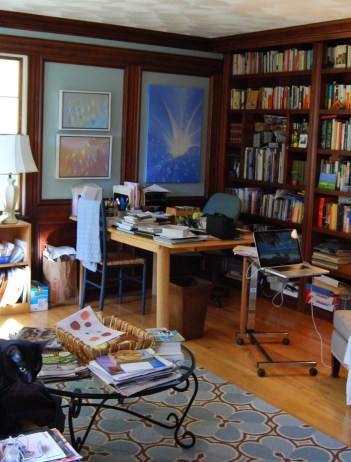
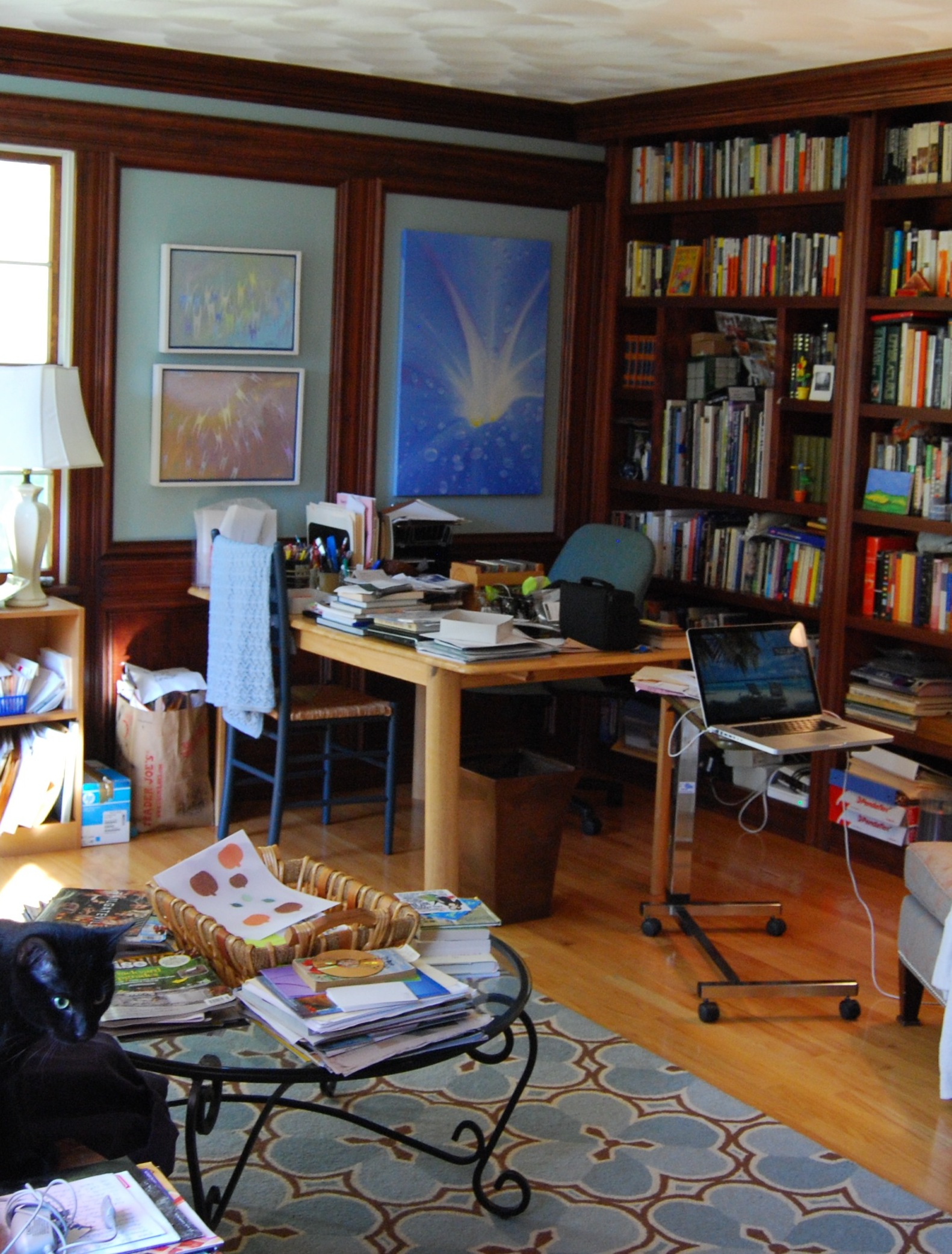
The basic footprint of the room hasn’t changed (months ago, we tried many different arrangements of the furniture, but nothing else worked). I did change out a yucky fiberboard bookshelf for a marginally better, longer bookshelf made by my ex-husband. (No, you can’t have it back!) Please ignore the hospital-style table on wheels (it’s one of the most practical things I own, and I use it all the time).

BEFORE

B_before

AFTER

B_after

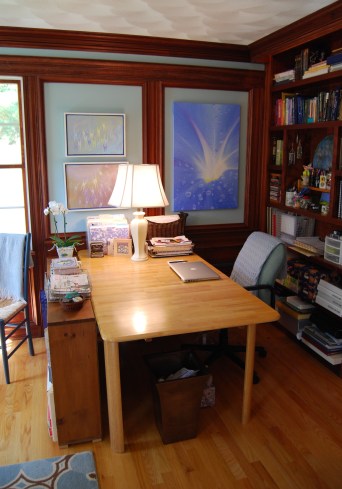
Desk corner before:

Desk_before

Desk corner after:

Desk_after

Considering that relatively little actually changed, aside from clearing out all the clutter, I can’t entirely explain the magic that this room now holds. I FREAKING LOVE IT. I want to be in here all the time. Yes, I’m in here now, typing on my laptop at my desk. I swear, it’s as if Mr. Roy G. Biv turned the room into a bowl of M&M’s. Very cozy at night, too:

night1

night2

So here’s my case for organizing books by color. In the first “after” photo above, fiction comprises the vertical shelf on the far right and the white shelf up the middle. That’s not really so many books. If I’m looking for a particular title, it’s not going to be hard to find even if I can’t remember the color of its spine. This is the only place I have adult fiction aside from my “to read” shelf on the other wall. The books to the left in the same photo are general nonfiction (biography, autobiography, and history). Again, these are mixed together, but it’s not a lot of shelf space for me to peruse if I need something. The fifth shelf is poetry.

On the other wall, books are broken down by genre. I have a shelf for editorial reference, a shelf for art reference, a shelf for books about writing, a shelf for books about creativity, a shelf for parenting, a shelf for self-help & metaphysical (yes, I have that many self-help and metaphysical books). There’s another shelf of semi-mixed nonfiction; a little chunk of current political books, a chunk of animal-related training books, a chunk of sports-related books, a section for gardening. Then there is the to-read shelf, as well a short fiction and plays. And so on.

For each of these subsections, I organized books by color and shape, depending on what looked best for each shelf. Again, I’m not going to have trouble finding anything because I know what each subsection is, and no single subsection is more than a shelf long.

So, now that I’ve dealt with the question of “how will you find anything?” I’ll get to why I think this is such a fabulous way to organize your books. First, a book is so much more than words on a page, or the author’s position in an alphabet. A book is a piece of art — even an old Bantam mass-market paperback — and to my mind, organizing books this way is something that honors each book as art. Positioning each book on a shelf in a way that maximizes its beauty (almost as “paint”) rather than by the name of the person who wrote it seems to me a more potent way to celebrate the beauty of a personal library. The shelves are pleasing and peaceful, without losing the vaguely chaotic and cozy look that is inherent in any library. The color progression is so eye-catching that I think it actually calls more attention to the books, not less — without dominating. What do you think?

The downside to having a dream library/work environment is this: There is pretty much no excuse left on the planet for not coming up with something brilliantly creative. I seem to have run out of excuses. And I DID just use an entire weekend’s worth of “free” moments to finish the room. Time to get to back to the writing 🙂

What do you think?
Your Creative Intentions: Monday Post ~ August 13, 2012

“Art is the means we have of undoing the damage of haste. It’s what everything else isn’t.” ~Theodore Roethke


This is the moment to deepen, or commit to, your regular creativity practice. Regularity — a daily practice, if at all possible — is one of the best ways to stay in touch with how you make meaning.

What are your plans for creative practice this week? Given the specifics of your schedule, decide on a realistic intention or practice plan — and ink that time in your calendar. The scheduling part is important, because as you know, if you try to “fit it in” around the edges, it generally won’t happen. An intention as simple as “I will write for 20 minutes every morning after breakfast” or “I will sketch a new still life on Wednesday evening” is what it’s all about.

Share your intentions or goals as a comment to this post, and let us know how things went with your creative plans for last week, if you posted to last week’s Monday Post. We use a broad brush in defining creativity, so don’t be shy. We also often include well-being practices that support creativity, such as exercise and journaling.

Putting your intentions on “paper” helps you get clear on what you want to do — and sharing those intentions with this community is a great way to leverage the motivation of an accountability group. Join us!

:::::::

If you’re an artist or writer with little ones, The Creative Mother’s Guide: Six Creative Practices for the Early Years is the essential survival guide written just for you. Concrete strategies for becoming more creative without adding stress and guilt. Filled with the wisdom of 13 insightful creative mothers; written by a certified creativity coach and mother of five. “Highly recommended.” ~Eric Maisel. 35 pages/$5.99. Available for download here.

The Importance of Making Space

During August, I’ll be sharing a few choice tidbits from the archives. Enjoy!

Making space for your creative work is almost as important as making time for your creative work. When you have a work space that feels inviting and inspiring — even if it’s just the corner of a room — turning to your creative work feels like a delightful retreat, rather than just another item on your endless “to-do” list. We also know that one way to dispel resistance is to shape your environment to support your goals. The easier it is to get at your work and get down to business, the more likely you’ll be to actually follow through.

In her fabulous book The Creative Habit, Twyla Tharp notes: “To get the creative habit, you need a working environment that’s habit-forming.” When you have a space that calls to you, it’s easier to go there regularly. Regularity, as Tharp points out throughout her book (as the title would suggest), is the heart of creative output.

We all know Virginia Woolf’s famous dictum that “A woman must have money and a room of her own if she is to write fiction.” Woolf was speaking about the feminist need for independence in order to create. Most of us probably feel comparatively liberated, despite the fact that we have children and Woolf did not — but her point is well taken.

How can you change your space in order to better support your creative work? Many of us don’t have the luxury of our own room or even the corner of a room to call our own. We take over the dining table when the muse strikes and then have to dismantle the work area when it’s time to eat. If this is the case for you, brainstorm ways to make this process as user-friendly as possible.

It’s also possible that there IS a nook or cranny lurking in your home that you could claim for yourself with a bit of re-thinking. Bring your creative skills to finding a space in your home that helps you return to your creative, authentic self as seamlessly as possible. And if you’re fortunate enough to have your own space, you might spend a bit of time this month editing out anything in this space that doesn’t work for you anymore. Clean it up, organize, bring in a few fresh visuals that speak to you. Make it yours. Then, dig in.

“Without the studio, however humble,
the room where the imagination can enter cannot exist.”
~Anna Hansen

What works for you?

Your Creative Intentions: Monday Post ~ August 5, 2012

“If you’re striving to be absolutely original, you’re engaging in an act of futility. The most original works of art, be they paintings or musical compositions or novels, draw from what has gone before. On the other hand, the way you see the world is your way and yours alone; it is inevitably unlike anyone else’s. The trick is to be able to highlight your special angle of vision, to offset it from conventional perceptions.” ~Fred White


This is the moment to deepen, or commit to, your regular creativity practice. Regularity — a daily practice, if at all possible — is one of the best ways to stay in touch with how you make meaning.

What are your plans for creative practice this week? Given the specifics of your schedule, decide on a realistic intention or practice plan — and ink that time in your calendar. The scheduling part is important, because as you know, if you try to “fit it in” around the edges, it generally won’t happen. An intention as simple as “I will write for 20 minutes every morning after breakfast” or “I will sketch a new still life on Wednesday evening” is what it’s all about.

Share your intentions or goals as a comment to this post, and let us know how things went with your creative plans for last week, if you posted to last week’s Monday Post. We use a broad brush in defining creativity, so don’t be shy. We also often include well-being practices that support creativity, such as exercise and journaling.

Putting your intentions on “paper” helps you get clear on what you want to do — and sharing those intentions with this community is a great way to leverage the motivation of an accountability group. Join us!

:::::::

If you’re an artist or writer with little ones, The Creative Mother’s Guide: Six Creative Practices for the Early Years is the essential survival guide written just for you. Concrete strategies for becoming more creative without adding stress and guilt. Filled with the wisdom of 13 insightful creative mothers; written by a certified creativity coach and mother of five. “Highly recommended.” ~Eric Maisel. 35 pages/$5.99. Available for download here.

Making Creative Hay Outside

During August, I’ll be sharing a few choice tidbits from the archives. Enjoy!

If it’s summertime in your part of the world — or if you live in a mild climate and enjoy fair weather more often than not — think about using outside resources to your creative advantage. When younger kids are out of school, making outdoor time a regular part of your routine can yield many benefits. We often end up spending time indoors just because it seems easier than setting up camp outside. But don’t let the force of habit inhibit your summertime fun and creativity.

If you have a yard of your own, make the most of this bonus. If you have a fenced-off space — even a small one — so much the better. Many mothers are able to sit on a lawn chair and write, read, or sketch while their kids play safely nearby. You can peruse that stack of magazines you haven’t read yet — any reading material that is easy to put down as needed. Outdoor time is also a great opportunity to take photographs of your kids or the world around you.

To stack the odds in your favor, use this four-pronged approach to outdoor (and indoor) downtime:

  1. Make sure everyone is well fed, watered, and toileted.
  2. Spend some time totally focused on the kids.
  3. When the kids seem engaged or playing independently after having some Mommy face time, turn to your creative work.
  4. Try to remain flexible. There will be days when the kids don’t want you staring at a notebook for even 30 seconds, and there will be other days when they’re happily immersed in their own worlds for 30 minutes. Go with the flow.

If your inventory of outdoor toys seems insufficient, yard sales and consignment shops are great places to pick up a few more. You might also send an e-mail to friends with older children to ask if they have anything hiding in their garages or attics that they no longer want.

Many toddlers and young children love to play with water. Consider filling a small kiddie pool with a few inches of water and a bunch of bath or beach toys ~ often good for at least 30 minutes of interest. For other outdoor play activities, do a bit of google searching and jot down the ideas you like best.

Food always seems to be more fun outdoors, too. Whether it’s just a snack in the backyard or a full-on picknick basket in the middle of a field, eating outside makes everyone happy.

When you’re headed to the park and your kids are old enough to play safely without constant supervision and won’t walk in front of the swings, don’t forget to bring a notepad, sketchbook, or something else to spend time with while you keep one eye on the children. You may find that it’s worth going out of your way to visit a playground that is fully enclosed and is equipped with a good amount of safe climbing structures to keep your kids entertained.

While you don’t want your kids to feel like you’re constantly on standby, waiting to bolt off to your own thing, you do want to be prepared to squeeze in some creative work when the opportunity arises. Over time, you’ll find the middle way that feels best for your and your family.

What works for you? Share your experience!