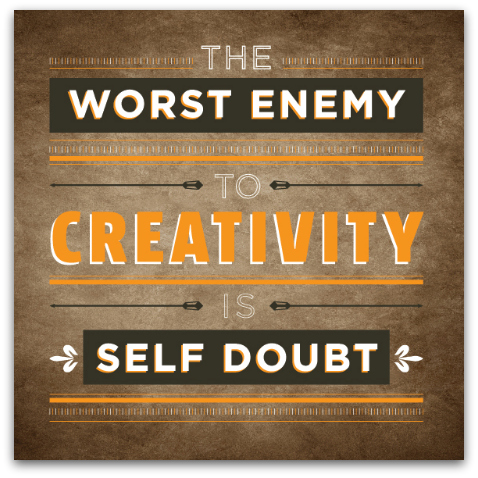
Meme of the Week

As found here. Happy Friday.
:::::
Mar 28
Mar 24
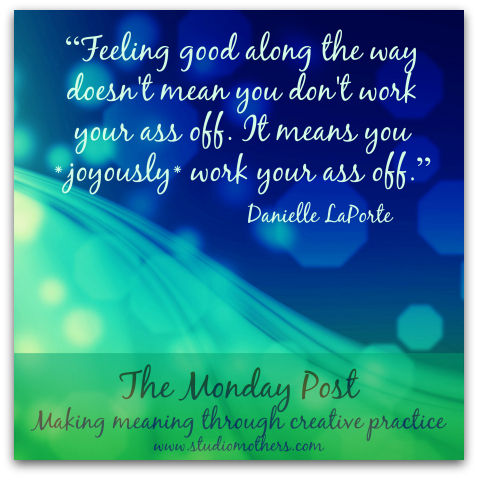
A regular creative practice — a daily practice, if possible — is key to staying in touch with how you make meaning. Key to living, not postponing. (Let’s all agree to give up on “someday.”)
What are your plans for creative practice this week? Given the specifics of your schedule, decide on a realistic intention or practice plan — and ink that time in your calendar. The scheduling part is important, because as you know, if you try to “fit it in” around the edges, it generally won’t happen. An intention as simple as “I will write for 20 minutes every morning after breakfast” or “I will sketch a new still life on Wednesday evening” is what it’s all about. If appropriate, use time estimates to containerize your task, which can make a daunting project feel more accessible.
Share your intentions or goals as a comment to this post, and let us know how things went with your creative plans for last week, if you posted to last week’s Monday Post. We use a broad brush in defining creativity, so don’t be shy. We also often include well-being practices that support creativity, such as exercise and journaling.
Putting your intentions on “paper” helps you get clear on what you want to do — and sharing those intentions with this community leverages the motivation of an accountability group. Join us!
:::::::
 If you’re an artist or writer with little ones, The Creative Mother’s Guide: Six Creative Practices for the Early Years is the essential survival guide written just for you. Concrete strategies for becoming more creative without adding stress and guilt. Filled with the wisdom of 13 insightful creative mothers; written by a certified creativity coach and mother of five. “Highly recommended.” ~Eric Maisel. 35 pages/$11.98. Available for download here.
Mar 21
Mar 17

A regular creative practice — a daily practice, if possible — is key to staying in touch with how you make meaning. Key to living, not postponing. (Let’s all agree to give up on “someday.”)
What are your plans for creative practice this week? Given the specifics of your schedule, decide on a realistic intention or practice plan — and ink that time in your calendar. The scheduling part is important, because as you know, if you try to “fit it in” around the edges, it generally won’t happen. An intention as simple as “I will write for 20 minutes every morning after breakfast” or “I will sketch a new still life on Wednesday evening” is what it’s all about. If appropriate, use time estimates to containerize your task, which can make a daunting project feel more accessible.
Share your intentions or goals as a comment to this post, and let us know how things went with your creative plans for last week, if you posted to last week’s Monday Post. We use a broad brush in defining creativity, so don’t be shy. We also often include well-being practices that support creativity, such as exercise and journaling.
Putting your intentions on “paper” helps you get clear on what you want to do — and sharing those intentions with this community leverages the motivation of an accountability group. Join us!
:::::::
If you’re an artist or writer with little ones, The Creative Mother’s Guide: Six Creative Practices for the Early Years is the essential survival guide written just for you. Concrete strategies for becoming more creative without adding stress and guilt. Filled with the wisdom of 13 insightful creative mothers; written by a certified creativity coach and mother of five. “Highly recommended.” ~Eric Maisel. 35 pages/$11.98. Available for download here.
Mar 10
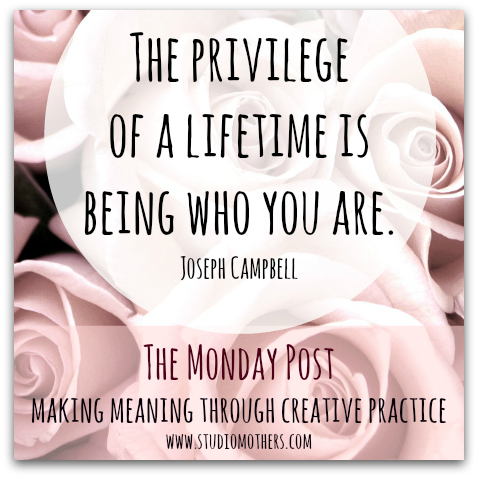
A regular creative practice — a daily practice, if possible — is key to staying in touch with how you make meaning. Key to living, not postponing. (Let’s all agree to give up on “someday.”)
What are your plans for creative practice this week? Given the specifics of your schedule, decide on a realistic intention or practice plan — and ink that time in your calendar. The scheduling part is important, because as you know, if you try to “fit it in” around the edges, it generally won’t happen. An intention as simple as “I will write for 20 minutes every morning after breakfast” or “I will sketch a new still life on Wednesday evening” is what it’s all about. If appropriate, use time estimates to containerize your task, which can make a daunting project feel more accessible.
Share your intentions or goals as a comment to this post, and let us know how things went with your creative plans for last week, if you posted to last week’s Monday Post. We use a broad brush in defining creativity, so don’t be shy. We also often include well-being practices that support creativity, such as exercise and journaling.
Putting your intentions on “paper” helps you get clear on what you want to do — and sharing those intentions with this community leverages the motivation of an accountability group. Join us!
:::::::
If you’re an artist or writer with little ones, The Creative Mother’s Guide: Six Creative Practices for the Early Years is the essential survival guide written just for you. Concrete strategies for becoming more creative without adding stress and guilt. Filled with the wisdom of 13 insightful creative mothers; written by a certified creativity coach and mother of five. “Highly recommended.” ~Eric Maisel. 35 pages/$11.98. Available for download here.
Mar 7
Mar 3
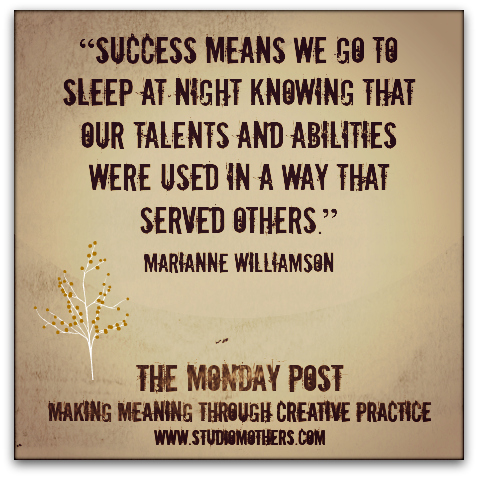
A regular creative practice — a daily practice, if possible — is key to staying in touch with how you make meaning. Key to living, not postponing. (Let’s all agree to give up on “someday.”)
What are your plans for creative practice this week? Given the specifics of your schedule, decide on a realistic intention or practice plan — and ink that time in your calendar. The scheduling part is important, because as you know, if you try to “fit it in” around the edges, it generally won’t happen. An intention as simple as “I will write for 20 minutes every morning after breakfast” or “I will sketch a new still life on Wednesday evening” is what it’s all about. If appropriate, use time estimates to containerize your task, which can make a daunting project feel more accessible.
Share your intentions or goals as a comment to this post, and let us know how things went with your creative plans for last week, if you posted to last week’s Monday Post. We use a broad brush in defining creativity, so don’t be shy. We also often include well-being practices that support creativity, such as exercise and journaling.
Putting your intentions on “paper” helps you get clear on what you want to do — and sharing those intentions with this community leverages the motivation of an accountability group. Join us!
:::::::
If you’re an artist or writer with little ones, The Creative Mother’s Guide: Six Creative Practices for the Early Years is the essential survival guide written just for you. Concrete strategies for becoming more creative without adding stress and guilt. Filled with the wisdom of 13 insightful creative mothers; written by a certified creativity coach and mother of five. “Highly recommended.” ~Eric Maisel. 35 pages/$11.98. Available for download here.
Feb 28
Feb 27
Ellen Olson-Brown is a creative inspiration to me in more ways than I can count. She is also a children’s book author, children’s yoga instructor, life-design junkie, Bikram devotee, and mother of twins. I love, love, love what she shares below. Enjoy!

Although I’m pretty proud of the collection above, crowing is truly not my motivation for posting. I’m posting this to make a point that is *so* important to me.
Every day this month I’ve made at least one of these little drawings on a sticky note. I find an image of a face online, paint its basic shape in watercolor, and then ink in the details with a permanent marker.
I’ve committed to this because I’ve found that mixing colors and drawing, even just a little, is one of those things that makes the rest of my day more vivid, easier.
Drawing on a sticky note is way less intimidating than using beautiful paper or a canvas, because of both the size and the humbleness of the materials. And committing to doing it every day of a short month quiets the “Should I? Why?” voice without overwhelming me.
So what’s the point I want to prove?
Well, it’s the same point I want desperately to prove when someone new practices near me in a yoga class and says, “But it looks so easy for you! I’ll never be able to do that!” and I have to tell them 1) It’s still *very* hard for me, and 2) I couldn’t touch my toes when I first started yoga. What I can do now has taken me 7 years and at least 1,000 classes of showing up and listening and trying and getting better and getting worse and having faith in the process and learning to add a gentle “yet” to a very bratty, “I can’t!!”
I love these little faces, my wall of friends and encouragers. Are they perfect? No. But I used to be scared, stiff, and frustrated when it came to drawing. I thought making art was a matter of talent, which I simply didn’t have. And now I am making things that bring me joy.
Talent is real. We’re each wired/built to optimize certain kinds of learning, performing.
But way more powerful than talent is openness, faith, courage, hard work, and enough self-kindness to let yourself be a beginner, show up, and see what happens.
Draw, run, sing, cook, garden, dance, do yoga — whatever that thing is that you’re drawn to, get your butt out there and try it 10 or 50 or 3,000 times.
Because you deserve to amaze yourself.
:::::
Feb 24
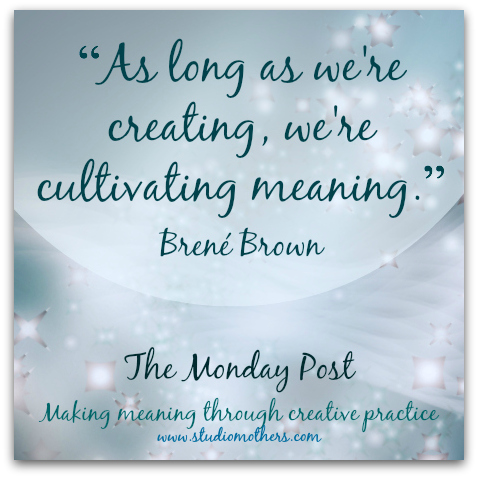
A regular creative practice — a daily practice, if possible — is key to staying in touch with how you make meaning. Key to living, not postponing. (Let’s all agree to give up on “someday.”)
What are your plans for creative practice this week? Given the specifics of your schedule, decide on a realistic intention or practice plan — and ink that time in your calendar. The scheduling part is important, because as you know, if you try to “fit it in” around the edges, it generally won’t happen. An intention as simple as “I will write for 20 minutes every morning after breakfast” or “I will sketch a new still life on Wednesday evening” is what it’s all about. If appropriate, use time estimates to containerize your task, which can make a daunting project feel more accessible.
Share your intentions or goals as a comment to this post, and let us know how things went with your creative plans for last week, if you posted to last week’s Monday Post. We use a broad brush in defining creativity, so don’t be shy. We also often include well-being practices that support creativity, such as exercise and journaling.
Putting your intentions on “paper” helps you get clear on what you want to do — and sharing those intentions with this community leverages the motivation of an accountability group. Join us!
:::::::
If you’re an artist or writer with little ones, The Creative Mother’s Guide: Six Creative Practices for the Early Years is the essential survival guide written just for you. Concrete strategies for becoming more creative without adding stress and guilt. Filled with the wisdom of 13 insightful creative mothers; written by a certified creativity coach and mother of five. “Highly recommended.” ~Eric Maisel. 35 pages/$11.98. Available for download here.
Feb 21










 Studio Mothers: Life & Art