NaNoWriMo: Productivity…?

Courtesy Inky Elbows — a great site for all procrastinating writers!
Nov 14
Courtesy Inky Elbows — a great site for all procrastinating writers!
 OK, so many of this blog’s readers are too busy with NaNoWriMo to do much blog surfing — or anything else besides keeping chaos at bay while trying to bang out the daily word count. This month, the word “balance” is probably not in your vocabulary. That said, if you can find a minute or two between carpools or diaper changes — or while on your lunch break at the office — it’s worth your time to check out the collection of pieces on balancing life and writing featured this month at WOW, Women On Writing. As is often the case, the useful nuggets in this content can be applied to most any creative pursuit.
Here’s a tasty sound bite from Christina Katz: “Who says you have to choose between writing and family? You don’t! If I can do it, so can you!” Definitely read WOW’s terrific interview with Christina Katz, aka the Writer Mama.
Enjoy — and then, get back to work!
 I came across a worthwhile blog post from Amanda Craig, British writer and journalist, about writing and motherhood. Interesting (or depressing?) to note that she doesn’t think it really gets any easier as the kids get older. An excerpt:
To write properly demands unbroken concentration, and solitude. You can just about manage a couple of hours early in the morning when they are sleeping in, but it’s in many ways worse that when they were very little and needed constant 24 hour attention. Teenagers get into scrapes, and need rescuing from the place where they’ve lost their Oyster card/mobile etc. They probably are less resilient than my generation, but when I think what that cost me in terms of fearfulness (catching an international aeroplane every three months aged twelve, alone, and having your passport stolen or getting on a flight diverted to another country are two of my least pleasant memories) then it’s something I’d rather not put them through. I don’t believe in that nonsense about what doesn’t destroy you makes you stronger.
So, no woman novelist of my acquaintance works at fiction during the holidays. It’s the same reason that you never find women with children going on those tempting-sounding writer’s retreats in places like Hawthornden Castle or Lake Como. Though, let me tell you, we need them rather more than the chaps and childless women who do go there, get served hot and cold repasts and bond.
It may be hard going, but Craig has done it, nonetheless. She has published six books and a number of short stories, at least some number of which she completed after having kids. Read the full post here.
I can’t resist including this passage from the author’s bio page:
…I continued to rewrite my first novel, which was a comedy about a spoilt, snobbish young woman discovering Italy and love. Along the way, I won a couple of prizes for my journalism (Young Journalist of the Year and the Catherine Pakenham award) each of which had the effect not of advancing my career but getting me fired from staff jobs I desperately needed. I led a very hand-to-mouth existence, cycling everywhere, reading newspapers in libraries and shopping in street markets. The Pakenham prize brought me to the attention of a well-known literary agent who asked to see my novel. I sent it to her, and she promptly lost it. Unfortunately, it was my only copy as I could not afford the photocopying costs.
So I sat down to write it all over again, and that novel became Foreign Bodies which was bought by Hutchinson, and published in 1990 to disastrous reviews. The second, A Private Place, was published in 1991. Its slightly more positive reception led to me becoming a critic on various national newspapers including The Independent. Since then, I have continued to combine writing fiction with reviewing it.
Can you imagine, an agent LOSES the ONLY copy of your manuscript, and you have to write the whole damn thing all over again? OH. MY. GOD.
You’ll also find an interesting blog post on this page, the second one down, entitled “What is the point of keeping on writing?” There are a few other goodies at Craig’s site. Enjoy.
Oct 26
 What lengths will you go to in order to protect your creative time?
I’ve come to depend on my Saturday morning “me time.” My husband and I split the weekend mornings; he gets Sunday. This means I can either sleep in on Saturdays or get up early and start writing — or a combination of the two. But I have from whenever I get up until 10:00 or even 11:00 (if I push it) all to myself, assuming that I don’t have to leave the house to go do something. Like pick kids up from sleepovers.
Sleepovers. A few weeks ago I came to realize that my Saturday morning time was increasingly being sacrificed to pickups for one of my older kids after a Friday night sleepover. Sleepover pickup time seems to be 10:00 by default. This means I need to leave the house by 9:45 in most instances — so I have to start showering/getting dressed by 9:15. If my husband and I were up late the night before and I want to sleep in a little, maybe I get out of bed at 8:00. So, up at 8:00, make coffee….by the time I’m happily ensconced back in bed with my coffee and laptop, I might have an hour left before having to stop. Now, an hour is nothing to sneeze at, but it’s a whole lot less than nearly THREE hours. And without question, once I’m up and have joined the family, that’s it. There’s no going back to my morning hidey-hole. What’s a mama to do?
I started telling my older kids that they had to nail-down pickup time BEFORE dropoff. Either they needed to know that I could pick them up at 11:00 or later, or they had to arrange for a ride home. If neither option was feasible, and the sleepover couldn’t be moved to our house, then no sleepover. I figured that this was only one of the two weekend nights anyway, so it couldn’t be too problematic.
My new edict took hold. Things were going well. I started remembering to remind the kids about pickup plans before I agreed to take them anywhere on Friday nights. More time to self = happier me.
Then, this weekend, my mother came down to babysit while my husband and I went to the David Gray concert in Boston. As we were leaving — late — my daughter asked if she could sleepover at a friend’s house. She needed a dropoff, however, and it was out of our way. No go. But then Grandma volunteered to take her, with the two little ones in tow. Fine. Daughter was happy and packed her stuff in a rush. Just as we were all heading out the door at the same time, I remembered: “What about tomorrow? Are you going to need a ride before 11:00?” Oh. Daughter wasn’t sure. She made a few calls. No, she had to be picked up by 10:00 because the host had a soccer game, and the other girl who was also sleeping over was unable to give my daughter a ride.
I thought about my morning, and how I was so looking forward to getting back to my manuscript. I thought about what I’d just said to Cathy about how your family won’t take your creative commitment seriously unless YOU take it seriously. I want to finish this book, and I need to treat my work LIKE MY WORK.
I told my daughter I couldn’t pick her up at 10:00.
She was sweet, and didn’t give me a guilt trip. “It’s OK,” she said. “I’m going to have a busy weekend NEXT weekend.”
I felt like crap. Really, was it such a big deal to cut my morning a little short? I couldn’t do it. “It’s fine, I’ll just get you in the morning,” I said (a little reluctantly). “No, Momma,” she said. “It’s fine.” She headed back to her room, and I let it go. We left, while I fell into maternal self-flagellation. Isn’t it a mother’s JOB to drive her kids all over the place? Was it really fair to deprive my daughter of a fun night with her friends, just because I selfishly wanted MORE time to myself?
I don’t know the answers to those questions, and I don’t know if I want to know. But my daughter didn’t go, and I used my morning time effectively. I kind of owed it to my daughter to do that, didn’t I?
What would YOU have done?
Some of our readers are contemplating (or have already committed to) NaNoWriMo. What are you going to do to protect the amount of time required for churning out 1,600 words a day? Sure, most people here (even non-writers!) could churn out 1,600 words in a single day. But EVERY day, for THIRTY days?
Despite the sheer terror mild panic, I’m thinking of running “bandit” on the NaNoWriMo road race. I can’t commit officially, because I want to work on my current fiction project and NoNoWriMo rules specify that all projects MUST be from scratch. I’m also more than a little intimidated by the 1,600 daily benchmark. Even just committing to 500 words a day might be a struggle for me. Once I get going, I’m fine, but finding the sit-in-your-seat-and-get-started window, every day, is pas evident.
Stepping up your game, and making sure that YOU are clear on your commitment and that you then communicate that commitment to your family, are essential steps. What else can we do to create — and protect — our time?
[Photo courtesy Shawn Allen under a Creative Commons license.]
Oct 21
I admit that I never really cared for the name Creative Construction. I think it was the alliteration that appealed to me as I struggled to find a WordPress name that was available. Last year, I purchased the domain name StudioMothers.com, knowing that I eventually wanted to migrate the blog to that URL. Turns out that the migration wasn’t difficult at all — and now we have a name that better describes who we are. I’m thrilled. Celebrate!
Oct 21
 Coming in January 2010: The Motherhood Muse, a new blog and literary magazine that you will definitely want to read. You might also be inspired to submit your own work. Check it out:
The Motherhood Muse is a literary magazine, created to encourage mother writers to rediscover and reconnect with nature through their bodies, minds, and souls. It is a creative writing source that inspires mother writers to share nature’s gifts with children through our actions and messages. Upon the birth of my second daughter I created The Motherhood Muse to bridge the gap between mothers and nature, so our children will not be detached from nature. This site will help mother writers find freedom, creativity, and privacy in nature, which will encourage our children to play where the wild things are. Through literature we seek connection with nature for ourselves and for our children. Why is this reunion between nature and people crucial? The answer is here!
The Motherhood Muse literary magazine and blog features original, brilliant creative writing that explores motherhood through the lens of nature, the female body, mind & spirit, and our children’s relationship with nature. We publish creative nonfiction essays, articles, fiction, poetry, columns and photos. The Motherhood Muse goes beyond a walk in the woods to rejuvenate our creative writing minds. We seek writing that explores the nature of motherhood on a deeper level to open our minds to the wonders of mother nature and our place in it.
Here at The Motherhood Muse mother writers find a comfortable, supportive nook for writing and discussing our journey in discovering ourselves as mothers and women in nature. The Writer’s Workshop provides literary information to help mother writers develop their craft in new, original ways.
The Motherhood Muse blog is a second resource for mother writers who wish to share more ideas and learn more about creative writing.
The concept of The Motherhood Muse is unique as it connects mother writers with nature through our bodies, minds, and souls. We strive to support mothers in their journey through the wild beauty of motherhood by sharing these works of literature.
Good luck to all at The Motherhood Muse — I look forward to reading the first issue.
Oct 20
 Last week I ranted about the mannequin-style approach at Mom Bloggers Club. Amy and Emma-Jane pointed out that the site’s header depicts women who are clearly NOT at home trying to bang out a blog post on an old laptop with a shift key that no longer works while the forgotten broccoli steams to mush on the stove and the kids pull each other’s hair out in front of a Disney DVD.
Many of you who shared the pain may be glad to hear about Moms without Blogs, a site for mother bloggers and non-bloggers who DON’T aspire to be the Martha Stewarts of the web. Moms without Blogs is “a team of super-cool chicas from around the country (both with and without blogs) who are committed to building this community of average supermoms by sharing our stories as real modern-day mamas. We each contribute an original, distinct flavor and style to this enterprise but together we are ‘MWOB.'” From the site’s about page:
Now THAT’S a little more like it, wouldn’t you say?
Oct 19
Canadian painter Robert Genn has a twice-weekly newsletter that I always enjoy reading. While Genn writes about painting, his thoughts usually apply to any creative pursuit, including writing — and I have reposted his letters here before. This week’s newsletter is of use to all creative mothers, in our search for making the most of fleeting and sporadic windows of creative opportunity. (Genn’s newsletter is reprinted here by permission. Thanks again, Bob.)
During a recent short workshop, I reintroduced my legendary hourglass. Bought in a junk shop some years ago, its “hour” consists of only 37 minutes. Such is the deflation of time. The idea for the 25 participants was to complete a painting in one turn of the glass. To level the playing field, I asked for 11 x 14’s. A few students groaned; others readily accepted the challenge.
We did the exercise three times. I asked them to squeeze out first, contemplate for a tiny minute and make their painting either from reference, reality, or their imagination. Blowing my little whistle to start and stop, I was not surprised to find some painters did more than one in the allotted time. Students brought their quickies forward and laid them out in rows. At the end of the workshop more than 100 time-sensitive paintings had been produced. We’ve put a photo of the hourglass in action at the top of the current clickback.
Apart from producing a pile of credible, pleasantly-underworked paintings, the exercise showed the value of short periods of full attention and unwavering focus. The mind quickens and so does the spirit. The audacious brush flicks here and there; the work moves holistically into being. Students were energized by the exercise — feelings of fulfillment and satisfaction rippled through the room. I thought of Ralph Waldo Emerson’s words: “To fill the hour — that is happiness.”
Countless times in my own studio, I’ve turned over my miraculous hourglass. Falling roof-rafters could not deter me from my 37-minute exercises. “Why don’t I just do this all the time?” I ask myself. Indeed, learning to focus and pay attention, if only for a short time, has been identified as a primary key to the development of human effectiveness.
I’m currently reading Winifred Gallagher’s new book Rapt: Attention and the Focused Life. She makes clear the simple value of training ourselves to focus. Our levels of concentration may be sullied or even vestigial in many of us, and the simple act of learning to pay attention is key to our dreams and aspirations. Happiness and success depend on it. Think a bit, grab your brush, time’s a wastin’. Toot!
Best regards,
Robert
PS: “I love deadlines. I especially like the whooshing sound they make as they go flying by.” (Douglas Adams) “Concentrate all your thoughts upon the work at hand. The sun’s rays do not burn until brought to a focus.” (Alexander Graham Bell)
Esoterica: “The Universal Society of Timed Painters” (USTP) ought to be established with chapters worldwide. No instructor need apply. Just get together and turn the glass. Keep doing it until pleasantly exhausted. Prizes may be awarded by popular vote at the end of the day, but the greatest prize of all will be your own increased levels of attention and focus.
I found Genn’s letter to be just what I needed to read right now. Writing or painting or doing anything creative “under the gun” forces you to turn off the editor and just produce. If your editor has taken over, a timed exercise such as Genn outlines above is just the ticket for getting back into the organics of your work. Baby just went down for a nap and the only thing you can count on is 30 minutes? Forget the laundry, turn off your internet connection, and go for it. You might get lucky: you find yourself in the groove and the baby ends up napping for an hour and a half. Or maybe you only get 20 minutes — but 20 minutes is still better than NOT 20 minutes, yes?
Oct 14
 No offense, Mom Bloggers Club, but the recent post on My Favorite Writing Habits and Approaches left a few rather gaping holes.
This part was reasonable enough: “To develop your writing and/or passion, first make your presence with it a priority. It is simple. Make time and space for it.”
But this is all that the author has to offer for making that time and space:
TIME
Find the ideal pocket of time in your usual routine. Whether you develop a little bit of it daily or focus on it once every week, find the spot that is just right; one that flows with your energy.
Use this as a “rock” in your flow. Allow other things to move around it; keep it your priority.
I prefer mornings when the energy is fresh and it is more likely to be nice and quiet so that I can really be with my self and am not as easily distracted.
SPACE
Set up a space customized for developing your passion; one that is attractive to you and draws you in. Place all the essential tools customized for you and this project within easy reach. Make it so that it prompts your creative flow and feels great to be in.
Visit it every day, a few times. Even if just for a check in. Allow it to serve as a keystone to always keep you connected.
Uhm….what about the kids who are climbing up onto your lap with peanut-butter fingers, impaling their thumbs on your stapler and trying to electrocute themselves by sucking on the end of your PC’s power cord?
I think the topics of time and space merit more exposition. For content geared specifically to mothers, we need HELP. Well, I do, anyway. Perhaps, given that this post was directed toward bloggers, not “writers,” I’m being too harsh. I probably shouldn’t critique ANY attempt to be helpful. I’m sure the author has the best of intentions, and judging from the comments, there were those who found inspiration in the post. But considering that this piece was featured in the Mom Bloggers newsletter, I think there is room for a little more exploration.
Glossing over this terrain only adds to my existing frustration. There are mothers who want desperately to express themselves creatively — mothers who are crying in the frozen food aisle right this second, because they are so painfully separated from the creative part of themselves and can’t figure out how to reconcile the dichotomous pieces of their lives — and this kind of advice doesn’t really apply to them. When you have very young children at home — and limited resources — I don’t think that it’s as easy as finding a pocket of time in your usual routine (let alone a pocket that actually optimizes your biorhythms), and setting up some space for your work. Isn’t that the whole reason why this blog — our blog — has the following that it has? This stuff isn’t easy or simple, even though we wish it were. Maybe, for some women, it isn’t so complicated. Those are probably the women who have FINISHED their novels, too.
<sigh….>
Oct 12
 Last year, while trawling the web, I came across mention of Rachel Power’s The Divided Heart: Art and Motherhood. The book’s scope was clearly related to my own work, so I immediately ordered a copy even though I had to order it directly from Red Dog, the Australian publisher. The book arrived in good stead — fat and enticing — but it took me nearly a year before making the time to read it while on vacation this August. I only wish I hadn’t waited so long.
Rachel Power explores the painful dichotomy that is inherent in being both a mother and an artist: “A divided heart; a split self; the sense that to succeed at one means to fail at the other.” Through profiles of professional creative women — many of whom are familiar names to an American audience — Rachel explores how the divided heart manifests for each artist. While every situation is different, there are undeniable — and affirming — commonalities. Rachel’s book is not prescriptive; rather it is an intimate exploration of what it means to be an artist and a mother.
The profiles are fascinating, but the most compelling parts of the book are the author’s introduction, first chapter, and conclusion — which are all personal and expository. Rachel Power is a beautiful writer, and her prose is brilliant and honest. Ultimately, I wished the book had included more of her own thoughts and analysis.
Here is an excerpt that will sell the book to this particular audience more than any reviewer’s pontification:
“I looked at the other mothers in the part in the hope of recognising something. But we were smiling, smiling, all noble silence. Inside, are you crushed? I wanted to ask them. Are you gazing at the planes that fly overhead with a barely disguised yearning? Are your legs restless to run? And then, do you see your child grinning proudly at you from the top of the slide and does your heart lurch? Does love storm through your body and cuase you to run toward that darling face as if you’ve never wanted anything more in your life?” (p. 15)
This, dear reader, is the divided heart. I know that you know it well. Fortunately, the book rings with optimism without glossing over the author’s premise: being an artist and a mother is inherently painful, but you CAN turn the experience into something beautiful and successful, if you try hard enough — and surrender to the rocky landscape. Rachel quotes Susan Rubein Suleiman: “…Any mother of young children…who wants to do serious creative work — with all that such work implies of the will to self-assertion, self-absorption, solitary grappling — must be prepared for the worst kind of struggle, which is the struggle against herself.”
The Aussie writer and blogger MamaMia (Mia Freedman) described The Divided Heart as “A book that changed my life” and posted a terrific interview with Rachel. In-depth blogger reviews abound; my favorites include Loobylu, PickleMeThis, and You can now order the book in hardcover through third parties at amazon, or a paperback via the publisher.
Rachel Power has her own blog, The Rachel Papers, which continues the conversation.
Without question, The Divided Heart is an important resource in our discussion and contemplation of motherhood and art.
Oct 7
From the London Evening Standard‘s Sebastian Shakespeare:
 There is no more sombre enemy of good art than the pram in the hall, wrote Cyril Connolly. Britain’s latest Nobel Laureate for Literature, Doris Lessing [at left], would doubtless agree. Lessing abandoned her two infant children (both under five) after leaving her first husband. “I had these two children and just couldn’t afford to keep them,” she said. Her two prams were not only enemies of promise but became emblematic of female poverty.
Some of the best female writers of the 20th century found it difficult to combine motherhood and creativity. Dame Muriel Spark walked out on her son when he was six to write novels and seek fame and fortune. She eventually cut her estranged son out of her multi-million pound will, leaving every penny of her assets to the female friend she lived with for 40 years.
Colette, who never wanted children, hardly ever saw her daughter, whom she left in the hands of an English nanny. She chillingly, albeit rather brilliantly, described children as “those happy unconscious little vampires who drain the maternal heart”. And as for Virginia Woolf, well, we all know what happened to her. The author of A Room of One’s Own, who argued that “a woman must have money and a room of her own if she is to write fiction”, ended up without children and committed suicide.
My wife, who is writing a book, recites this litany of names above as proof positive that motherhood and creativity do not go hand in hand — and the reason why she is putting procreation on hold. And Lessing’s Laureateship is now the icing on her anti-natal cake. Doris has set my breeding programme back by five years. However, for every bad egg there are plenty of examples of model literary mothers. What about Toni Morrison (1993 Nobel Prize winner), who continues to collaborate with her musician son Slade on children’s books?
Motherhood, far from being a hindrance, can be a spur to creativity. Look at JK Rowling, one of the most successful writers of the modern (or any) era, worth £500 million, who was a single mother when she embarked on writing her Harry Potter books.
Connolly’s maxim is not only out of date — in my block of flats I can’t keep a pram in the communal hallway — but plain wrong. The whole point of the perambulator is that you should push it around. JK Rowling took her baby out for a walk in the pram because it was the only way to get her child to fall asleep while she scribbled away in various Edinburgh cafés. You could argue that there is no better friend of good art than the pram in the mall. And, if you are lucky, the little blighter might actually get round to reading your book as well. At least that is what I’ll be telling my wife. Will my argument change her mind? I’ll get back to you.
Sebastian seems to be trying to convince himself, doesn’t he? I don’t feel comforted. Is this little piece uplifting, or just depressing?
Oct 5
Warning. This post contains an unusually intense degree of navel-gazing and otherwise raving on and on about one’s home library and related minutiae. If you find such material nauseating, turn away now. I warned you!
On Friday, I posted this on Facebook:
Miranda Hersey Helin is staging a serious overhaul of the home library/office today, with Mom’s help. The question is — and please don’t cringe, fellow bibliophiles — shelve the books by author last name, or by jacket color? I know, I know….but I peruse and admire many design blogs and must admit that books shelved by color look fabulous. Although I’m not sure I can bring myself to mix genres…..help!
I was amused by the considerable volume of responses. People feel VERY strongly about how to organize their books — as well they should. This is serious business, people!
 When I first heard of organizing books by color, I thought the premise was among the most ridiculous things I’d ever heard of. Not to mention sacrilegious. The whole idea sounded like “book as prop,” in the way that a professional decorator might buy small decorative things for a client’s room simply because they look nice against the wallpaper; nothing whatsoever to do with the item’s meaning or symbolism or its emotional value to the owner. Just “stuff.” Books, of course, are not “stuff.” Ew.
But over time, I came across more instances of books organized by color that really looked beautiful. Not just a stack of three yellow books next to a yellow vase, but shelves organized wholesale by color. Still, how would you ever find anything if you didn’t organize all of your books by genre and then by author last name?
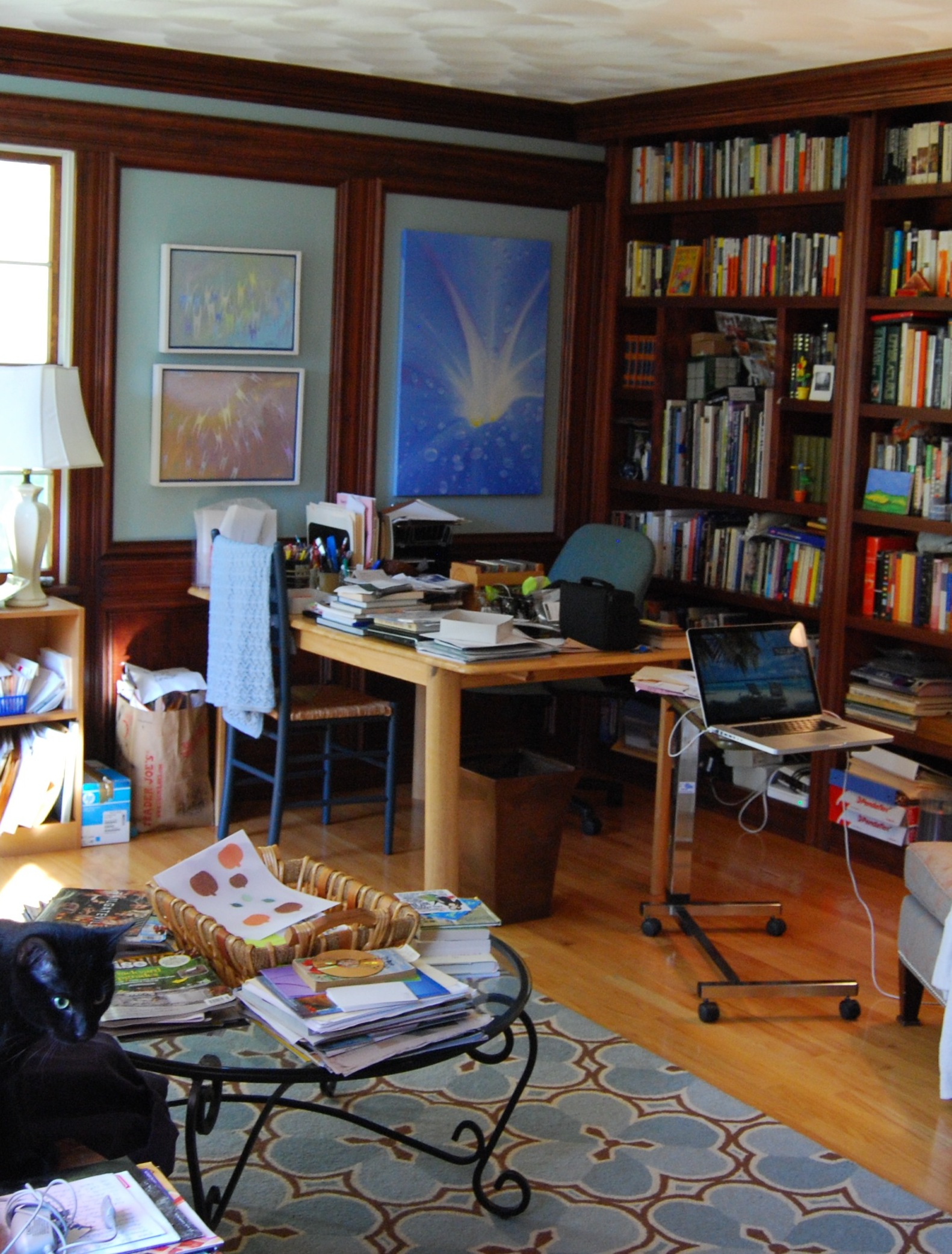
When we moved into our new home in February of this year, I was thrilled to unpack my books and various possessions into our new library. I very vaguely segregated the books by nonfiction and fiction, intending to properly sort out the shelves, alphabetize my collection, and arrange all of my non-book items in the near future. Eight months later, the time finally arrived. My mother had given me a birthday coupon for a day’s worth of organizational help (and, most importantly, moral support) so I booked my sitter for an extra day, and on Friday my mother and I tackled the library. (It seemed indulgent to pay for babysitting in order to overhaul my library/home office, but considering that my mother and I worked all day long on Friday, and then I spent the better part of the weekend finishing the job myself, I know that this never would have happened if I hadn’t paid for the extra help.)
So, alphabet or color? I was intrigued by the color principle, and I had to try it. (Obviously, by the photo I ran above, there isn’t much question about which way I went.) I can’t believe HOW LONG it took to sort all the books, but we did it. (All those “taupe” books — are they gray? Are they brown? Are they off-white?) It was a LOT of fun, I have to admit. And I came to realize fairly early on that finding a specific book was not going to be a problem. But more on that later.
I also went through ever drawer and bin, sorting out all of my office supplies. I weeded out tons of stuff I don’t need or want. I filed every stack of paper. I found (or created) logical homes for all those little things that you pick up and say “what do I do with THIS?”
I now have a desk that I can actually use! I paid bills sitting at the desk last night, and everything I needed was in arm’s reach. My art supplies are organized in the hall closet around the corner, as there just isn’t room for everything in one place. But it all works.
The basic footprint of the room hasn’t changed (months ago, we tried many different arrangements of the furniture, but nothing else worked). I did change out a yucky fiberboard bookshelf for a marginally better, longer bookshelf made by my ex-husband. (No, you can’t have it back!) Please ignore the hospital-style table on wheels (it’s one of the most practical things I own, and I use it all the time).
BEFORE

AFTER

Desk corner before:
Desk corner after:

Considering that relatively little actually changed, aside from clearing out all the clutter, I can’t entirely explain the magic that this room now holds. I FREAKING LOVE IT. I want to be in here all the time. Yes, I’m in here now, typing on my laptop at my desk. I swear, it’s as if Mr. Roy G. Biv turned the room into a bowl of M&M’s. Very cozy at night, too:
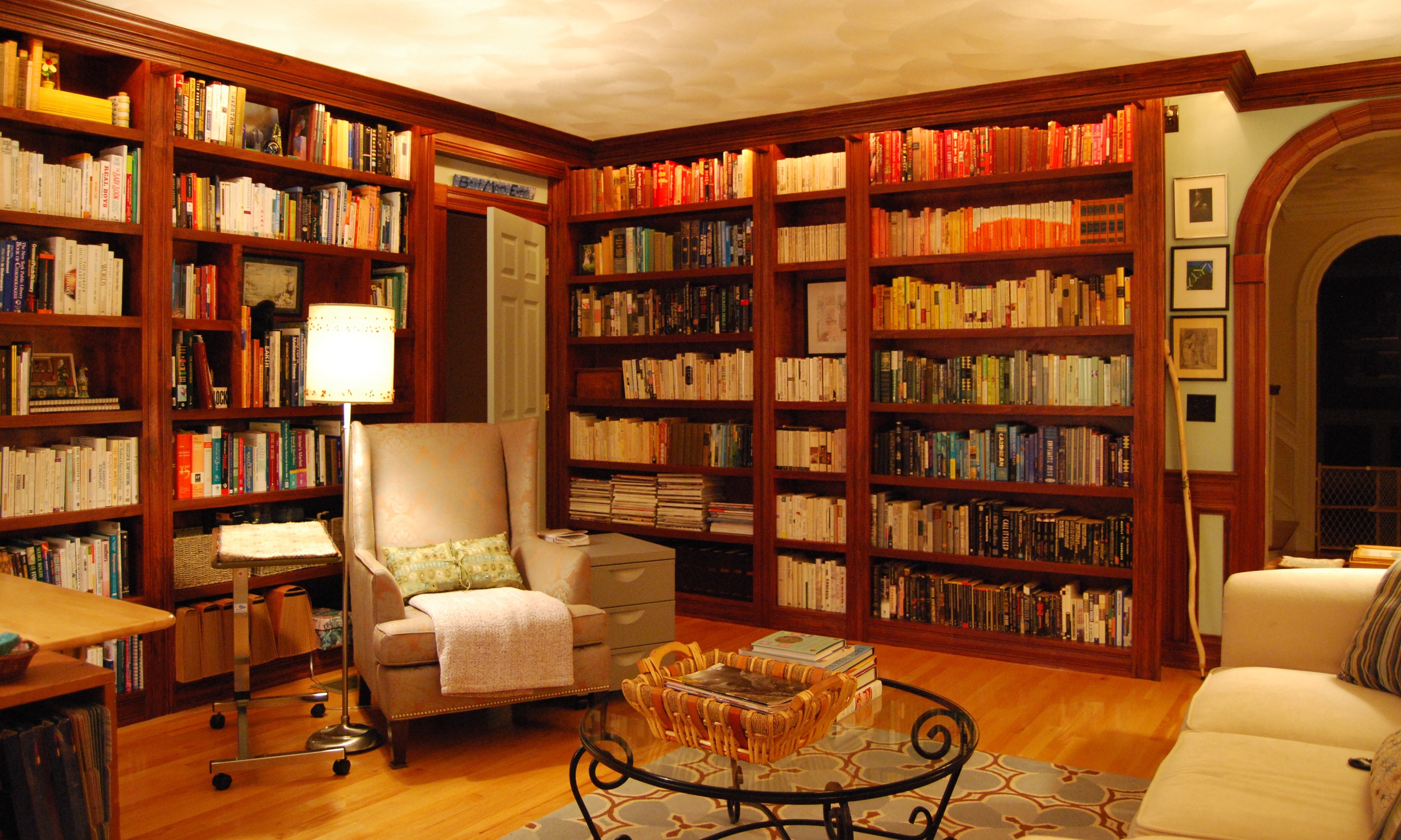
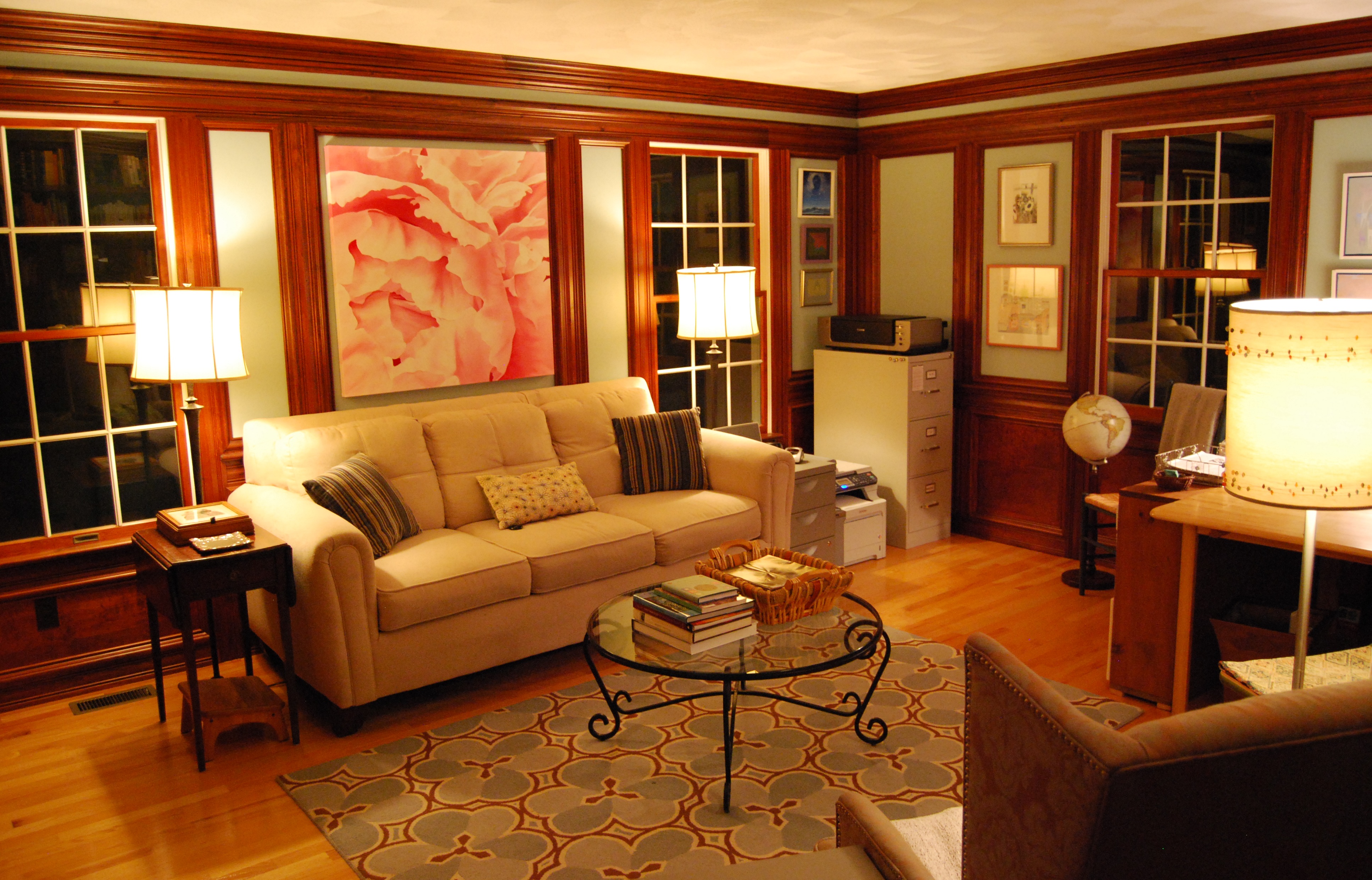
So here’s my case for organizing books by color. In the first “after” photo above, fiction comprises the vertical shelf on the far right and the white shelf up the middle. That’s not really so many books. If I’m looking for a particular title, it’s not going to be hard to find even if I can’t remember the color of its spine. This is the only place I have adult fiction aside from my “to read” shelf on the other wall. The books to the left in the same photo are general nonfiction (biography, autobiography, and history). Again, these are mixed together, but it’s not a lot of shelf space for me to peruse if I need something. The fifth shelf is poetry.
On the other wall, books are broken down by genre. I have a shelf for editorial reference, a shelf for art reference, a shelf for books about writing, a shelf for books about creativity, a shelf for parenting, a shelf for self-help & metaphysical (yes, I have that many self-help and metaphysical books). There’s another shelf of semi-mixed nonfiction; a little chunk of current political books, a chunk of animal-related training books, a chunk of sports-related books, a section for gardening. Then there is the to-read shelf, as well a short fiction and plays. And so on.
For each of these subsections, I organized books by color and shape, depending on what looked best for each shelf. Again, I’m not going to have trouble finding anything because I know what each subsection is, and no single subsection is more than a shelf long.
So, now that I’ve dealt with the question of “how will you find anything?” I’ll get to why I think this is such a fabulous way to organize your books. First, a book is so much more than words on a page, or the author’s position in an alphabet. A book is a piece of art — even an old Bantam mass-market paperback — and to my mind, organizing books this way is something that honors each book as art. Positioning each book on a shelf in a way that maximizes its beauty (almost as “paint”) rather than by the name of the person who wrote it seems to me a more potent way to celebrate the beauty of a personal library. The shelves are pleasing and peaceful, without losing the vaguely chaotic and cozy look that is inherent in any library. The color progression is so eye-catching that I think it actually calls more attention to the books, not less — without dominating. What do you think?
The downside to having a dream library/work environment is this: There is pretty much no excuse left on the planet for not coming up with something brilliantly creative. I seem to have run out of excuses. And I DID just use an entire weekend’s worth of “free” moments to finish the room. Time to get to back to the writing 🙂




 Studio Mothers: Life & Art