Skip to content

Posts from the ‘Miranda’ Category

Panster versus Plotter

planning_the_journeyDuring November, the interwebs were abuzz with National Novel Writing Month (NaNoWriMo), the literary marathon during which participants bang out a 50,000-word novel in 30 days. A debate always emerges during NaNoWriMo, centered on a process question that is relevant to writers and artists alike. Which is better: pantser, or plotter?

A pantser, as the name implies, is one who flies by the seat of his or her pants. No outline, no roadmap, no limits. Pantsers feel constrained by outlines; many say that planning strips away their creative mojo. On the flip side, plotters prefer to know precisely which direction they’re headed in. A plotter novelist might produce a full set of index cards with each scene in bullet points before relaxing into the writing process. Writers in either camp vehemently defend their preferences (just google “pantser versus planner” and see for yourself).

Of course, neither approach is inherently better than the other. You need to do what works best for you. But sometimes we get stuck in what we think we “should” do, or what we learned from a mentor’s example, or what seems more legitimate. When that happens, it can be difficult to adopt the other method, even if it might be to our benefit.

The only way you’ll really know what works best for you is to try both. If the idea of planning your fiction feels frightening, give it a go. You might find inspiration in the clarity that an outline brings. And if you tend to plan the composition of your painting down to the last square centimeter, you might try purely intuitive work and see if that unlocks anything new.

The value of knowing if you’re a pantser or a plotter by nature—or if you fall somewhere in between—is that understanding your authentic process is part of your identity as an artist or writer. The more you understand (and anticipate) how you work, the more confident you become, and the more you are able to invest in your process rather than the outcome.

What works for you? (And if you participated in this year’s NaNoWriMo, hearty congratulations!)

This piece was originally published in Creativity Calling, the newsletter of the Creativity Coaching Association.

:::::

Writer’s Block: Fact or Fiction?

Writer’s block. Whether or not you’re a writer, as a creative person you know what it feels like to be paralyzed by the page, the canvas, the studio — completely unable to move forward. Whether you feel bereft of ideas and inspiration or are simply unable to realize an existing project, banging your head against your creative work doesn’t ever feel good.

As a creativity coach, I can tell you that the best protection against writer’s block is to show up and do your creative work every day, on schedule. (Those of you who are doing NaNoWriMo this year know that you don’t have the luxury of being blocked.) The force of habit is a powerful antidote for creative paralysis.

But sometimes a block does seem insurmountable. You show up, install your butt in the chair, and gnash your teeth for two hours. You find yourself doing anything and everything aside from your creative work. You spend so much time doing “research” on the web that you can’t even remember what you’re researching. Suddenly you find yourself reading about how yellow was an exceptionally popular color among Latvian car buyers in 1982 and realize just how far you’ve sunk.

Now, if you’ve been procrastinating for months/years, then you’re not doing your work at all, which is a different topic. But what if you are doing your work, merrily rolling along, and then one day — BAM! — you can’t dredge up so much as a line of prose or a square inch of canvas? What’s going on? Should you plow on through with your eyes closed, or give yourself space to percolate and breathe?

I was struck by these two contrasting views of writer’s block:

Toni Morrison: “When I sit down in order to write, sometimes it’s there; sometimes it’s not. But that doesn’t bother me anymore. I tell my students there is such a thing as ‘writer’s block,’ and they should respect it. You shouldn’t write through it. It’s blocked because it ought to be blocked, because you haven’t got it right now.

Thomas Mallon: “My prescription for writer’s block is to face the fact that there is no such thing. It’s an invented condition, a literary version of the judicial ‘abuse excuse.” Writing well is difficult, but one can always write something. And then, with a lot of work, make it better. It’s a question of having enough will and ambition, not of hoping to evade this mysterious hysteria people are always talking about.”

What do you think? I’ve generally been of the mind that there’s no block that can stand up to the bulldozer of a 500-word daily quota. But in recent months, I too have had days when even 500 words were impossible. I had to wait out torture at the keyboard (literally, on my wordcount log, I wrote “hours of torture” next to my piddly 62 words for the day). Thankfully, those periods pass and invariably I return to flow. Still, more often than not, I think there’s a danger in giving writer’s block more credit than it deserves. It becomes too easy to shrug off our work when it gets difficult. Of course it’s difficult; it wouldn’t be worth doing if it were easy, would it? Hitting an uncomfortable patch doesn’t mean that we need to put a “gone fishing” sign on the door and tell ourselves to wait for the muse to return.

As Jodi Picoult put it, “Writing is total grunt work. A lot of people think it’s all about sitting and waiting for the muse. I don’t buy that. It’s a job. There are days when I really want to write, days when I don’t. Every day I sit down and write.”

And one of my favorites, from William Faulkner: “I only write when I am inspired. Fortunately I am inspired at 9 o’clock every morning.”

What’s your view of writer’s block? Where, in your opinion, is the line between being at a creative crossroads and merely giving in to another excuse to avoid your work?

:::::

Quantity versus Quality: A Tale of Two Artists

Canadian painter Robert Genn has a twice-weekly newsletter that I always enjoy. While Genn writes primarily about painting, his thoughts apply to any creative pursuit, including writing — and we’ve reposted his letters here several times before. The gem below, which illustrates the importance of practice and gets to the heart of what “success” really means, is reprinted by permission.

Because this is a bit personal, I’m not using their real names. They’re both about 40 years old.

“Jack” got a BFA and then an MFA from a Midwestern University. He’s visited many of the major contemporary art museums and follows the work of several “important” contemporary painters. He’s written articles on Philip Guston and others. He subscribes to several art magazines and is “the most knowledgeable art-guy in any discussion.” After university he worked for a while in a commercial art gallery. He sometimes writes me long, well-informed letters. He’s painted eleven large paintings (two unfinished) since leaving school. He’s not represented by any gallery. He thinks you need to move to New York and “get lucky” with a dealer who “really represents you.”

“Jill” took two years of art school and then quit. She pays little attention to other artists. She subscribes to no art magazines but has taken several workshops. Her hobbies include bowling and travelling. At one time she also worked in a commercial art gallery. On two or three occasions she’s written to me. She’s painted “approximately two thousand paintings” since leaving school. She’s represented by four commercial galleries in four, well-separated mid-sized cities.

There’s a great story in David Bayles and Ted Orland’s Art and Fear. Here it is: 

“The ceramics teacher announced on opening day that he was dividing the class into two groups. All those on the left side of the studio, he said, would be graded solely on the quantity of the work they produced, all those on the right solely on its quality. His procedure was simple: On the final day of class he would bring in his bathroom scales and weigh the work in the “quantity” group: fifty pounds of pots rated an “A,” forty pounds a “B,” and so on. Those being graded on “quality,” however, needed to produce only one pot — albeit a perfect one — to get an “A”. Well, came grading time and a curious fact emerged: the works of the highest quality were all produced by the group being graded for quantity. It seems that while the “quantity” group was busy turning out piles of work — and learning from their mistakes — the “quality” group had sat theorizing about perfection, and in the end had little more to show for their efforts than grandiose theories and a pile of dead clay.”

Best regards,

Robert

PS: “Artists get better by sharpening their skills or by acquiring new ones; they get better by learning to work, and by learning from their work.” (David Bayles and Ted Orland)

Esoterica: Both subscribers Jack and Jill are thoughtful and enthusiastic artists. Art is central to their lives. And while success and “being able to function as a full time artist” may not be important to some of us, their current situations are quite different. Jack rents an apartment and makes $2,150 per month (plus tips and benefits) as an airport porter. Jill works daily in her converted garage in a home she now owns. These days she’s averaging $18,000 per month. She has “no benefits.”

:::::

Don’t miss the treasure trove of Genn’s letters here.

Writer’s Block? Meet NaNoWriMo

It’s November 1, which means that thousands of writers around the world are throwing themselves into the month-long writing marathon known as National Novel Writing Month, or NaNoWriMo. This group of participants — improbable as it might seem — include people with children, people with jobs, and people with far too many other commitments to even consider doing such a thing. They do it anyway. This project has given birth to several New York Times bestsellers, so it’s not just an exercise in frustration. Although it may certainly be that too, as evidenced by a perusal of Instagram photos from Day 1 (a few highlights seen below).

Blocked or not, nothing cures procrastination like a massive deadline and public accountability, both of which NaNoWriMo provides, if you so choose.

(If you’re an artist but would like to take advantage of this kind of inspiration-on-steroids, check out November’s Art Every Day Month, the initiative of Leah Piken Kolidas.)


What is NaNoWriMo, really? Here’s the organization’s press release on this year’s festivities:

If on November 1 you hear furious keyboard pounding echoing around the world, fear not. It is the sound of more than 250,000 people beginning a literary challenge of epic proportions: 30 days, 50,000 words, and one original novel.
Why? Because November is National Novel Writing Month, or NaNoWriMo, the world’s largest writing event and nonprofit literary crusade. Participants pledge to write 50,000 words in a month, starting from scratch and reaching “The End” by November 30. There are no judges, no prizes, and entries are deleted from the server before anyone even reads them.
“NaNoWriMo is the writing world’s version of a marathon,” said Grant Faulkner, executive director of National Novel Writing Month. “Writers exit the month with more than a novel; they’ve experienced a transformative creative journey.” More than 650 regional volunteers in more than 60 countries will hold write-ins, hosting writers in coffee shops, bookstores, and libraries. Write-ins offer a supportive environment and surprisingly effective peer pressure, turning the usually solitary act of writing into a community experience.
“Not only did I write 50,000 words by November 30, I also had cheerleaders from the next block, from across the Atlantic and from NaNoWriMo daily blogs,” said participant Twana Biram. “Imagine getting pep talks through the heavy irony and hilarity of Lemony Snicket, and the clarity and appreciation of fan fiction from Mercedes Lackey.”
With NaNoWriMo’s Young Writers Program, that community crosses age boundaries into K-12 classrooms around the globe. The YWP allows kids and teens to set their own word-count goals, and offers educators high-quality free resources to get nearly 100,000 students writing original, creative works.
Although the event emphasizes creativity and adventure over creating a literary masterpiece, more than 90 novels begun during NaNoWriMo have since been published, including Water for Elephants by Sara Gruen, The Night Circus by Erin Morgenstern, and Cinder by Marissa Meyer, all #1 New York Times Best Sellers.
“You can’t revise what isn’t written yet, right? This novel-in-a-month challenge is such a fantastic way to jump-start your story,” said Lindsey Grant, NaNoWriMo’s Program Director. “Plus it is officially the most fun—and effective—way to shed the constant self-doubts and inner-criticisms and simply pour that story onto the page.”
For more information on National Novel Writing Month, or to speak to NaNoWriMo participants in your area, visit www.nanowrimo.org.

I’d heart it more if I didn’t have writers block #nanowrimo
Thu, Nov 01 2012 02:31:40

Well this has started well. #book #writing #nanowrimo #sarcasm
Thu, Nov 01 2012 01:37:26

#nanowrimo #writing #nojoke #50kin30days
Thu, Nov 01 2012 02:44:43

Already up and over day 1 goal. Can’t wait to wake up and write more. Goodnight, and good luck. #NaNoWriMo
Thu, Nov 01 2012 02:51:28

How to Manage the Loss of Naptime

Losing naptime is a panic-inducing prospect for many work-at-home parents. When it comes to working with a little one at home, you have several other options after naptime has been crossed off the list.

Keep an open mind

The key thing to remember is that “ideal” is not necessarily relevant while you have a small person at home. It’s not uncommon for creative parents—especially those who aren’t earning a living from their creative pursuits—to complain that they “can’t” work without at least three hours of uninterrupted time, or they “can’t” work when others are at home, or they “can’t” work unless all of the household chores are done first. When I hear these objections, I have to ask, “What’s more important: Getting your creative work done on your own terms, or getting your creative work done?”

When you make your art a priority, you’ll find a solution, even if it’s several notches down on your list of preferences. A self-described night owl may find that her only work opportunity is from 5:00 am to 6:30 am before the family wakes up. So she gradually gets up 15 minutes earlier each morning until she adjusts to the schedule change and has a work window she can count on. It’s not ideal given her internal clock, but she can enjoy the rest of each day knowing that she’s already taken care of her creative work. Most importantly, she’s writing every day.

Conversely, an early-bird whose children are very early risers may decide that he needs to rely on an hour every evening right after the kids go to bed, even though his creative mind isn’t at its best at that hour. Sometimes making do is the best you can do.

Your options

Examine your basic routine and look for places where you might be able to juggle things around to give yourself a work window. This may well require giving up something else, like watching television with your spouse or attending a regular evening commitment. You may need to give up an hour of sleep on one end or the other, if you can manage that without deprivation. If you’re a perfectionist, you’ll also benefit from lowering your standards on the domestic front during this preschool period. What’s more important: writing your book, or dusting picture frames? Prioritize and become extremely careful about how you spend your time. In the larger scope, you can have it all—but that doesn’t mean you can have it all right now.

The options below, alone or in combination, are your basic menu for creative work:

  • Get up early and write in the morning
  • Work after your child goes to sleep for the night
  • Enroll your child in part-time preschool or hire a babysitter
  • Barter for regular babysitting or develop a playdate co-op
  • Arrange for your spouse or other family member to take evening or weekend stints
  • Learn how to work with your child around

Regarding this last suggestion, many parents balk at the idea of combining writing with parenting. I strongly suggest developing this capability, however. The more your child enjoys independent play, the more latitude you can enjoy. I know of one mother who wrote most of a novel on a hand-held PDA in 5-minute blocks while her two children were playing on the swing set or occupied with Matchbox cars. This strategy requires a lot of flexibility, as you need to be able to set your work aside when your child needs you—and it’s important to have plenty of time with your child when you aren’t staring at a screen—but the ability to blend your creative life into your parenting life is a huge advantage. As a writer, you have this portability. Potters, for example, are far more tied to their studios, and their work requires a greater investment in setup and cleanup time. It’s also not usually safe for young children to entertain themselves in a studio that might have lots of fascinating (and dangerous) tools and materials lying around.

The best solution will come from you, as you know your child best. While you’re working it out, be sure to take a second look at any option that you immediately write off. Sometimes something that seems implausible at first glance turns out to be quite workable.

Without fail, just when you get into the groove with your new routine, the parameters will turn on end and you’ll end up going through this process all over again.

The plug-in Mary Poppins

If you’re inclined to let your daughter watch television at all, be sure to capitalize on her TV time by writing during that window. Children under the age of 2 should not watch any television whatsoever, as recommended by the American Academy of Pediatrics. There are many parents who commendably keep their older preschoolers away from the TV entirely, but others among us rely on the electronic babysitter (preferably free of commercials) for 30-60 minutes of creative productivity on occasion. Don’t abuse this distraction, however, and ensure that your child is getting plenty of physical activity, imaginative play, fresh air, and face time with Mom.

Bend and stretch

The schedule of a work-at-home parent must be fluid by nature. The more flexible and broad you become with your creative paradigm, the better. If you’re working on your project regularly, it will stay fresh in your mind and percolate in the background as you go about your day. Then, when a sudden opportunity strikes—your child becomes engrossed in the dollhouse or takes an unexpected nap—you can grab that opportunity for creative work. When you aren’t in regular contact with your project, the prospect of jumping in can feel like standing at the edge of an icy lake in midwinter. The more frequently you work, the less intimidating that work becomes. In this sense, frequency can actually be more important than duration. A mere 30 minutes every day adds up to 15 hours over the course of a month. That’s significant.

Become a creative opportunist

Live large by reveling in the beauty of small, everyday moments. Allow yourself to follow creative threads that intrigue you, even if you aren’t sure where they’ll lead. By deepening your practice of creativity in other areas of your life, you will enrich the process and output of your primary artistic focus. Your senses will strengthen and you’ll be ever more able to be creative on the fly. Make notes while you sit in your car waiting for a child to emerge from gymnastics class; write a haiku in your head while you’re in the dentist’s chair; use your camera phone to take impromptu photos of anything that strikes your interest during daily life. Record a funny conversation you overheard at the grocery store or a perceptive observation that your child makes. Fill your well.

This too shall pass

It’s also important to remember that whatever is happening right now is not going to last forever. Adopting a less-than-ideal work solution is more palatable when you bear in mind that it’s only temporary. That said, it’s important to be as regular as possible with whatever time slot you’re aiming for in a given time period. Regularity breeds habit, and habit gets the work done.

Be well, and be creative!

:::::

Want more practical tips to support your creativity? If you’re an artist or writer with little ones, The Creative Mother’s Guide: Six Creative Practices for the Early Years is the essential survival guide written just for you. Concrete strategies for becoming more creative without adding stress and guilt. Filled with the wisdom of 13 insightful creative mothers; written by a certified creativity coach and mother of five. “Highly recommended.” ~Eric Maisel. 35 pages/$11.98. Available for download here.

Pages of Wisdom: Liz Hum

Liz Hum, writer and artist, is one of 13 contributors whose wisdom appears in the e-book The Creative Mother’s Guide: Six Creative Practices for the Early Years. If you’re not already reading Liz’s blog, you’re missing out. Enjoy the following gift of Liz’s words as taken directly from the e-book.

I struggle most with guilt. The guilt of not creating when I try to be a mom. The guilt of not being a mom when I’m trying to create. The guilt of feeling like a crappy artist when I try to rush through a creative project just to get it done. Not to mention the guilt I feel for not being able to be all things at once.

Marketing makes it look easy to “have it all,” doesn’t it? We can wear our babies to the coffee shop after yoga class where we can bang out another chapter on our novel, take them to the park, whip up an optimally nutritious meal, teach our children some brilliant skill or new language and then have them delightfully fingerpaint on the floor next to us as we finish our own masterpiece? Did I mention we’re supposed to be cool and stylish at all times as well?

I’m in awe of creative moms who can crochet a sweater while breastfeeding or create their crafts while rattling off their kid’s math problems, but I don’t know if I have fully forgiven myself for not being one of them.

Give yourself a break. When you find you have free time, go for it! But you know what? If you don’t, don’t sweat it — you will. If you live in the present instead of fretting about all the projects and dinners you’re trying to juggle, you’ll start enjoying your time with your kids more and you’ll be able to recognize and utilize your pockets of free time. Sometimes you have to put your art on the back burner and take care of your kids while they need you. Baby and toddlerhood is a temporary condition, mommas, remember that. They’ll all be in school soon, right? And we’ll have a few hours every day in which to get to know ourselves again. Eyes on the prize, ladies…eyes on the prize.

:::::::

If you’re an artist or writer with little ones, The Creative Mother’s Guide: Six Creative Practices for the Early Years is the essential survival guide written just for you. Concrete strategies for becoming more creative without adding stress and guilt. Filled with the wisdom of 13 insightful creative mothers; written by a certified creativity coach and mother of five. “Highly recommended.” ~Eric Maisel. 35 pages/$11.98. Available for download here.

The Early Morning Creative Practice: Start Your Day With What Matters Most

Back in April, I wrote about my morning centering practice. This practice has evolved in several key ways in the past six months. Now, for the first time ever, I feel that I am truly and consistently walking the talk when it comes to my personal creativity.

It’s no secret that successful people make the very most of early morning hours. Whether you have a day job, a family, and/or wear 14 other hats, the first hours of the day are often your only shot at having time to yourself without interruption and distraction. As soon as your kids are sleeping through the night, you can start leveraging this opportunity.

For me, getting up early means 4:00 am.

Of course, there’s no such thing as a free lunch. Getting up early requires going to bed on time (9:00 – 9:15 pm over here). It also requires a fairly consistent schedule, as it’s difficult to get up at 4:00 on Monday morning after getting up at 7:00 on Saturday and Sunday. So I get up for writing practice at 5:00 on weekends. That means I’m not up late or out on the town on weekends. Is that a sacrifice? Maybe. But it doesn’t feel like one at the moment.

For me, getting up early is built on the foundation of exercise and eating right. I’ve been a vegetarian for many years, and as you may have read here before, I’ve long felt that wheat products are not my friend. I don’t have celiac disease, but I find that eating wheat (even whole grain) stimulates strong cravings and makes me feel hungry — and tired. (This book was quite affirming.) Today I am nearly vegan and totally wheat free. I eat a very low-carb diet and eat lightly at dinner. I don’t eat after 7:00 pm, ever. By eating lightly and going to bed a little bit hungry, I wake up full of energy and ready to launch into my writing practice. Bonus: I just took off a stubborn 10 pounds.

As you might imagine, the fact that I need to be in bed by 9:00 in order to get 7 hours of sleep has an impact on my marriage. My husband likes screen time in the evening, and I prefer to read, so this isn’t a huge issue. I try to make sure that we connect over dinner and on the weekends. Sometimes he comes to bed at the same time I do. We also share our daily morning meditation practice, which to my mind is more valuable than sitting next to each other in front of the TV half comatose for a couple of hours in the evening.

It won’t always be this way. Writing is important to me, and right now, this is what it takes to be a serious player. Play-ah! No more excuses. (As I’m sure you know, there are always 18,489 “good” excuses.)

Yeah, great, but what does that really LOOK like?

My morning practice starts at 4:00 am and ends at 8:15 am when I leave the house with my two youngest children. I started the 4:00 wake-up over the summer and have now incorporated the school routine. Here’s what my morning practice looks like, woven into the regular flow of home life:

  • 4:00: out of bed, make tea, settle into office
  • Read the day’s page in The Daily Writer
  • Writing practice: 500-word minimum (this helps me focus on output rather than falling into editing)
  • 5:20: join my husband upstairs for 20 minutes of meditation
  • Do three vinyasas (sun salutations)
  • 5:45: back in office, read the day’s entry in Mark Nepo’s Mark Nepo’s The Book of Awakening
  • Draw an Osho Zen Tarot or Faerie Tarot card
  • Record last night’s dream(s) in my dream journal, if I remember anything
  • 6:15: stop to ensure that daughter is awake, make breakfast for her, eat a few spoonfuls of peanut butter if I haven’t already, husband leaves
  • Make lunch for daughter and two younger sons (daughter catches school bus at 6:48)
  • At some point here, the two little ones wake up; feed them breakfast
  • Unload dishwasher and tidy kitchen
  • At kitchen table, finish morning pages/intention journaling if not already complete
  • Review my list of personal goals and intentions for the year
  • Plan the day (in planner, assigning a time and a duration for each task, or adding them to the “batch task” block)
  • Dress self and youngest son, brush teeth, make bed, put in a load of laundry if time, make sure we’re all ready to leave the house
  • 8:15 heard little boys out of the house for bus/school run

Note that the writing practice comes FIRST. That way, if a wee one wakes up exceptionally early, it’s still already done. If I have to scrap the centering part of my practice (mediation, journaling, etc.) then so be it. But the writing practice isn’t threatened. Usually, it all falls into place, with a little juggling between the aforementioned time slots. Everyone gets off to school and work in good stead, and the house is (gasp!) clean and tidy.

I understand that a routine like this might seem baffling — or totally unappealing. But for me, it’s a completely sustainable loop. Those four hours and fifteen minutes are routine now. It’s a routine that is grounded in my macro level intentions and priorities. I can’t overstate what it means to me to have a daily writing practice that absolutely happens every day. Seven days a week. I’m in touch with my creative work every day, all day, because it’s always fresh, always percolating. Without this morning anchor, the demands of my editorial business, my coaching practice, my studio storefront, and my family/domestic life eat up every available moment.

Interested in what an early morning creative practice could do for you? My last post on this topic included some ideas for developing your own morning centering practice. Add the creative session, mix well, and enjoy.

And hey: If you’re up at 4:00 am eastern time, know that you and I are creative buds.

What think?

::::

The Artist at Work: Do You Welcome the Family, or Bar the Door?

The Daily WriterI enjoy starting my daily morning writing practice by reading a page in Fred White’s daybook The Daily Writer: 366 Meditations to Cultivate a Productive and Meaningful Writing Life. Today’s entry was particularly relevant to our scope here at Studio Mothers, whatever your medium. Here’s the excerpt:

August 30: Dealing with Family Interference

Writers mostly work at home, and that can pose a problem, especially if the writer has children. To ensure against quarrels or having the kids or the spouse feel neglected, the writer in the family needs to negotiate (not mandate like some dictator) ground rules. Another approach is to open your study to the kids. Introduce them to your work, explain your project to them in ways they’ll both understand and appreciate. You might even invite them to hang around and watch you working (about as unexciting as can be imagined for most children); it makes them feel more a part of you and gain more of an internal understanding of why you need to work uninterrupted. The opposite approach, making your study off limits, giving it the impression of being The Forbidden Zone, might prove just as effective superficially, but doesn’t do much to foster family togetherness.

Perhaps the best way to handle family interference is to let them interfere in the sense of making them feel welcome in your inner sanctum. There’s a memorable photograph of JFK at work in the Oval Office with four-year-old John-John frolicking at his feet. Children can better intuit how best to behave around a working parent once they feel that they’re included rather than excluded.

How about you? Do you include your children and/or your spouse in your creative work? What’s best for you and your family?

Miranda: For the Love of Books, Before and After

During August, I’ll be sharing a few choice tidbits from the archives. Enjoy!

Warning. This post contains an unusually intense degree of navel-gazing and otherwise raving on and on about one’s home library, books, and related minutiae. If you find such material nauseating, turn away now. 

Recently, I posted this on Facebook:

I’m staging a serious overhaul of the home library/office today, with Mom’s help. The question is — and please don’t cringe, fellow bibliophiles — shelve the books by author last name, or by jacket color? I know, I know….but I peruse and admire many design blogs and must admit that books shelved by color look fabulous. Although I’m not sure I can bring myself to mix genres…..help!

I was amused by the considerable volume of responses. People feel VERY strongly about how to organize their books — as well they should. This is serious business, people!

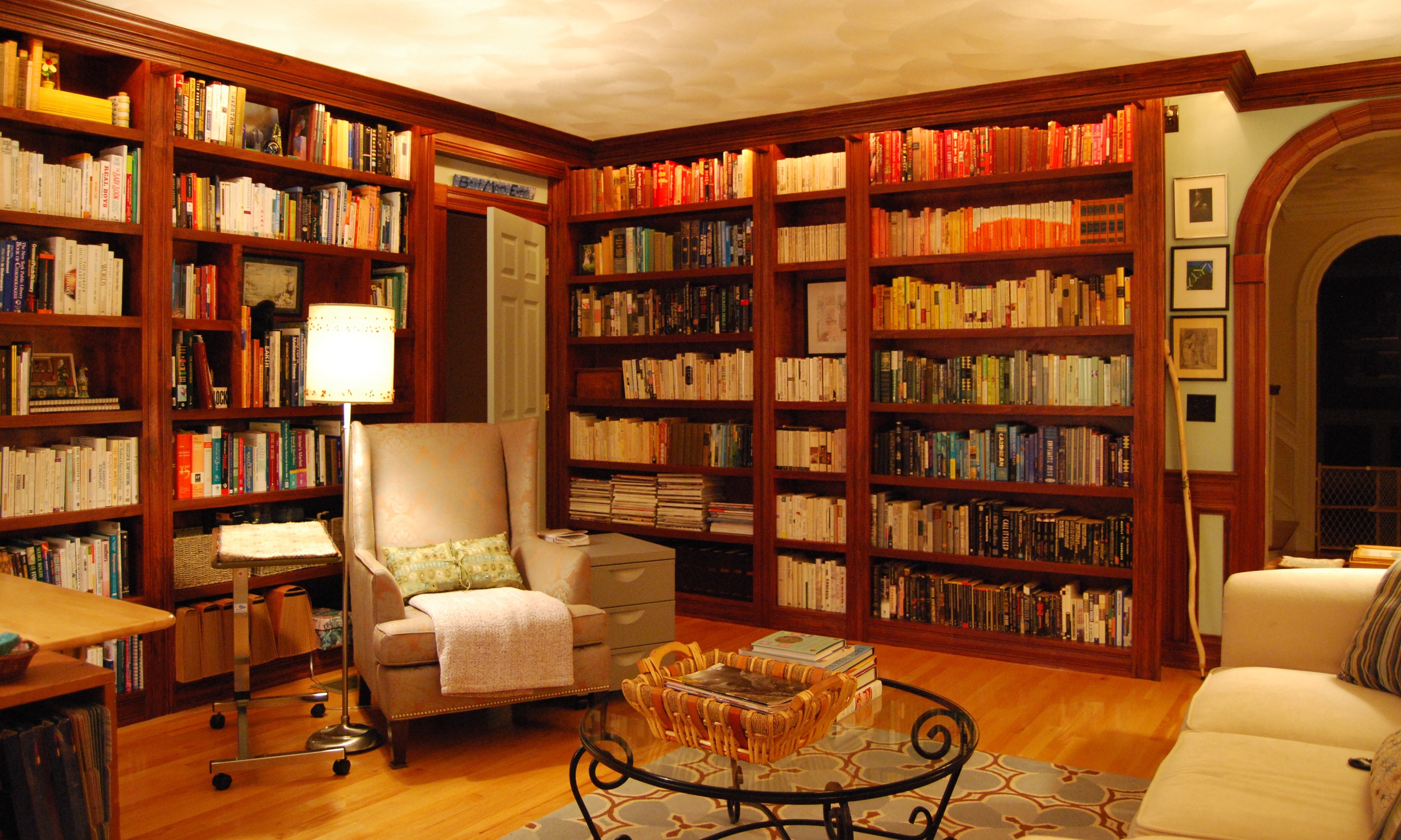
rainbowWhen I first heard of organizing books by color, I thought the premise was among the most ridiculous things I’d ever heard of. Not to mention sacrilegious. The whole idea sounded like “book as prop,” in the way that a professional decorator might buy small decorative things for a client’s room simply because they look nice against the wallpaper; nothing whatsoever to do with the item’s meaning or symbolism or its emotional value to the owner. Just “stuff.” Books, of course, are not “stuff.” Ew.

But over time, I came across more instances of books organized by color that really looked beautiful. Not just a stack of three yellow books next to a yellow vase, but shelves organized wholesale by color. Still, how would you ever find anything if you didn’t organize all of your books by genre and then by author last name?

When we moved into our new home, I was thrilled to unpack my books and various possessions into our new library. I very vaguely segregated the books by nonfiction and fiction, intending to properly sort out the shelves, alphabetize my collection, and arrange all of my non-book items in the near future. Eight months later, the time finally arrived. My mother had given me a birthday coupon for a day’s worth of organizational help (and, most importantly, moral support) so I booked my sitter for an extra day, and on Friday my mother and I tackled the library. (It seemed indulgent to pay for babysitting in order to overhaul my library/home office, but considering that my mother and I worked all day long on Friday, and then I spent the better part of the weekend finishing the job myself, I know that this never would have happened if I hadn’t paid for the extra help.)

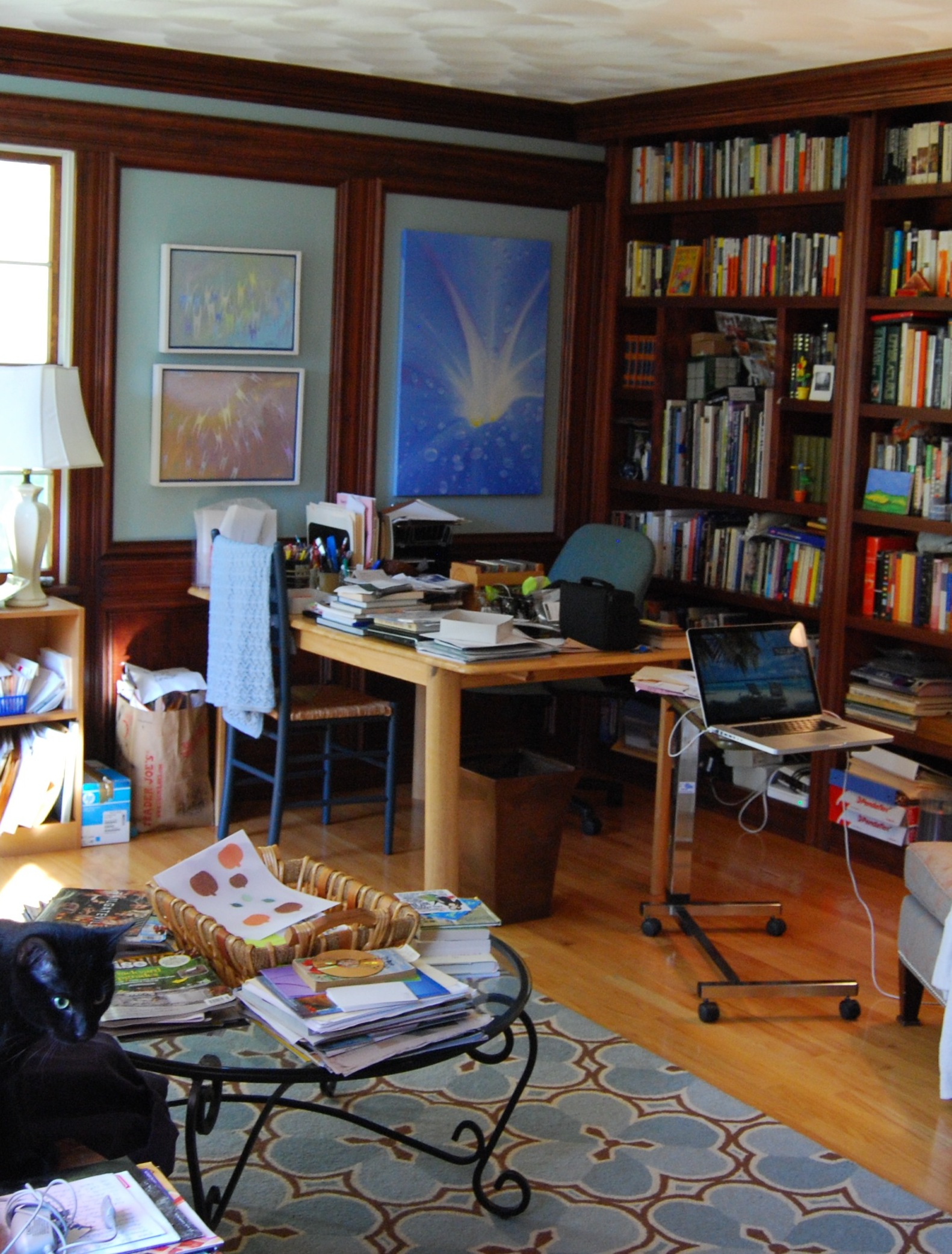
So, alphabet or color? I was intrigued by the color principle, and I had to try it. (Obviously, by the photo I ran above, there isn’t much question about which way I went.) I can’t believe HOW LONG it took to sort all the books, but we did it. (All those “taupe” books — are they gray? Are they brown? Are they off-white?) It was a LOT of fun, I have to admit. And I came to realize fairly early on that finding a specific book was not going to be a problem. But more on that later.

I also went through ever drawer and bin, sorting out all of my office supplies. I weeded out tons of stuff I don’t need or want. I filed every stack of paper. I found (or created) logical homes for all those little things that you pick up and say “what do I do with THIS?”

I now have a desk that I can actually use! I paid bills sitting at the desk last night, and everything I needed was in arm’s reach. My art supplies are organized in the hall closet around the corner, as there just isn’t room for everything in one place. But it all works.

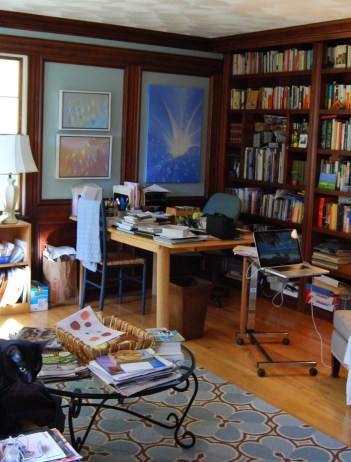
The basic footprint of the room hasn’t changed (months ago, we tried many different arrangements of the furniture, but nothing else worked). I did change out a yucky fiberboard bookshelf for a marginally better, longer bookshelf made by my ex-husband. (No, you can’t have it back!) Please ignore the hospital-style table on wheels (it’s one of the most practical things I own, and I use it all the time).

BEFORE

B_before

AFTER

B_after

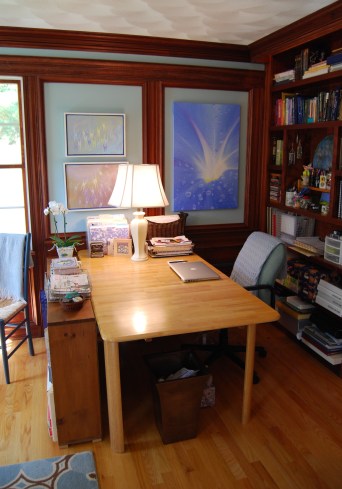
Desk corner before:

Desk_before

Desk corner after:

Desk_after

Considering that relatively little actually changed, aside from clearing out all the clutter, I can’t entirely explain the magic that this room now holds. I FREAKING LOVE IT. I want to be in here all the time. Yes, I’m in here now, typing on my laptop at my desk. I swear, it’s as if Mr. Roy G. Biv turned the room into a bowl of M&M’s. Very cozy at night, too:

night1

night2

So here’s my case for organizing books by color. In the first “after” photo above, fiction comprises the vertical shelf on the far right and the white shelf up the middle. That’s not really so many books. If I’m looking for a particular title, it’s not going to be hard to find even if I can’t remember the color of its spine. This is the only place I have adult fiction aside from my “to read” shelf on the other wall. The books to the left in the same photo are general nonfiction (biography, autobiography, and history). Again, these are mixed together, but it’s not a lot of shelf space for me to peruse if I need something. The fifth shelf is poetry.

On the other wall, books are broken down by genre. I have a shelf for editorial reference, a shelf for art reference, a shelf for books about writing, a shelf for books about creativity, a shelf for parenting, a shelf for self-help & metaphysical (yes, I have that many self-help and metaphysical books). There’s another shelf of semi-mixed nonfiction; a little chunk of current political books, a chunk of animal-related training books, a chunk of sports-related books, a section for gardening. Then there is the to-read shelf, as well a short fiction and plays. And so on.

For each of these subsections, I organized books by color and shape, depending on what looked best for each shelf. Again, I’m not going to have trouble finding anything because I know what each subsection is, and no single subsection is more than a shelf long.

So, now that I’ve dealt with the question of “how will you find anything?” I’ll get to why I think this is such a fabulous way to organize your books. First, a book is so much more than words on a page, or the author’s position in an alphabet. A book is a piece of art — even an old Bantam mass-market paperback — and to my mind, organizing books this way is something that honors each book as art. Positioning each book on a shelf in a way that maximizes its beauty (almost as “paint”) rather than by the name of the person who wrote it seems to me a more potent way to celebrate the beauty of a personal library. The shelves are pleasing and peaceful, without losing the vaguely chaotic and cozy look that is inherent in any library. The color progression is so eye-catching that I think it actually calls more attention to the books, not less — without dominating. What do you think?

The downside to having a dream library/work environment is this: There is pretty much no excuse left on the planet for not coming up with something brilliantly creative. I seem to have run out of excuses. And I DID just use an entire weekend’s worth of “free” moments to finish the room. Time to get to back to the writing 🙂

What do you think?
The Importance of Making Space

During August, I’ll be sharing a few choice tidbits from the archives. Enjoy!

Making space for your creative work is almost as important as making time for your creative work. When you have a work space that feels inviting and inspiring — even if it’s just the corner of a room — turning to your creative work feels like a delightful retreat, rather than just another item on your endless “to-do” list. We also know that one way to dispel resistance is to shape your environment to support your goals. The easier it is to get at your work and get down to business, the more likely you’ll be to actually follow through.

In her fabulous book The Creative Habit, Twyla Tharp notes: “To get the creative habit, you need a working environment that’s habit-forming.” When you have a space that calls to you, it’s easier to go there regularly. Regularity, as Tharp points out throughout her book (as the title would suggest), is the heart of creative output.

We all know Virginia Woolf’s famous dictum that “A woman must have money and a room of her own if she is to write fiction.” Woolf was speaking about the feminist need for independence in order to create. Most of us probably feel comparatively liberated, despite the fact that we have children and Woolf did not — but her point is well taken.

How can you change your space in order to better support your creative work? Many of us don’t have the luxury of our own room or even the corner of a room to call our own. We take over the dining table when the muse strikes and then have to dismantle the work area when it’s time to eat. If this is the case for you, brainstorm ways to make this process as user-friendly as possible.

It’s also possible that there IS a nook or cranny lurking in your home that you could claim for yourself with a bit of re-thinking. Bring your creative skills to finding a space in your home that helps you return to your creative, authentic self as seamlessly as possible. And if you’re fortunate enough to have your own space, you might spend a bit of time this month editing out anything in this space that doesn’t work for you anymore. Clean it up, organize, bring in a few fresh visuals that speak to you. Make it yours. Then, dig in.

“Without the studio, however humble,
the room where the imagination can enter cannot exist.”
~Anna Hansen

What works for you?

Making Creative Hay Outside

During August, I’ll be sharing a few choice tidbits from the archives. Enjoy!

If it’s summertime in your part of the world — or if you live in a mild climate and enjoy fair weather more often than not — think about using outside resources to your creative advantage. When younger kids are out of school, making outdoor time a regular part of your routine can yield many benefits. We often end up spending time indoors just because it seems easier than setting up camp outside. But don’t let the force of habit inhibit your summertime fun and creativity.

If you have a yard of your own, make the most of this bonus. If you have a fenced-off space — even a small one — so much the better. Many mothers are able to sit on a lawn chair and write, read, or sketch while their kids play safely nearby. You can peruse that stack of magazines you haven’t read yet — any reading material that is easy to put down as needed. Outdoor time is also a great opportunity to take photographs of your kids or the world around you.

To stack the odds in your favor, use this four-pronged approach to outdoor (and indoor) downtime:

  1. Make sure everyone is well fed, watered, and toileted.
  2. Spend some time totally focused on the kids.
  3. When the kids seem engaged or playing independently after having some Mommy face time, turn to your creative work.
  4. Try to remain flexible. There will be days when the kids don’t want you staring at a notebook for even 30 seconds, and there will be other days when they’re happily immersed in their own worlds for 30 minutes. Go with the flow.

If your inventory of outdoor toys seems insufficient, yard sales and consignment shops are great places to pick up a few more. You might also send an e-mail to friends with older children to ask if they have anything hiding in their garages or attics that they no longer want.

Many toddlers and young children love to play with water. Consider filling a small kiddie pool with a few inches of water and a bunch of bath or beach toys ~ often good for at least 30 minutes of interest. For other outdoor play activities, do a bit of google searching and jot down the ideas you like best.

Food always seems to be more fun outdoors, too. Whether it’s just a snack in the backyard or a full-on picknick basket in the middle of a field, eating outside makes everyone happy.

When you’re headed to the park and your kids are old enough to play safely without constant supervision and won’t walk in front of the swings, don’t forget to bring a notepad, sketchbook, or something else to spend time with while you keep one eye on the children. You may find that it’s worth going out of your way to visit a playground that is fully enclosed and is equipped with a good amount of safe climbing structures to keep your kids entertained.

While you don’t want your kids to feel like you’re constantly on standby, waiting to bolt off to your own thing, you do want to be prepared to squeeze in some creative work when the opportunity arises. Over time, you’ll find the middle way that feels best for your and your family.

What works for you? Share your experience!

Pages of Wisdom: Suzi Banks Baum

Suzi Banks Baum, writer and artist, is one of 13 contributors whose wisdom appears in the e-book The Creative Mother’s Guide: Six Creative Practices for the Early Years. If you’re not already reading Suzi’s blog, Laundry Line Divine, add it to your roster of regular reading, pronto. What follows is the gift of Suzi’s words as taken directly from the e-book. Enjoy!

When our son Ben was born, I was ready to simply focus on having a child. Prior to my pregnancy, I was pursuing my acting career and running a custom-made clothing business from our studio apartment. I would swipe away the fabric scraps to write every morning, then polish a monologue in the same space where we ate, lived, and carried on our married life. Adding Ben to the mix in that small space made it nearly impossible for me to do anything but care for him. I left off auditioning and doing readings completely. I wrote every morning. And, happily, had not much attention for anything else.

My husband Jonathan, from the first days of Ben’s life, made sure I took time to write. Journal keeping was my lifeline through the early years of mothering. If I did nothing else for myself, I wrote for 45 minutes. Jonathan’s support made it possible for me to keep those thin tethers to my private thoughts supple and alive. Without him, I might have grown resentful of the time I devoted to mothering.

I kept sewing small projects I knew I could do with a long deadline. And the most important thing I did was learn to knit. My best friend teases me to this day about her first visit to us when Ben was 5 months old. She would hold Ben and play with him and I would keep telling her, “Just let me finish this row.” Up to that point, knitting was one fiber art I had not studied. I leapt in fully and became an accomplished knitter. And I learned other creative things I could do with a child around me, like preserving, gardening, and other needlework.

The most specific mindset is to find things you can do in stages. Try projects — and this may be a new way of working as an artist — but do things that you can put down and pick up again a day or a week later. The newborn and baby years are not the time to start your master’s degree or commit to an engagement with immoveable deadlines.

My biggest piece of advice is this (and I know how hard this is to accept): During the early years of your kids’ lives, let yourself off the hook. Don’t try to accomplish so much that you make yourself nuts. As a new mom, you are susceptible to massive self-doubt. You will double your grief by holding yourself to standards you kept pre-baby. Just take a break. Nap. Dream. Navigate these waters of motherhood knowing that things will change.

As kindly and well as you care for your child’s needs, turn that same attention on yourself. Nap, feed, and clothe yourself with the same amount of care. Schedule art dates for yourself just as you schedule play times for your children. Choose your friends wisely. Spend time with mothers who are living as you’d like to live. Find common ground and dwell with them there.

:::::::

If you’re an artist or writer with little ones, The Creative Mother’s Guide: Six Creative Practices for the Early Years is the essential survival guide written just for you. Concrete strategies for becoming more creative without adding stress and guilt. Filled with the wisdom of 13 insightful creative mothers; written by a certified creativity coach and mother of five. “Highly recommended.” ~Eric Maisel. 35 pages/$5.99. Available for download here.