Skip to content

Posts tagged ‘time’

Your Creative Intentions: The Monday Post ~ June 23, 2014

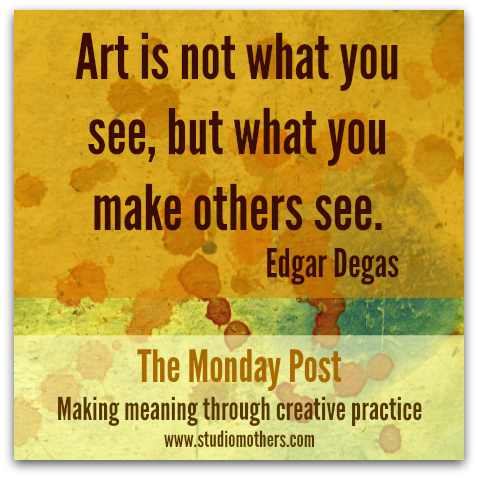
Edgar Degas art quote

A regular creative practice — a daily practice, if possible — is key to staying in touch with how you make meaning. Key to living, not postponing. (Let’s all agree to give up on “someday.”)

What are your plans for creative practice this week? Given the specifics of your schedule, decide on a realistic intention or practice plan — and ink that time in your calendar. The scheduling part is important, because as you know, if you try to “fit it in” around the edges, it generally won’t happen. An intention as simple as “I will write for 20 minutes every morning after breakfast” or “I will sketch a new still life on Wednesday evening” is what it’s all about. If appropriate, use time estimates to containerize your task, which can make a daunting project feel more accessible.

Share your intentions or goals as a comment to this post, and let us know how things went with your creative plans for last week, if you posted to last week’s Monday Post. We use a broad brush in defining creativity, so don’t be shy. We also often include well-being practices that support creativity, such as exercise and journaling.

Putting your intentions on “paper” helps you get clear on what you want to do — and sharing those intentions with this community leverages the motivation of an accountability group. Join us!

:::::::

If you’re an artist or writer with little ones, The Creative Mother’s Guide: Six Creative Practices for the Early Years is the essential survival guide written just for you. Concrete strategies for becoming more creative without adding stress and guilt. Filled with the wisdom of 13 insightful creative mothers; written by a certified creativity coach and mother of five. “Highly recommended.” ~Eric Maisel. 35 pages/$11.98. Available for download here.

Your Creative Intentions: The Monday Post ~ June 16, 2014

Graham Greene quote

A regular creative practice — a daily practice, if possible — is key to staying in touch with how you make meaning. Key to living, not postponing. (Let’s all agree to give up on “someday.”)

What are your plans for creative practice this week? Given the specifics of your schedule, decide on a realistic intention or practice plan — and ink that time in your calendar. The scheduling part is important, because as you know, if you try to “fit it in” around the edges, it generally won’t happen. An intention as simple as “I will write for 20 minutes every morning after breakfast” or “I will sketch a new still life on Wednesday evening” is what it’s all about. If appropriate, use time estimates to containerize your task, which can make a daunting project feel more accessible.

Share your intentions or goals as a comment to this post, and let us know how things went with your creative plans for last week, if you posted to last week’s Monday Post. We use a broad brush in defining creativity, so don’t be shy. We also often include well-being practices that support creativity, such as exercise and journaling.

Putting your intentions on “paper” helps you get clear on what you want to do — and sharing those intentions with this community leverages the motivation of an accountability group. Join us!

:::::::

If you’re an artist or writer with little ones, The Creative Mother’s Guide: Six Creative Practices for the Early Years is the essential survival guide written just for you. Concrete strategies for becoming more creative without adding stress and guilt. Filled with the wisdom of 13 insightful creative mothers; written by a certified creativity coach and mother of five. “Highly recommended.” ~Eric Maisel. 35 pages/$11.98. Available for download here.

Your Creative Intentions: The Monday Post ~ June 9, 2014

George Eliot quote

A regular creative practice — a daily practice, if possible — is key to staying in touch with how you make meaning. Key to living, not postponing. (Let’s all agree to give up on “someday.”)

What are your plans for creative practice this week? Given the specifics of your schedule, decide on a realistic intention or practice plan — and ink that time in your calendar. The scheduling part is important, because as you know, if you try to “fit it in” around the edges, it generally won’t happen. An intention as simple as “I will write for 20 minutes every morning after breakfast” or “I will sketch a new still life on Wednesday evening” is what it’s all about. If appropriate, use time estimates to containerize your task, which can make a daunting project feel more accessible.

Share your intentions or goals as a comment to this post, and let us know how things went with your creative plans for last week, if you posted to last week’s Monday Post. We use a broad brush in defining creativity, so don’t be shy. We also often include well-being practices that support creativity, such as exercise and journaling.

Putting your intentions on “paper” helps you get clear on what you want to do — and sharing those intentions with this community leverages the motivation of an accountability group. Join us!

:::::::

If you’re an artist or writer with little ones, The Creative Mother’s Guide: Six Creative Practices for the Early Years is the essential survival guide written just for you. Concrete strategies for becoming more creative without adding stress and guilt. Filled with the wisdom of 13 insightful creative mothers; written by a certified creativity coach and mother of five. “Highly recommended.” ~Eric Maisel. 35 pages/$11.98. Available for download here.

Your Creative Intentions: The Monday Post ~ June 2, 2014

Robert Genn

Today we honor the legacy of Robert Genn, painter and champion of artists around the world. Bob passed away last week. This loss is felt by so many in the creative community. Always generous, Bob often allowed us to reprint his insightful and inspiring twice-weekly letters here at Studio Mothers. His daughter, Sara, is ably carrying Robert’s legacy into the future. Our thoughts, prayers, and every good wish are with the Genns.


A regular creative practice — a daily practice, if possible — is key to staying in touch with how you make meaning. Key to living, not postponing. (Let’s all agree to give up on “someday.”)

What are your plans for creative practice this week? Given the specifics of your schedule, decide on a realistic intention or practice plan — and ink that time in your calendar. The scheduling part is important, because as you know, if you try to “fit it in” around the edges, it generally won’t happen. An intention as simple as “I will write for 20 minutes every morning after breakfast” or “I will sketch a new still life on Wednesday evening” is what it’s all about. If appropriate, use time estimates to containerize your task, which can make a daunting project feel more accessible.

Share your intentions or goals as a comment to this post, and let us know how things went with your creative plans for last week, if you posted to last week’s Monday Post. We use a broad brush in defining creativity, so don’t be shy. We also often include well-being practices that support creativity, such as exercise and journaling.

Putting your intentions on “paper” helps you get clear on what you want to do — and sharing those intentions with this community leverages the motivation of an accountability group. Join us!

:::::::

If you’re an artist or writer with little ones, The Creative Mother’s Guide: Six Creative Practices for the Early Years is the essential survival guide written just for you. Concrete strategies for becoming more creative without adding stress and guilt. Filled with the wisdom of 13 insightful creative mothers; written by a certified creativity coach and mother of five. “Highly recommended.” ~Eric Maisel. 35 pages/$11.98. Available for download here.

Your Creative Intentions: The Monday Post ~ May 26, 2014

Winslow Homer quote

A regular creative practice — a daily practice, if possible — is key to staying in touch with how you make meaning. Key to living, not postponing. (Let’s all agree to give up on “someday.”)

What are your plans for creative practice this week? Given the specifics of your schedule, decide on a realistic intention or practice plan — and ink that time in your calendar. The scheduling part is important, because as you know, if you try to “fit it in” around the edges, it generally won’t happen. An intention as simple as “I will write for 20 minutes every morning after breakfast” or “I will sketch a new still life on Wednesday evening” is what it’s all about. If appropriate, use time estimates to containerize your task, which can make a daunting project feel more accessible.

Share your intentions or goals as a comment to this post, and let us know how things went with your creative plans for last week, if you posted to last week’s Monday Post. We use a broad brush in defining creativity, so don’t be shy. We also often include well-being practices that support creativity, such as exercise and journaling.

Putting your intentions on “paper” helps you get clear on what you want to do — and sharing those intentions with this community leverages the motivation of an accountability group. Join us!

:::::::

If you’re an artist or writer with little ones, The Creative Mother’s Guide: Six Creative Practices for the Early Years is the essential survival guide written just for you. Concrete strategies for becoming more creative without adding stress and guilt. Filled with the wisdom of 13 insightful creative mothers; written by a certified creativity coach and mother of five. “Highly recommended.” ~Eric Maisel. 35 pages/$11.98. Available for download here.

Your Creative Intentions: The Monday Post ~ May 19, 2014

Kurt Vonnegut quote

A regular creative practice — a daily practice, if possible — is key to staying in touch with how you make meaning. Key to living, not postponing. (Let’s all agree to give up on “someday.”)

What are your plans for creative practice this week? Given the specifics of your schedule, decide on a realistic intention or practice plan — and ink that time in your calendar. The scheduling part is important, because as you know, if you try to “fit it in” around the edges, it generally won’t happen. An intention as simple as “I will write for 20 minutes every morning after breakfast” or “I will sketch a new still life on Wednesday evening” is what it’s all about. If appropriate, use time estimates to containerize your task, which can make a daunting project feel more accessible.

Share your intentions or goals as a comment to this post, and let us know how things went with your creative plans for last week, if you posted to last week’s Monday Post. We use a broad brush in defining creativity, so don’t be shy. We also often include well-being practices that support creativity, such as exercise and journaling.

Putting your intentions on “paper” helps you get clear on what you want to do — and sharing those intentions with this community leverages the motivation of an accountability group. Join us!

:::::::

If you’re an artist or writer with little ones, The Creative Mother’s Guide: Six Creative Practices for the Early Years is the essential survival guide written just for you. Concrete strategies for becoming more creative without adding stress and guilt. Filled with the wisdom of 13 insightful creative mothers; written by a certified creativity coach and mother of five. “Highly recommended.” ~Eric Maisel. 35 pages/$11.98. Available for download here.

Your Creative Intentions: The Monday Post ~ May 12, 2014

John Cleese creativity quote

A regular creative practice — a daily practice, if possible — is key to staying in touch with how you make meaning. Key to living, not postponing. (Let’s all agree to give up on “someday.”)

What are your plans for creative practice this week? Given the specifics of your schedule, decide on a realistic intention or practice plan — and ink that time in your calendar. The scheduling part is important, because as you know, if you try to “fit it in” around the edges, it generally won’t happen. An intention as simple as “I will write for 20 minutes every morning after breakfast” or “I will sketch a new still life on Wednesday evening” is what it’s all about. If appropriate, use time estimates to containerize your task, which can make a daunting project feel more accessible.

Share your intentions or goals as a comment to this post, and let us know how things went with your creative plans for last week, if you posted to last week’s Monday Post. We use a broad brush in defining creativity, so don’t be shy. We also often include well-being practices that support creativity, such as exercise and journaling.

Putting your intentions on “paper” helps you get clear on what you want to do — and sharing those intentions with this community leverages the motivation of an accountability group. Join us!

:::::::

If you’re an artist or writer with little ones, The Creative Mother’s Guide: Six Creative Practices for the Early Years is the essential survival guide written just for you. Concrete strategies for becoming more creative without adding stress and guilt. Filled with the wisdom of 13 insightful creative mothers; written by a certified creativity coach and mother of five. “Highly recommended.” ~Eric Maisel. 35 pages/$11.98. Available for download here.

Your Creative Intentions: The Monday Post ~ May 5, 2014

Jennifer Louden quote

A regular creative practice — a daily practice, if possible — is key to staying in touch with how you make meaning. Key to living, not postponing. (Let’s all agree to give up on “someday.”)

What are your plans for creative practice this week? Given the specifics of your schedule, decide on a realistic intention or practice plan — and ink that time in your calendar. The scheduling part is important, because as you know, if you try to “fit it in” around the edges, it generally won’t happen. An intention as simple as “I will write for 20 minutes every morning after breakfast” or “I will sketch a new still life on Wednesday evening” is what it’s all about. If appropriate, use time estimates to containerize your task, which can make a daunting project feel more accessible.

Share your intentions or goals as a comment to this post, and let us know how things went with your creative plans for last week, if you posted to last week’s Monday Post. We use a broad brush in defining creativity, so don’t be shy. We also often include well-being practices that support creativity, such as exercise and journaling.

Putting your intentions on “paper” helps you get clear on what you want to do — and sharing those intentions with this community leverages the motivation of an accountability group. Join us!

:::::::

If you’re an artist or writer with little ones, The Creative Mother’s Guide: Six Creative Practices for the Early Years is the essential survival guide written just for you. Concrete strategies for becoming more creative without adding stress and guilt. Filled with the wisdom of 13 insightful creative mothers; written by a certified creativity coach and mother of five. “Highly recommended.” ~Eric Maisel. 35 pages/$11.98. Available for download here.

Zoë: Breaking the Silence

Many of you will resonate with this moving portrait from guest blogger Zoë Purdy, a freelance writer and editor. Zoë lives with her husband and three children in Toronto, Canada.

Zoe Purdy

“I’ve been thinking, and I don’t want to be a mother when I grow up,” Sofie announced gravely one day when she was about three years old. “Oh, yeah?” I answered. “Well, you get to decide, of course, but you don’t have to make up your mind until you’re an adult.” She nodded, the relief evident on her face. Sofie is my middle child, cheerful and smart, stubborn and quirky.

“Babies are cute and stuff,” she went on, “but if I have one of my own then I’ll have to take care of it.” “True enough,” I agreed. “And you don’t think you’d enjoy taking care of a baby?” Sofie has always been gentle and empathetic, and of my three children I think of her as the most nurturing. She is the one who wants to bring every ailing insect and earthworm home to be nursed back to health. When our youngest was a baby, Sofie eagerly suggested ways to soothe her when she cried: nursing, cuddling, feeding her an ice-cream sundae, covering her in stickers. It surprised me to hear that she didn’t find the idea of motherhood attractive. “It’s just that there are so many other things that I want to do and if I’m a mother, I won’t get to do them,” she explained in a matter-of-fact tone.

I protested, of course, forcing myself to sound enthusiastic despite the ache I felt gathering in my chest. I told her that being a mother is only one part of who I am, albeit a very important part. There was absolutely no reason why she couldn’t do all those incredible things she imagined and have a baby. I believed what I was saying, but I know that it fell flat. This is why: as a parent, how I engage with life and who I am fundamentally as a person have far more impact on my children than anything I actively try to teach them.

Over the next days and weeks I returned to that conversation again and again. Something bothered me and it wasn’t that my daughter’s vision of her adult life didn’t include children. If she ultimately decides that parenthood isn’t for her, I won’t object. No, what really bothered me was this: my daughter found my life unappealing and I really couldn’t fault her for it. I had let myself be swallowed whole by motherhood and I had barely noticed. When had I given up on doing gratifying and important work myself? When had I decided that it was enough to raise other people who might grow up to do interesting things, to make their own valuable contributions to the world?

Three-year-olds are fickle creatures. You could ask Sofie what she wants to do when she grows up and get a different answer every day of the week. I’m sure that I too entertained a variety of career fantasies as a child, but one thing has remained constant throughout my life: my love of the written word. I have been devoted to writing and books for as long as I can remember.

My mother tells me that I dictated stories to her before I could read and write. Later I took to carrying around a small notebook just like one of my favourite storybook heroines, Harriet the Spy. As we rode the bus I would jot down notes about the other passengers and then spin off into wild speculations about their lives. At school I was known as a daydreamer — I was always busy putting together stories in my head, making up characters and sticking them into different scenarios to see what would happen.

Sofie writingI was a shy child who was constantly told to speak up at school. Whenever a teacher read my writing for the first time, they always remarked with surprise that my voice was so strong and clear. In writing, I was able to try out other lives, to get out of my own head and inhabit someone else’s. It’s not that I was unhappy with my particular circumstances or with who I was; I simply wasn’t content to experience everything through only one set of eyes when books and my imagination gave me the ability to live and to feel so much more broadly and deeply.

I felt a kinship with the protagonist of Roald Dahl’s children’s novel Matilda. I almost cried in recognition when I read these lines: “So Matilda’s strong young mind continued to grow, nurtured by the voices of all those authors who had sent their books out into the world like ships on the sea. These books gave Matilda a hopeful and comforting message: You are not alone.”

As I got older, I never gave any thought to whether I could make my living as a writer. I always assumed that I would find a different way to support myself, but I never doubted that I would continue to write. It was a part of who I am, as basic and incontrovertible as the colour of my eyes.

When I graduated from university with a degree in English literature, I had no firm plan for what would come next. My boyfriend Erik was working on his PhD in chemical engineering at the time, and he spent his days in the lab developing a novel method of aerosol sampling. We joked that our relationship represented the meeting of Arts and Science. While there are plenty of good things to be said about a liberal arts program, it doesn’t prepare you for any specific occupation. Engineering majors become engineers, while English majors become… Englishologists? Baristas? My fellow graduates were all heading off to teacher’s college and law school in droves, but I hadn’t applied to either. I already had a full-time job at a bookstore. While I didn’t envision myself in retail forever, selling books certainly beat selling coffee. I decided to take a year to work and figure out what to do next.

I cast a wide net, sending out resumes and applications to anything that looked remotely appealing. I was particularly interested in a Master of Fine Arts in writing and literature. Spending a couple of years in an MFA program doing nothing but writing and reading was incredibly appealing. Even better, for the first time in my life I would be in the company of other people who thought that these activities were not only legitimate but also important. It was a way to put off adult life and its responsibilities a while longer. There was scholarship money available, and undergraduate teaching or editorial internships could offset the costs further while providing work experience. It wasn’t entirely impractical. I put together my portfolio, rustled up some reference letters, and summoned the courage to send in my applications.

The acceptance letter came that spring, the day after I found out that I was pregnant. Erik and I had agreed that we wanted children, but in that vague way you talk about things that are too far away to feel real. This, however, was real. When the shock wore off, we welcomed the idea of a baby. The timing wasn’t perfect: we weren’t married, we had no money, and Erik was still a student himself. The MFA would have necessitated moving across the country — so for now, school and motherhood were mutually exclusive. I turned down the offer. I told myself that I was postponing it rather than giving up on the idea entirely, but then, as if on cue, I stopped writing. As my belly grew, I imagined my creativity being channeled into the new life within it.

That autumn just after the new school year started, I gave birth to our son. Max entered the world in dramatic fashion, an accidental homebirth. Erik remembered only one thing from our prenatal class and it turned out to be highly relevant: newborns are extremely slippery, and you must keep a firm grasp on them if you don’t want to drop them onto the floor. So on that sunny fall afternoon we went from being two individuals to being a family of three. The world turned upside down. Read more
The True Genius of Mothers

The piece below originally appeared in this month’s Creative Times newsletter.

By Suzi Banks Baum

frost doodleI strive for One Thing Only. But I was not doing one thing only last week at my 18-year-old’s ski race. I’m not sure exactly what I was doing when I left the sidelines and accepted my son’s invitation to step onto the back of his skis for a “little ride” down the mountain. He’d just fallen during his ski race — not badly, but a fall that disqualified him. I wanted to be near him, just to make sure he was okay. That was one thing.

The other thing, the idea of a “little ride,” is what gave me a black eye.

That ride on the slick skis of a slalom racer landed me face-first in the icy snow on the downward slope of a small mountain in the frigid evening air, where I never would have ended up if I’d listened to my inner guidance and stayed home to make soup, but I did not heed that thought, no, there I was on the slopes to cheer. (Something of the crowd’s response told me that cheering is just not done at races. Maybe that is why my boy fell?)

Well. I yelled anyway. I believe in my kids knowing they are being seen.

But I did not yell when I fell.

8452838039_db8de2fe8b_mNo, headfirst in the snow, then sitting up with my cold hand pressed to my hot cheek, I silently beheld the egg blooming under my skin. Now, doing one simple thing, but holding about 10 other thoughts in my mind. “Is anything broken? Why did I listen to my kid? Argh, he makes me nuts! Oh, but he fell too. How is he? Hurt? Embarrassed? Do I need an EMT? What about dinner now? I hate dinner! Will I be able to teach this weekend?”

This morning, I read: “True genius is the ability to hold two contradictory thoughts simultaneously without losing your mind.” Charles Baudelaire wrote that. I’d say he was describing the genius of mother-thoughts entirely.

Some days, I ace thinking one thing at a time. Quiet prevails, the phone is ignored, the Wi-Fi is off, and the laundry dries peacefully on the line, no one needs me, no one is hollering my name from another part of the house, no meal awaits creation, no ski race demands my yelling, just me. Here. With you, the little black tendrils that I coax into letters that make these words that give form to my thoughts.

It is a simple as that.

8348911559_0c808ed79c_mWhen I have been multi-tasking too much, I doodle to settle myself. Then, with my concentration engaged, I can write.

One little black thread of a line leads to another.

And of those thoughts, those layers and layers of mother-thoughts, I work around them, never truly shedding them, but today, I can see they are part of my genius.

Merci, Monsieur Baudelaire. Now please pass the ice pack.

:::::

suzi_banks_baumGrowing up in the Upper Peninsula of Michigan made author, blogger, artist, and fulltime mom Suzi Banks Baum a lover of winter. Not afraid of the blank page, blank canvas, or wide expanse of snow, she makes patterns and trails, worlds and visions with her work. Suzi is about to launch an anthology of writings by women on mothering and creativity entitled An Anthology of Babes: Thirty-six Women Give Motherhood a Voice. The book will be sold at her March 1, 2013 event for the Berkshire Festival of Women Writers called Out of the Mouths of Babes: An Evening of Mothers Reading to Others. You can find Suzi at  Laundry Line Divine or at the 10X10on10 Arts Festival in Pittsfield, MA, this month or better yet, out ice-skating.

How to Do One Thing at a Time

The piece below originally appeared in this month’s Creative Times newsletter.

How to Do One Thing at a TimeIn our do-it-all-now culture, multitasking is considered a skill. Just look at a few help wanted ads online — most job descriptions call for candidates who are able to “multitask.”

But we know from research that multitasking is actually unnatural and inefficient. “Do two or more things simultaneously, and you’ll do none at full capacity.”

Multitasking is the antithesis of the concept of “flow” or “being in the zone,” as identified by Mihaly Csikszentmihalyi. We want flow. It’s an essential part of creativity. Can you be creative when you’re unfocused and distracted? Sure. But the output probably won’t be as great — or feel as good — as what you get when you experience flow.

While it may be a lot to expect to enter flow on a daily basis, it’s not too much to develop work habits that support doing one thing at a time. I recently realized that my own habits had reached new depths of multitasking frenzy. The ugly truth looked something like this:

I’m in the middle of a client project and reflexively check my e-mail. A new action item comes in — something that will only take a couple of minutes to take care of. So I do that quick thing, and in the process remember that I’ve forgotten to order more paper towels. So I go to amazon to order paper towels and realize that I need to order a few other things too. I try to remember what those things are while going to the kitchen to make a fresh cup of tea. I unload the dishwasher while waiting for the kettle to boil. Back at my desk, finishing the amazon order, I get a text from one of my sons asking for a ride home from the train station later. I look at my schedule and realize that I have to make an ATM deposit, which I can do on the way to the train station. I take a few minutes to put together my deposit, which requires me to open my bookkeeping application and make a few entries. I glance at my to-do list and realize that I’m overdue for posting an update to a client’s facebook account. I go to facebook to make the update, but inevitably see my personal notifications at the same time. I get sucked into the feed. I click through to external pages. When a page is slow to load, I open another browser window and read news headlines or take a turn in Words With Friends. I realize it’s getting late and I really need to finish the client project I started with. I work on that for a a short burst before reflexively checking my e-mail again and the whole cycle repeats in some variation.

A pathetic spin on If You Give a Mouse a Cookie. Can you relate?

At the end of the day, I’d have the unpleasant feeling of having been busy for hours without having made much measurable progress — and without having done anything to the best of my ability. That doesn’t work well, and doesn’t feel good.

How had I gone so awry? How could doing just one thing at a time possibly be so complicated? I knew it had something to do with electronic life — and the real-time availability and demands that come with it. I realized that I needed some training wheels. More than training wheels, I needed some duct tape and a hammer. I had to start doing one thing at a time, doing each task until a) it was completed or b) for external or predetermined reasons I had to stop. Duh. But for some reason, I couldn’t get myself to stick to this simple framework.

Enter the time log, which has — literally — transformed my life. We know that dieters who write down everything they eat lose more weight than those who don’t. There’s something about having to fess up — even if just to yourself — that encourages you to stick with your intentions. Here’s what I started doing.

In the “notes” side of my two-page per day planner (although you could use anything — including a sheet of paper) I write down the time and what task I’m starting. When the moment comes that I need/want to do something else, I write down the time and what I’m about to do. I can do anything I want, but I can only do the one thing I last wrote down. If I’m going to change tasks, I have to write it down first.

It’s that simple. Write down the time and what you’re about to do. Then do that one thing, and only that thing, until you need/want to do something else. Then write that thing down. Repeat. If something unexpected comes up and you need to deal with it, write it down. That’s now your one “thing.”

Here’s an excerpt from my log for Friday, February 1, 2013:

10:00 work on Coaching Circle planner
11:31 Client coaching call
12:05 work on Coaching Circle planner
12:26 e-mail Coaching Circle planner to recipients
12:35 check facebook
12:38 check e-mail/respond client messages
12:40 lunch and playtime with Liam
2:27 help Emma with online project
2:57 check e-mail/respond client messages
3:10 draft blog post
3:50 write e-mail to EB
3:55 send messages to coaching clients
4:20 writing practice
5:15 depart for Matthew pickup

You get the idea. The thing is, if I hadn’t been keeping this log, I wouldn’t have stuck with that 90-minute focused work block at 10:00, and I wouldn’t have refrained from checking e-mail during my playtime with Liam. Keeping this log continually reminds me of my commitment to doing just one thing at a time, and to doing it as well as I can. For larger projects, I decide ahead of time that I’m going to spend 60 or 90 minutes on that project. Then, if necessary, I stop and move on to the other things that have to get taken care of.

Want to try it? I encourage you to use paper for your time log, rather than an electronic device. Paper is immediate — and unplugged. It isn’t full of distractions like your phone and computer. And I think there’s something about having a log in your own handwriting that keeps it all “real.”

Do yourself a big favor and close your e-mail client and all social media when you’re not actually “doing” those things. Sticking to your time log is easier without those added temptations.

It also helps to spend some time in the morning outlining what you need and want to get done that day, so that as you finish one thing, you don’t get lost trying to decide on the next. Assign time estimates to each task on your list beforehand. And if you like to take a lot of breaks, by all means, take them! Just write down what you’re doing. Then you don’t run the risk of kidding yourself when your 20-minute break turns into a 2-hour social media binge.

The only downside to the log is that now I feel lost without it. I’ve started using it from the moment I get up in the morning. It helps me avoid OD’ing on Words With Friends when I really want to be doing my Morning Pages.

If you’re motivated to try this, or have another plan for reducing your busy-ness, please share it below!

::::::

If you’re an artist or writer with little ones, The Creative Mother’s Guide: Six Creative Practices for the Early Years is the essential survival guide written just for you. Concrete strategies for becoming more creative without adding stress and guilt. Filled with the wisdom of 13 insightful creative mothers; written by a certified creativity coach and mother of five. “Highly recommended.” ~Eric Maisel. 35 pages/$11.98. Available for download here.

Coach, You Gotta Walk the Talk

CommunityAs a creativity coach, I have an obligation to walk the talk. It’s important to me that my coaching strategies come not just from training and books, but from real-life experience and an active personal practice. If I were to champion the virtues of an early morning creative practice, for example, while I was secretly sleeping until noon and hadn’t flexed a creative muscle in years, I’m pretty sure that most of you would call me a fraud. And I’d have to agree.

In this vein, I recently came to an important decision.

I often work with clients who struggle with extreme shortages of time but are seemingly unable to edit anything out of their schedules. Looking in as an outsider, it’s not hard for me to identify items that might merit the chopping block in order to free up time for creative work. While I can make gentle suggestions, ultimately, those decisions can’t come from me; they have to come from the client’s own shifting perspective. That shift requires looking at everything with openness and a willingness to see beyond “I can’t.”

This year, like many of my clients, I found myself in the position of having too much to do — way too much to do — and being unable to see how I might do less. “But it’s all good, important, relevant stuff!” I told myself. “I’ve already gotten rid of the obvious things!” (Volunteering for the PTA, for example. Duh.)

Many of you know that in January of this year, I opened Open Studio Groton, a brick-and-mortar studio here in Massachusetts, with my dear friend and business partner Ellen Olson-Brown. Open Studio was launched as a place where people in our community could connect, create, and grow. Looking back over the year, we have an amazing collection of successes to celebrate. Connections have been made over ideas, projects, and conversations. Artwork, manuscripts, businesses, friendships — all were created in our cozy little space. Individuals connected and grew in their own ways: some developed into stronger writers through our writers’ workshops and writers’ groups, some became more flexible yogis through Buddha Nest Yoga, some enjoyed our other diverse offerings, from blacksmithing to writing a personal creed. Four talented artists had shows in our space. Personal friendships were formed; our community grew stronger.

To our surprise, our little experiment turned out to be sustainable. We hit the black in late spring, even while we were still refining our elevator speech. (“What *is* Open Studio, anyway?”) But over the months, we often scrambled to keep all of our many studio balls in the air. The marketing alone, as with any business, was a considerable undertaking. (“Crap! I need to write that press release within the hour!”) Other areas of my life were neglected this year. One of you dear readers even wrote to me to inquire about what happened to my formerly monthly newsletter — which was just one of several sacrifices (my garden, my sanity, and the folding of clean laundry were a few others) that I didn’t want to make.

Ellen and I both have other businesses to take care of (in addition to coaching I own an editorial services business — and Ellen is a children’s book author and children’s yoga instructor). Open Studio made so much sense, bringing together so many of our passions — and it still makes sense. But in the space of a week this fall, we went from planning 2013 to acknowledging that if the two of us wanted to stay sane, we needed to pull back, take stock, and reaffirm our primary commitments.

It isn’t easy to let go of something when it’s relevant to your life work, the community supports your efforts, and you’ve already launched on your planned trajectory. But the inescapable truth is that there are only 168 hours in the week. When there are too many things to fit in your box, you have to take something out. In this instance, you can’t actually get a bigger box. It’s really that simple.

And so it became clear that while the studio as a business is sustainable, the time that it requires on both of our parts is not. As I sometimes remind clients, “You can have it all, just not all at once.” My threshold for investing personal energy — and time — has to have a finer filter. Because energy, like time, is finite. I am committed to my personal writing practice. I am committed to my coaching work. I am committed to my editorial business. I am committed to my family. I am committed to myself: reading, yoga, breathing. I am committed to moving slowly enough that I can savor where I’m at. Because if I’m not savoring, what’s the point?

The studio will close on December 31 and Ellen and I will turn with renewed focus to all the other things requiring our attention. But we’ll have a few more ounces of focus at our disposal, and a few more minutes at hand. Hopefully, we’ll do a better job with everything that remains. Most importantly, we’ll celebrate the success of 2012, and affirm the value of doing a little less — and doing it well.

Oh, and by the way. Stay tuned for my next newsletter. 😉

(Ellen Olson-Brown contributed more than a few words to this post. Thanks, E.)