Skip to content

Posts tagged ‘practice’

The Beauty of a Daily Drawing Practice, Sticky-Note Style

Ellen Olson-Brown is a creative inspiration to me in more ways than I can count. She is also a children’s book author, children’s yoga instructor, life-design junkie, Bikram devotee, and mother of twins. I love, love, love what she shares below. Enjoy!

:::::
 

drawing faces practice

Although I’m pretty proud of the collection above, crowing is truly not my motivation for posting. I’m posting this to make a point that is *so* important to me.

Every day this month I’ve made at least one of these little drawings on a sticky note. I find an image of a face online, paint its basic shape in watercolor, and then ink in the details with a permanent marker.

I’ve committed to this because I’ve found that mixing colors and drawing, even just a little, is one of those things that makes the rest of my day more vivid, easier.

Drawing on a sticky note is way less intimidating than using beautiful paper or a canvas, because of both the size and the humbleness of the materials. And committing to doing it every day of a short month quiets the “Should I? Why?” voice without overwhelming me.

So what’s the point I want to prove?

Well, it’s the same point I want desperately to prove when someone new practices near me in a yoga class and says, “But it looks so easy for you! I’ll never be able to do that!” and I have to tell them 1) It’s still *very* hard for me, and 2) I couldn’t touch my toes when I first started yoga. What I can do now has taken me 7 years and at least 1,000 classes of showing up and listening and trying and getting better and getting worse and having faith in the process and learning to add a gentle “yet” to a very bratty, “I can’t!!”

I love these little faces, my wall of friends and encouragers. Are they perfect? No. But I used to be scared, stiff, and frustrated when it came to drawing. I thought making art was a matter of talent, which I simply didn’t have. And now I am making things that bring me joy.

Talent is real. We’re each wired/built to optimize certain kinds of learning, performing.

But way more powerful than talent is openness, faith, courage, hard work, and enough self-kindness to let yourself be a beginner, show up, and see what happens.

Draw, run, sing, cook, garden, dance, do yoga — whatever that thing is that you’re drawn to, get your butt out there and try it 10 or 50 or 3,000 times.

Because you deserve to amaze yourself.

:::::

Meme of the Week

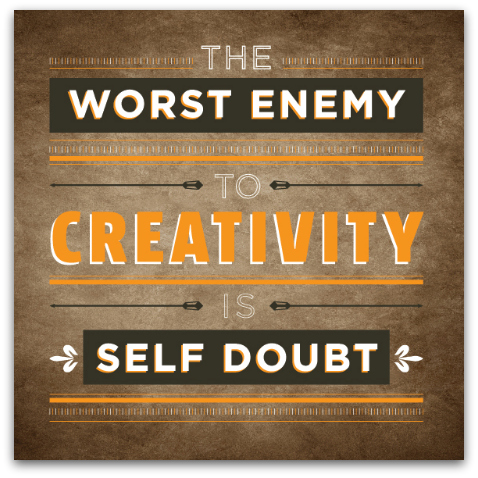
enemy of creativity

As found here. Happy Friday.

:::::

Think you don’t have time for a daily creative practice? Think again

Rick DaddarioEditor’s note: Last December, we received a thought-provoking set of comments on a Monday Post from reader Rick Daddario. Rick, an artist based in Hawaii, had a lot of useful and inspiring things to say about maintaining a daily creative practice. With Rick’s permission, I’m reposting his remarks here. I think you’ll find several gems among these wise words; recommended reading.

timeI agree enthusiastically with the idea of creating daily. I know personally for me when I do not create for a day or two I begin to feel quite “off” in many ways. That can lead to a downward spiral for me. So I find a way to create every day. Writing, taking photographs, working with digital technology or traditional materials — it all counts for me.

I’ve also learned that my day works best if I follow patterns. I’m not die-hard about my patterns, though. It’s easy to shift them on one day when needed and they evolve over time too allow me to fit in the things I need to do around my creating rather than my creating around what I need to do.

As a pattern, I find a way to work with my digital technology each day even though I do not post every day necessarily.

When I decide to get into the traditional materials I find that daily practice is extremely important as well. Sometimes I need to start out slow: 5-minute drawings; 15- to 30-minute paintings. After a few days to a week of this it’s hard to stop at 5 minutes or half an hour and I let my times increase as needed.

Scheduling time is a good way to commit yourself to a practice. Although I’ve found I’m quite contrary and tend to push my times around as needed. I know if I say I will do something to myself I often do the opposite. The doing is what is important however, and I find a way to do my art even if I have to stay up an extra half hour to an hour before sleeping. Yes, I will work tired if that is how I have to get my time in.

Some other ways I’ve heard that work for people and I’ve tried and found fun:

  • When I’m clearing the table after breakfast say, as one of my jobs, I will daily do a sketch of the breakfast table (or one item on it or any part of it) just as I’ve left it before clearing it. It’s a way for me to allow myself the time to draw. I have to draw before I do the dishes or I lose my visual. I may set a timer if I need to limit my time but the commitment to drawing that table or any part of it gives me the permission to sit and draw BEFORE I do the dishes. Way fun on that. This kind of practice can be used with any task, per the bullets below.
  • Shopping: Draw/photograph the shopping bags before you put everything away (maybe the milk and frozen items can go in the fridge and then I draw). You can take an item or two out to draw too. Still life with packages, bottles, cans, or fresh veggies/fruits.
  • Weeding: Draw/photograph the tools before you weed (after, I’m usually a bit dusty mucky).
  • Gardening, as in watering and general: A bouquet of flowers or the veggies/fruit etc. that you pick are great subjects.
  • Laundry: The pile of clothes. Or clothes hug up to dry. Or folded.
  • Kids’ toys: One a day. Or as they lay. Or as they look put away.
  • Seasonal: Gift wrapping: before, during, or after wrapping a present.

When it’s writing rather than drawing/painting/photos that I’m after the same practice can work. Write from the moments the items suggest themselves or the thoughts that come up while you were working. Write of that moment or something those items bring up in a memory, or fantasize. . . .

I’m sure you get the idea.

Once I make creating part of my daily life it’s like any other job or chore I have to do. My day is not done until I do it. And if it’s fun, I’ll want to do it again. So I do what is fun for me. I play with line, or light, or shapes, or color etc. If it’s writing, I may play with writing forms, or shotgun writings, or 55-word short stories, etc. Way fun on that. And seasonal fun on all too.

I am passionate about creating daily. Even 5 minutes count — writing, drawing, or painting. 10 or 15 minutes even better. Just do it, though. That’s what what is important. Start. Just start and do it.

Don’t think you can draw/write something in 5 minutes?? Try this: Set a timer for 1 minute. See how much you can draw (or write on) something in 1 minute. When the timer goes off, click it and start on a new page again on the same thing. Again when the timer goes off, click it and repeat the process until you have 5 drawings (or 5 sentences or observations in words). Try to push yourself to get more down each time. The light, the shape edges, the lines. Now set the timer for 5 minutes and see how much you can get down. That’s a total of 10 minutes — but once you understand that you actually can get the entire thing down in some way in 5 minutes you can do this with anything and take only 5 minutes (or 10 when you have it).

We all have hurry-up-and-wait times. The doctor’s office, picking up a child from school or play time, the bus stop (local and long distance), car pool, train and plane ports. Bring your pencil and pad (hard back, double wired, small like 6 x 6 is my preference — or my iPad with drawing apps) and sketch/draw/write for 5 minutes.

Sit in the car and draw before you go in to shop, a hair appointment, the dentist, the visit with a friend. Or even on your way to work.

At one time I got so I’d leave 5 minutes early just so I could flip my pad open and draw. Then it was 15 minutes early to any activity and half an hour to 45 minutes early to work (at a photo lab). I could stop along the way or in the parking lot finding different views even there each day. Or sit on a bench or low wall on the walk to work.

Eventually I had to set a time when I stopped like this or I’d end up running over time and become late for my appointment or work — that happened once and I started the timer idea. Even then I’d push the timing, though.

It made my day to get a drawing in before work and then one after work that could be untimed. After work the drawing times were often shorter because I was tired. However, I felt a lot better for sitting and letting go in a drawing (or writing) for those few minutes.

Yeah, get me rambling along these lines and I reel out the things that are fun fun for me.

Aloha.

— Rick

Check out Rick’s work at his blog and his website. Thank you, Rick!
Your Creative Intentions: The Monday Post ~ November 11, 2013

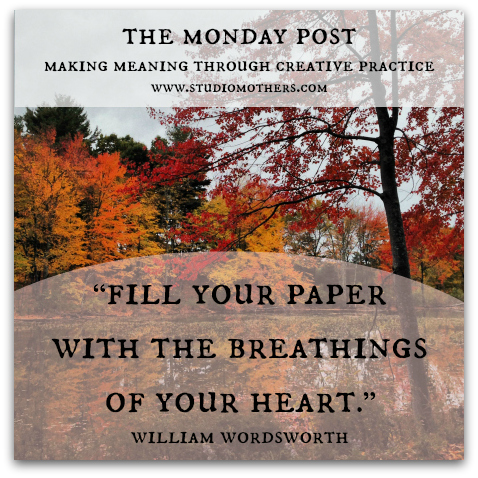
William Wordsworth

Commit to a regular creativity practice. Regularity — a daily practice, if possible — is key to staying in touch with how you make meaning.

What are your plans for creative practice this week? Given the specifics of your schedule, decide on a realistic intention or practice plan — and ink that time in your calendar. The scheduling part is important, because as you know, if you try to “fit it in” around the edges, it generally won’t happen. An intention as simple as “I will write for 20 minutes every morning after breakfast” or “I will sketch a new still life on Wednesday evening” is what it’s all about. If appropriate, use time estimates to containerize your task, which can make a daunting project feel more accessible.

Share your intentions or goals as a comment to this post, and let us know how things went with your creative plans for last week, if you posted to last week’s Monday Post. We use a broad brush in defining creativity, so don’t be shy. We also often include well-being practices that support creativity, such as exercise and journaling.

Putting your intentions on “paper” helps you get clear on what you want to do — and sharing those intentions with this community leverages the motivation of an accountability group. Join us!

:::::::

If you’re an artist or writer with little ones, The Creative Mother’s Guide: Six Creative Practices for the Early Years is the essential survival guide written just for you. Concrete strategies for becoming more creative without adding stress and guilt. Filled with the wisdom of 13 insightful creative mothers; written by a certified creativity coach and mother of five. “Highly recommended.” ~Eric Maisel. 35 pages/$11.98. Available for download here.

Your Creative Intentions: The Monday Post ~ November 4, 2013

Samuel Beckett

Commit to a regular creativity practice. Regularity — a daily practice, if possible — is key to staying in touch with how you make meaning.

What are your plans for creative practice this week? Given the specifics of your schedule, decide on a realistic intention or practice plan — and ink that time in your calendar. The scheduling part is important, because as you know, if you try to “fit it in” around the edges, it generally won’t happen. An intention as simple as “I will write for 20 minutes every morning after breakfast” or “I will sketch a new still life on Wednesday evening” is what it’s all about. If appropriate, use time estimates to containerize your task, which can make a daunting project feel more accessible.

Share your intentions or goals as a comment to this post, and let us know how things went with your creative plans for last week, if you posted to last week’s Monday Post. We use a broad brush in defining creativity, so don’t be shy. We also often include well-being practices that support creativity, such as exercise and journaling.

Putting your intentions on “paper” helps you get clear on what you want to do — and sharing those intentions with this community leverages the motivation of an accountability group. Join us!

:::::::

If you’re an artist or writer with little ones, The Creative Mother’s Guide: Six Creative Practices for the Early Years is the essential survival guide written just for you. Concrete strategies for becoming more creative without adding stress and guilt. Filled with the wisdom of 13 insightful creative mothers; written by a certified creativity coach and mother of five. “Highly recommended.” ~Eric Maisel. 35 pages/$11.98. Available for download here.

Your Creative Intentions: The Monday Post ~ October 28, 2013

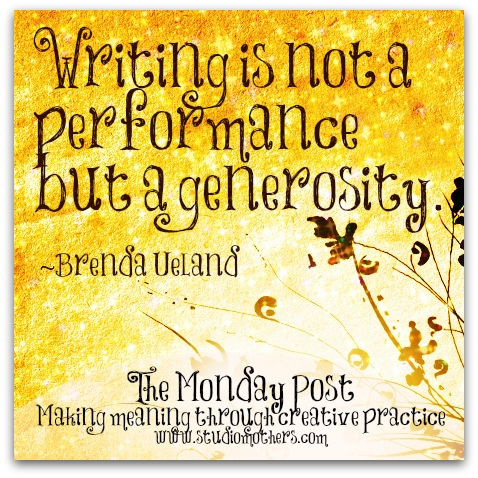
Monday_Post_Brenda_Ueland

Commit to a regular creativity practice. Regularity — a daily practice, if possible — is key to staying in touch with how you make meaning.

What are your plans for creative practice this week? Given the specifics of your schedule, decide on a realistic intention or practice plan — and ink that time in your calendar. The scheduling part is important, because as you know, if you try to “fit it in” around the edges, it generally won’t happen. An intention as simple as “I will write for 20 minutes every morning after breakfast” or “I will sketch a new still life on Wednesday evening” is what it’s all about. If appropriate, use time estimates to containerize your task, which can make a daunting project feel more accessible.

Share your intentions or goals as a comment to this post, and let us know how things went with your creative plans for last week, if you posted to last week’s Monday Post. We use a broad brush in defining creativity, so don’t be shy. We also often include well-being practices that support creativity, such as exercise and journaling.

Putting your intentions on “paper” helps you get clear on what you want to do — and sharing those intentions with this community leverages the motivation of an accountability group. Join us!

:::::::

If you’re an artist or writer with little ones, The Creative Mother’s Guide: Six Creative Practices for the Early Years is the essential survival guide written just for you. Concrete strategies for becoming more creative without adding stress and guilt. Filled with the wisdom of 13 insightful creative mothers; written by a certified creativity coach and mother of five. “Highly recommended.” ~Eric Maisel. 35 pages/$11.98. Available for download here.

Meme of the Week

How to be an artist

As seen at Gwarlingo.

Happy Friday.

:::::

Your Creative Intentions: The Monday Post ~ October 21, 2013

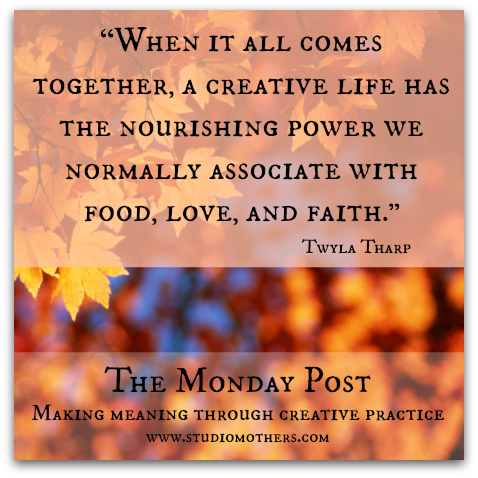
Twyla Tharp

Commit to a regular creativity practice. Regularity — a daily practice, if possible — is key to staying in touch with how you make meaning.

What are your plans for creative practice this week? Given the specifics of your schedule, decide on a realistic intention or practice plan — and ink that time in your calendar. The scheduling part is important, because as you know, if you try to “fit it in” around the edges, it generally won’t happen. An intention as simple as “I will write for 20 minutes every morning after breakfast” or “I will sketch a new still life on Wednesday evening” is what it’s all about. If appropriate, use time estimates to containerize your task, which can make a daunting project feel more accessible.

Share your intentions or goals as a comment to this post, and let us know how things went with your creative plans for last week, if you posted to last week’s Monday Post. We use a broad brush in defining creativity, so don’t be shy. We also often include well-being practices that support creativity, such as exercise and journaling.

Putting your intentions on “paper” helps you get clear on what you want to do — and sharing those intentions with this community leverages the motivation of an accountability group. Join us!

:::::::

If you’re an artist or writer with little ones, The Creative Mother’s Guide: Six Creative Practices for the Early Years is the essential survival guide written just for you. Concrete strategies for becoming more creative without adding stress and guilt. Filled with the wisdom of 13 insightful creative mothers; written by a certified creativity coach and mother of five. “Highly recommended.” ~Eric Maisel. 35 pages/$11.98. Available for download here.

Meme of the Week

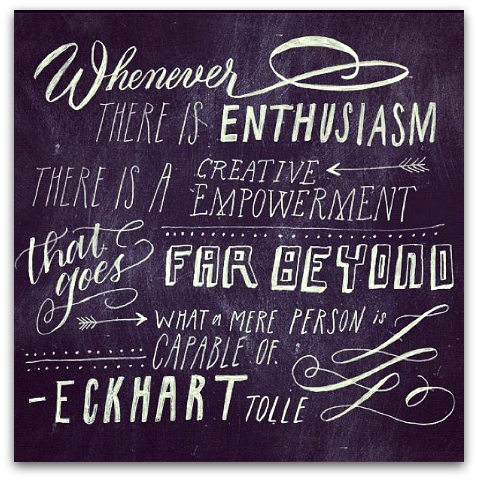
Eckhart Tolle quote

Happy Friday.

:::::

Your Creative Intentions: The Monday Post ~ October 14, 2013

Thomas Vasquez quote

Commit to a regular creativity practice. Regularity — a daily practice, if possible — is key to staying in touch with how you make meaning.

What are your plans for creative practice this week? Given the specifics of your schedule, decide on a realistic intention or practice plan — and ink that time in your calendar. The scheduling part is important, because as you know, if you try to “fit it in” around the edges, it generally won’t happen. An intention as simple as “I will write for 20 minutes every morning after breakfast” or “I will sketch a new still life on Wednesday evening” is what it’s all about. If appropriate, use time estimates to containerize your task, which can make a daunting project feel more accessible.

Share your intentions or goals as a comment to this post, and let us know how things went with your creative plans for last week, if you posted to last week’s Monday Post. We use a broad brush in defining creativity, so don’t be shy. We also often include well-being practices that support creativity, such as exercise and journaling.

Putting your intentions on “paper” helps you get clear on what you want to do — and sharing those intentions with this community leverages the motivation of an accountability group. Join us!

:::::::

If you’re an artist or writer with little ones, The Creative Mother’s Guide: Six Creative Practices for the Early Years is the essential survival guide written just for you. Concrete strategies for becoming more creative without adding stress and guilt. Filled with the wisdom of 13 insightful creative mothers; written by a certified creativity coach and mother of five. “Highly recommended.” ~Eric Maisel. 35 pages/$11.98. Available for download here.

Meme of the Week

Inspiring creativity

Happy Friday.

:::::

Your Creative Intentions: The Monday Post ~ October 7, 2013

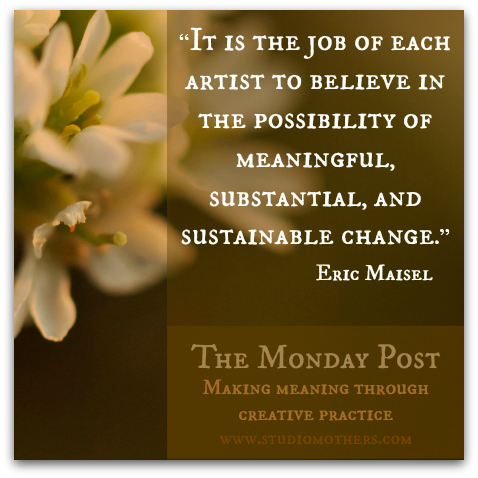
Eric Maisel quote

Commit to a regular creativity practice. Regularity — a daily practice, if possible — is key to staying in touch with how you make meaning.

What are your plans for creative practice this week? Given the specifics of your schedule, decide on a realistic intention or practice plan — and ink that time in your calendar. The scheduling part is important, because as you know, if you try to “fit it in” around the edges, it generally won’t happen. An intention as simple as “I will write for 20 minutes every morning after breakfast” or “I will sketch a new still life on Wednesday evening” is what it’s all about. If appropriate, use time estimates to containerize your task, which can make a daunting project feel more accessible.

Share your intentions or goals as a comment to this post, and let us know how things went with your creative plans for last week, if you posted to last week’s Monday Post. We use a broad brush in defining creativity, so don’t be shy. We also often include well-being practices that support creativity, such as exercise and journaling.

Putting your intentions on “paper” helps you get clear on what you want to do — and sharing those intentions with this community leverages the motivation of an accountability group. Join us!

:::::::

If you’re an artist or writer with little ones, The Creative Mother’s Guide: Six Creative Practices for the Early Years is the essential survival guide written just for you. Concrete strategies for becoming more creative without adding stress and guilt. Filled with the wisdom of 13 insightful creative mothers; written by a certified creativity coach and mother of five. “Highly recommended.” ~Eric Maisel. 35 pages/$11.98. Available for download here.