Skip to content

Posts tagged ‘practice’

Creative Imperfection Is Perfect

The following is an excerpt from my e-book short, The Creative Mother’s Guide: Six Creative Practices for the Early Years.

Imperfection Is PerfectPerfectionists tend to experience a greater amount of creative resistance than those who are more easy-going. I don’t have scientific data to back up this observation, but reams of anecdotal observation tell me I’m right. Unwilling to sacrifice in any area where someone else is depending on them and unwilling to settle for less, perfectionist creatives often avoid creativity if they can’t have it on their own, ideal terms.

Research does show that perfectionists are more likely to experience burnout, stress, and even depression. If you tend toward perfectionism, you might benefit from trying to readjust that framework, if only in a few areas of your life. The bar may be too high on quality, and it may also be too high on quantity. Or you may be too conditional. For example, if you tell yourself that you can’t write, paint, or create unless you have X hours of uninterrupted solitude — after your house is clean and the laundry’s done — be prepared to wait. If you have children, be prepared to wait for a long time forever.

As time management and productivity guru David Allen puts it, “You can do anything. You just can’t do everything.” The good news is that you don’t have to move mountains or make big sacrifices in order to live a more creatively fulfilling life. Instead of beating yourself up for what you’re not doing, set the stage for success. Your success: feeling creatively satisfied with your ability to “make something” given the constraints and gifts that come with your particular situation. It’s the making part that matters.

Perfectionist standards indicate a focus on outcome, rather than process. Accept that practice is not about perfection. It’s about practice. Is there anything in life that we can knock out of the park on the first try, and thereafter never have to practice, ever? (If there is, please inform me immediately!) Anything that’s worth doing is worth doing. Chalk up those perfectionist voices to the brain noise that prevents us from doing. Forget about perfection. Instead, just do.

And if you end up with a garbage can or recycling bin full of “failures,” so much the better. That basketful of rejects is a lot more useful to your creative journey — and a lot more important to your well-being — than a basketful of nothing.

:::::::

More where this came from: If you’re an artist or writer with little ones, The Creative Mother’s Guide: Six Creative Practices for the Early Years is the essential survival guide written just for you. Concrete strategies for becoming more creative without adding stress and guilt. Filled with the wisdom of 13 insightful creative mothers; written by a certified creativity coach and mother of five. “Highly recommended.” ~Eric Maisel. 35 pages/$11.98. Available for download here.

Your Creative Intentions: The Monday Post ~ February 25, 2013

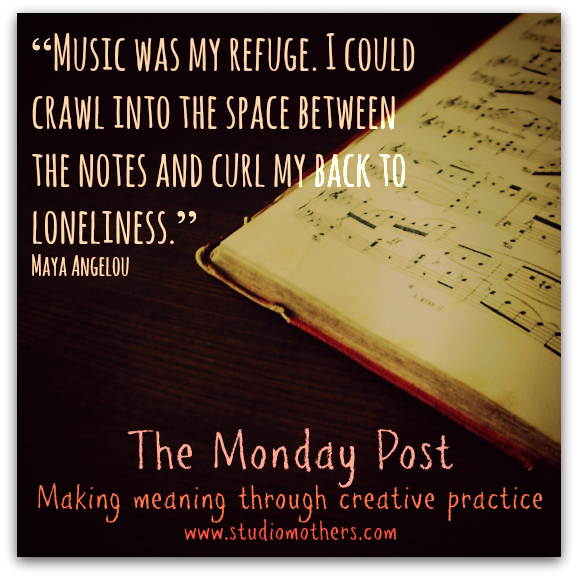
Maya Angelou quote

If you aren’t doing your creative work as often as you’d like, recommit to a regular creativity practice. Regularity — a daily practice, if possible — is one of the best ways to stay in touch with how you make meaning. Can a regular creative practice be part of your intentions for 2013?

What are your plans for creative practice this week? Given the specifics of your schedule, decide on a realistic intention or practice plan — and ink that time in your calendar. The scheduling part is important, because as you know, if you try to “fit it in” around the edges, it generally won’t happen. An intention as simple as “I will write for 20 minutes every morning after breakfast” or “I will sketch a new still life on Wednesday evening” is what it’s all about.

Share your intentions or goals as a comment to this post, and let us know how things went with your creative plans for last week, if you posted to last week’s Monday Post. We use a broad brush in defining creativity, so don’t be shy. We also often include well-being practices that support creativity, such as exercise and journaling.

Putting your intentions on “paper” helps you get clear on what you want to do — and sharing those intentions with this community leverages the motivation of an accountability group. Join us!

:::::::

If you’re an artist or writer with little ones, The Creative Mother’s Guide: Six Creative Practices for the Early Years is the essential survival guide written just for you. Concrete strategies for becoming more creative without adding stress and guilt. Filled with the wisdom of 13 insightful creative mothers; written by a certified creativity coach and mother of five. “Highly recommended.” ~Eric Maisel. 35 pages/$11.98. Available for download here.

The True Genius of Mothers

The piece below originally appeared in this month’s Creative Times newsletter.

By Suzi Banks Baum

frost doodleI strive for One Thing Only. But I was not doing one thing only last week at my 18-year-old’s ski race. I’m not sure exactly what I was doing when I left the sidelines and accepted my son’s invitation to step onto the back of his skis for a “little ride” down the mountain. He’d just fallen during his ski race — not badly, but a fall that disqualified him. I wanted to be near him, just to make sure he was okay. That was one thing.

The other thing, the idea of a “little ride,” is what gave me a black eye.

That ride on the slick skis of a slalom racer landed me face-first in the icy snow on the downward slope of a small mountain in the frigid evening air, where I never would have ended up if I’d listened to my inner guidance and stayed home to make soup, but I did not heed that thought, no, there I was on the slopes to cheer. (Something of the crowd’s response told me that cheering is just not done at races. Maybe that is why my boy fell?)

Well. I yelled anyway. I believe in my kids knowing they are being seen.

But I did not yell when I fell.

8452838039_db8de2fe8b_mNo, headfirst in the snow, then sitting up with my cold hand pressed to my hot cheek, I silently beheld the egg blooming under my skin. Now, doing one simple thing, but holding about 10 other thoughts in my mind. “Is anything broken? Why did I listen to my kid? Argh, he makes me nuts! Oh, but he fell too. How is he? Hurt? Embarrassed? Do I need an EMT? What about dinner now? I hate dinner! Will I be able to teach this weekend?”

This morning, I read: “True genius is the ability to hold two contradictory thoughts simultaneously without losing your mind.” Charles Baudelaire wrote that. I’d say he was describing the genius of mother-thoughts entirely.

Some days, I ace thinking one thing at a time. Quiet prevails, the phone is ignored, the Wi-Fi is off, and the laundry dries peacefully on the line, no one needs me, no one is hollering my name from another part of the house, no meal awaits creation, no ski race demands my yelling, just me. Here. With you, the little black tendrils that I coax into letters that make these words that give form to my thoughts.

It is a simple as that.

8348911559_0c808ed79c_mWhen I have been multi-tasking too much, I doodle to settle myself. Then, with my concentration engaged, I can write.

One little black thread of a line leads to another.

And of those thoughts, those layers and layers of mother-thoughts, I work around them, never truly shedding them, but today, I can see they are part of my genius.

Merci, Monsieur Baudelaire. Now please pass the ice pack.

:::::

suzi_banks_baumGrowing up in the Upper Peninsula of Michigan made author, blogger, artist, and fulltime mom Suzi Banks Baum a lover of winter. Not afraid of the blank page, blank canvas, or wide expanse of snow, she makes patterns and trails, worlds and visions with her work. Suzi is about to launch an anthology of writings by women on mothering and creativity entitled An Anthology of Babes: Thirty-six Women Give Motherhood a Voice. The book will be sold at her March 1, 2013 event for the Berkshire Festival of Women Writers called Out of the Mouths of Babes: An Evening of Mothers Reading to Others. You can find Suzi at  Laundry Line Divine or at the 10X10on10 Arts Festival in Pittsfield, MA, this month or better yet, out ice-skating.

Your Creative Intentions: The Monday Post ~ February 18, 2013

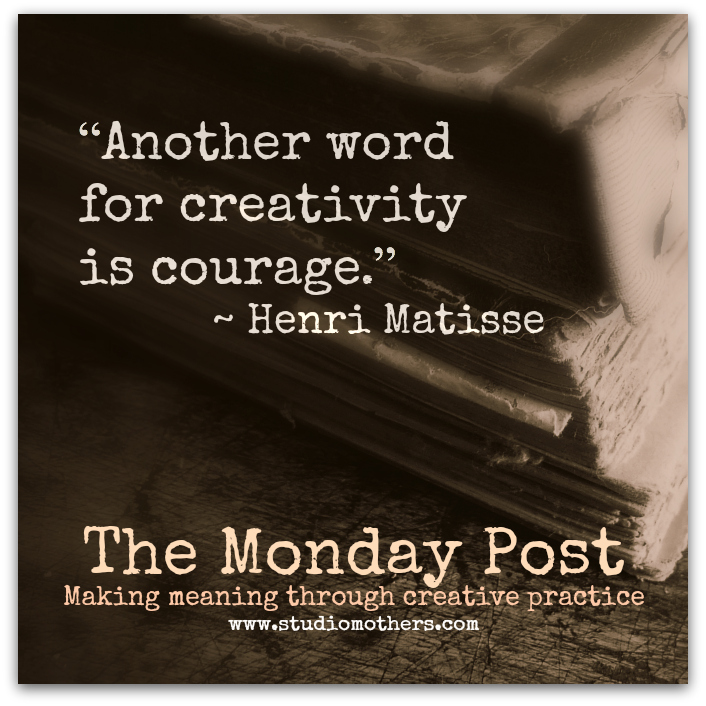
Monday Post Henri Matisse quote

If you aren’t doing your creative work as often as you’d like, recommit to a regular creativity practice. Regularity — a daily practice, if possible — is one of the best ways to stay in touch with how you make meaning. Can a regular creative practice be part of your intentions for 2013?

What are your plans for creative practice this week? Given the specifics of your schedule, decide on a realistic intention or practice plan — and ink that time in your calendar. The scheduling part is important, because as you know, if you try to “fit it in” around the edges, it generally won’t happen. An intention as simple as “I will write for 20 minutes every morning after breakfast” or “I will sketch a new still life on Wednesday evening” is what it’s all about.

Share your intentions or goals as a comment to this post, and let us know how things went with your creative plans for last week, if you posted to last week’s Monday Post. We use a broad brush in defining creativity, so don’t be shy. We also often include well-being practices that support creativity, such as exercise and journaling.

Putting your intentions on “paper” helps you get clear on what you want to do — and sharing those intentions with this community leverages the motivation of an accountability group. Join us!

:::::::

If you’re an artist or writer with little ones, The Creative Mother’s Guide: Six Creative Practices for the Early Years is the essential survival guide written just for you. Concrete strategies for becoming more creative without adding stress and guilt. Filled with the wisdom of 13 insightful creative mothers; written by a certified creativity coach and mother of five. “Highly recommended.” ~Eric Maisel. 35 pages/$11.98. Available for download here.

How to Do One Thing at a Time

The piece below originally appeared in this month’s Creative Times newsletter.

How to Do One Thing at a TimeIn our do-it-all-now culture, multitasking is considered a skill. Just look at a few help wanted ads online — most job descriptions call for candidates who are able to “multitask.”

But we know from research that multitasking is actually unnatural and inefficient. “Do two or more things simultaneously, and you’ll do none at full capacity.”

Multitasking is the antithesis of the concept of “flow” or “being in the zone,” as identified by Mihaly Csikszentmihalyi. We want flow. It’s an essential part of creativity. Can you be creative when you’re unfocused and distracted? Sure. But the output probably won’t be as great — or feel as good — as what you get when you experience flow.

While it may be a lot to expect to enter flow on a daily basis, it’s not too much to develop work habits that support doing one thing at a time. I recently realized that my own habits had reached new depths of multitasking frenzy. The ugly truth looked something like this:

I’m in the middle of a client project and reflexively check my e-mail. A new action item comes in — something that will only take a couple of minutes to take care of. So I do that quick thing, and in the process remember that I’ve forgotten to order more paper towels. So I go to amazon to order paper towels and realize that I need to order a few other things too. I try to remember what those things are while going to the kitchen to make a fresh cup of tea. I unload the dishwasher while waiting for the kettle to boil. Back at my desk, finishing the amazon order, I get a text from one of my sons asking for a ride home from the train station later. I look at my schedule and realize that I have to make an ATM deposit, which I can do on the way to the train station. I take a few minutes to put together my deposit, which requires me to open my bookkeeping application and make a few entries. I glance at my to-do list and realize that I’m overdue for posting an update to a client’s facebook account. I go to facebook to make the update, but inevitably see my personal notifications at the same time. I get sucked into the feed. I click through to external pages. When a page is slow to load, I open another browser window and read news headlines or take a turn in Words With Friends. I realize it’s getting late and I really need to finish the client project I started with. I work on that for a a short burst before reflexively checking my e-mail again and the whole cycle repeats in some variation.

A pathetic spin on If You Give a Mouse a Cookie. Can you relate?

At the end of the day, I’d have the unpleasant feeling of having been busy for hours without having made much measurable progress — and without having done anything to the best of my ability. That doesn’t work well, and doesn’t feel good.

How had I gone so awry? How could doing just one thing at a time possibly be so complicated? I knew it had something to do with electronic life — and the real-time availability and demands that come with it. I realized that I needed some training wheels. More than training wheels, I needed some duct tape and a hammer. I had to start doing one thing at a time, doing each task until a) it was completed or b) for external or predetermined reasons I had to stop. Duh. But for some reason, I couldn’t get myself to stick to this simple framework.

Enter the time log, which has — literally — transformed my life. We know that dieters who write down everything they eat lose more weight than those who don’t. There’s something about having to fess up — even if just to yourself — that encourages you to stick with your intentions. Here’s what I started doing.

In the “notes” side of my two-page per day planner (although you could use anything — including a sheet of paper) I write down the time and what task I’m starting. When the moment comes that I need/want to do something else, I write down the time and what I’m about to do. I can do anything I want, but I can only do the one thing I last wrote down. If I’m going to change tasks, I have to write it down first.

It’s that simple. Write down the time and what you’re about to do. Then do that one thing, and only that thing, until you need/want to do something else. Then write that thing down. Repeat. If something unexpected comes up and you need to deal with it, write it down. That’s now your one “thing.”

Here’s an excerpt from my log for Friday, February 1, 2013:

10:00 work on Coaching Circle planner
11:31 Client coaching call
12:05 work on Coaching Circle planner
12:26 e-mail Coaching Circle planner to recipients
12:35 check facebook
12:38 check e-mail/respond client messages
12:40 lunch and playtime with Liam
2:27 help Emma with online project
2:57 check e-mail/respond client messages
3:10 draft blog post
3:50 write e-mail to EB
3:55 send messages to coaching clients
4:20 writing practice
5:15 depart for Matthew pickup

You get the idea. The thing is, if I hadn’t been keeping this log, I wouldn’t have stuck with that 90-minute focused work block at 10:00, and I wouldn’t have refrained from checking e-mail during my playtime with Liam. Keeping this log continually reminds me of my commitment to doing just one thing at a time, and to doing it as well as I can. For larger projects, I decide ahead of time that I’m going to spend 60 or 90 minutes on that project. Then, if necessary, I stop and move on to the other things that have to get taken care of.

Want to try it? I encourage you to use paper for your time log, rather than an electronic device. Paper is immediate — and unplugged. It isn’t full of distractions like your phone and computer. And I think there’s something about having a log in your own handwriting that keeps it all “real.”

Do yourself a big favor and close your e-mail client and all social media when you’re not actually “doing” those things. Sticking to your time log is easier without those added temptations.

It also helps to spend some time in the morning outlining what you need and want to get done that day, so that as you finish one thing, you don’t get lost trying to decide on the next. Assign time estimates to each task on your list beforehand. And if you like to take a lot of breaks, by all means, take them! Just write down what you’re doing. Then you don’t run the risk of kidding yourself when your 20-minute break turns into a 2-hour social media binge.

The only downside to the log is that now I feel lost without it. I’ve started using it from the moment I get up in the morning. It helps me avoid OD’ing on Words With Friends when I really want to be doing my Morning Pages.

If you’re motivated to try this, or have another plan for reducing your busy-ness, please share it below!

::::::

If you’re an artist or writer with little ones, The Creative Mother’s Guide: Six Creative Practices for the Early Years is the essential survival guide written just for you. Concrete strategies for becoming more creative without adding stress and guilt. Filled with the wisdom of 13 insightful creative mothers; written by a certified creativity coach and mother of five. “Highly recommended.” ~Eric Maisel. 35 pages/$11.98. Available for download here.
Your Creative Intentions: The Monday Post ~ February 11, 2013

Thoreau quote

If you aren’t doing your creative work as often as you’d like, recommit to a regular creativity practice. Regularity — a daily practice, if possible — is one of the best ways to stay in touch with how you make meaning. Can a regular creative practice be part of your intentions for 2013?

What are your plans for creative practice this week? Given the specifics of your schedule, decide on a realistic intention or practice plan — and ink that time in your calendar. The scheduling part is important, because as you know, if you try to “fit it in” around the edges, it generally won’t happen. An intention as simple as “I will write for 20 minutes every morning after breakfast” or “I will sketch a new still life on Wednesday evening” is what it’s all about.

Share your intentions or goals as a comment to this post, and let us know how things went with your creative plans for last week, if you posted to last week’s Monday Post. We use a broad brush in defining creativity, so don’t be shy. We also often include well-being practices that support creativity, such as exercise and journaling.

Putting your intentions on “paper” helps you get clear on what you want to do — and sharing those intentions with this community leverages the motivation of an accountability group. Join us!

:::::::

If you’re an artist or writer with little ones, The Creative Mother’s Guide: Six Creative Practices for the Early Years is the essential survival guide written just for you. Concrete strategies for becoming more creative without adding stress and guilt. Filled with the wisdom of 13 insightful creative mothers; written by a certified creativity coach and mother of five. “Highly recommended.” ~Eric Maisel. 35 pages/$11.98. Available for download here.

Your Creative Intentions: The Monday Post ~ February 4, 2013

Simone Weil Monday Post

Now is the time to recommit to a regular creativity practice. Regularity — a daily practice, if possible — is one of the best ways to stay in touch with how you make meaning. Can a regular creative practice be part of your intentions for 2013?

What are your plans for creative practice this week? Given the specifics of your schedule, decide on a realistic intention or practice plan — and ink that time in your calendar. The scheduling part is important, because as you know, if you try to “fit it in” around the edges, it generally won’t happen. An intention as simple as “I will write for 20 minutes every morning after breakfast” or “I will sketch a new still life on Wednesday evening” is what it’s all about.

Share your intentions or goals as a comment to this post, and let us know how things went with your creative plans for last week, if you posted to last week’s Monday Post. We use a broad brush in defining creativity, so don’t be shy. We also often include well-being practices that support creativity, such as exercise and journaling.

Putting your intentions on “paper” helps you get clear on what you want to do — and sharing those intentions with this community leverages the motivation of an accountability group. Join us!

:::::::

If you’re an artist or writer with little ones, The Creative Mother’s Guide: Six Creative Practices for the Early Years is the essential survival guide written just for you. Concrete strategies for becoming more creative without adding stress and guilt. Filled with the wisdom of 13 insightful creative mothers; written by a certified creativity coach and mother of five. “Highly recommended.” ~Eric Maisel. 35 pages/$11.98. Available for download here.

My New Rule: The Power of One (wherein I attempt to be slightly less manic)

The piece below originally appeared in this month’s Creative Times newsletter.

The Power of One

For many months now — or is it years? — I’ve been on a quest. A quest to slow things down. A quest to stop running around like a maniac from calendar item to calendar item. A quest to breathe more and do less. And I’m pretty sure you know what I’m talking about.

After being over-booked and over-worked for way too long, with too many days like this one, I finally realized that I have to stop overestimating the bandwidth of any given day. I have a bad habit of continually anticipating more time than I actually have, not leaving room for the significant amount of unexpected and last-minute requests and events that force me to shoe-horn my “regular” work into the margins. I decided to take drastic action with my schedule.

At the beginning of this month, I enacted a One Thing Only rule. This means that I only schedule one thing on any given day. There are still all of the regular activities — kids, domestic life, errands, hours of laptop-based work — but any kind of one-off that gets written in my calendar has to stand alone. This means that if I have a client meeting in the afternoon, I don’t schedule anything else for that day. If I decide to schedule morning coffee with a friend, I leave the afternoon unbooked. If I have a dentist appointment just after lunch, the rest of the day is locked down. Crazy, huh?

It hasn’t been easy. I still look at my planner and say “Well, on Thursday I only have a 30-minute coaching call at 11:00. I can fit an hour-long editorial conference call in at 2:00, right?” I mean, who wouldn’t do that? But the truth is, that with two or more events scheduled in any given day, reality eats up the rest of my schedule. I end up losing the hours of actual work time that I’d planned on. By the time I crawl into bed, I’ve been busy all day but I haven’t crossed off even half of the action items on my list. As a freelancer and a coach, I don’t get paid without billable time — and I don’t get billable time unless I’m at my desk, uninterrupted, doing my work.

Working for yourself means that you have the luxury — and the potential curse — of managing your time in the way that works best for you. If you’re a fulltime employee at an office, your time isn’t entirely within your control. There are days when you sit in endless meetings and feel like you didn’t get a moment of actual work done. Is there any way you can creatively apply the One Thing Only rule to parts of your workday, or at least your time away from the office?

In time, as the anxiety about being less scheduled recedes, what takes its place is a greater sense of calmness, focus, and satisfaction. You really can do more with less.

I’ll be writing more about the power of one in next month’s issue of the Creative Times. If you’re motivated to try this, or have already enacted a different plan for reducing your busy-ness, please share.

::::::

Your Creative Intentions: The Monday Post ~ January 28, 2013

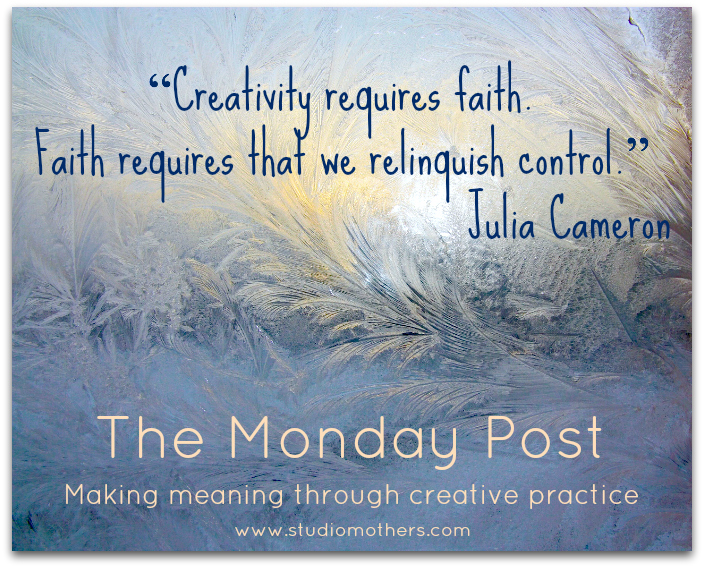
Monday Post frost

Now is the time to recommit to a regular creativity practice. Regularity — a daily practice, if possible — is one of the best ways to stay in touch with how you make meaning. Can a regular creative practice be part of your intentions for 2013?

What are your plans for creative practice this week? Given the specifics of your schedule, decide on a realistic intention or practice plan — and ink that time in your calendar. The scheduling part is important, because as you know, if you try to “fit it in” around the edges, it generally won’t happen. An intention as simple as “I will write for 20 minutes every morning after breakfast” or “I will sketch a new still life on Wednesday evening” is what it’s all about.

Share your intentions or goals as a comment to this post, and let us know how things went with your creative plans for last week, if you posted to last week’s Monday Post. We use a broad brush in defining creativity, so don’t be shy. We also often include well-being practices that support creativity, such as exercise and journaling.

Putting your intentions on “paper” helps you get clear on what you want to do — and sharing those intentions with this community leverages the motivation of an accountability group. Join us!

:::::::

If you’re an artist or writer with little ones, The Creative Mother’s Guide: Six Creative Practices for the Early Years is the essential survival guide written just for you. Concrete strategies for becoming more creative without adding stress and guilt. Filled with the wisdom of 13 insightful creative mothers; written by a certified creativity coach and mother of five. “Highly recommended.” ~Eric Maisel. 35 pages/$11.98. Available for download here.

The One-Thing Sketching Practice

The piece below, which appeared in this month’s Creative Times newsletter, was written by my friend and former business partner Ellen Olson-Brown. Enjoy!


One Thing Sketching Practice

On the first of the month, I choose one familiar household object — a toy, a necklace, a clock on the wall — to sketch every morning of that month. I draw every day because I want to draw well, and I believe in the power of consistent practice, for two minutes or an hour, or an entire morning. I draw because I find the nonverbal work of visual observation and moving the pencil on the page to be meditative and centering. I draw because anchoring myself in wordless observation and movement ultimately helps me access my writing (the word-soaked centerpiece of the creative work that I do) from a more honest and flexible place.

Drawing the same object every morning means that I eliminate “but I don’t know what to draw!” as a barrier to getting started. It allows me to zoom in, sometimes drawing a tiny portion of an object, or to zoom out and include context and surroundings. It allows me to try and fail and try again to capture curves and shadows and relationships, to be playful, with the knowledge that I can give it another go the next day.

At the end of the month, I flip back through my journal and review the drawings I’ve done. I literally stack up evidence that I have met my commitment to myself, and this deepens my belief (and the self-fulfilling prophecy) that I’ll be able to show up again in the future, for drawing and other projects. I’m often surprised by the quality of what I’ve drawn, especially on the mornings where I recall feeling frustrated or stuck. And I’m never able to look at the objects I’ve drawn for 28 or 20 or 31 days without feeling that they’re not just props in my life, but friends I know intimately.

Would this practice work for you? Give it a try and let us know!

::::::

Ellen Olson-Brown, M.Ed., is a teacher, author of four children’s books, yoga teacher, and enthusiastic consumer of art and office supplies. Positive psychology, mindfulness, and the science of human flourishing are her current fascinations, and she loves supportively daring people to amaze themselves. Ellen lives in Groton, Mass., with her husband and twin sons.

Your Creative Intentions: The Monday Post ~ January 21, 2013

“Sometimes life is hard. Things go wrong — and in life, and in love, and in business, and in friendship, and in health, and in all the other ways in which life can go wrong. And when things get tough, this is what you should do: Make good art. I’m serious. Husband runs off with a politician? Make good art. Leg crushed and then eaten by a mutated boa constrictor? Make good art. IRS on your trail? Make good art. Cat exploded? Make good art. Someone on the internet thinks what you’re doing is stupid, or evil, or it’s all been done before? Make good art.”
~Neil Gaiman

Monday_Post_January_21_2013

Now is the time to recommit to a regular creativity practice. Regularity — a daily practice, if possible — is one of the best ways to stay in touch with how you make meaning. Can a regular creative practice be part of your intentions for 2013?

What are your plans for creative practice this week? Given the specifics of your schedule, decide on a realistic intention or practice plan — and ink that time in your calendar. The scheduling part is important, because as you know, if you try to “fit it in” around the edges, it generally won’t happen. An intention as simple as “I will write for 20 minutes every morning after breakfast” or “I will sketch a new still life on Wednesday evening” is what it’s all about.

Share your intentions or goals as a comment to this post, and let us know how things went with your creative plans for last week, if you posted to last week’s Monday Post. We use a broad brush in defining creativity, so don’t be shy. We also often include well-being practices that support creativity, such as exercise and journaling.

Putting your intentions on “paper” helps you get clear on what you want to do — and sharing those intentions with this community leverages the motivation of an accountability group. Join us!

:::::::

If you’re an artist or writer with little ones, The Creative Mother’s Guide: Six Creative Practices for the Early Years is the essential survival guide written just for you. Concrete strategies for becoming more creative without adding stress and guilt. Filled with the wisdom of 13 insightful creative mothers; written by a certified creativity coach and mother of five. “Highly recommended.” ~Eric Maisel. 35 pages/$11.98. Available for download here.

Your Creative Intentions: The Monday Post ~ January 14, 2013

“Finally, if you want to write, you have to just shut up, pick up a pen, and do it. I’m sorry there are no true excuses. This is our life. Step forward. Maybe it’s only for ten minutes. That’s okay. To write feels better than all the excuses.”
~Natalie Goldberg

Monday_Post_Jan_14_2013

Now is the time to recommit to a regular creativity practice. Regularity — a daily practice, if at all possible — is one of the best ways to stay in touch with how you make meaning. Can a regular creative practice be part of your intentions for 2013?

What are your plans for creative practice this week? Given the specifics of your schedule, decide on a realistic intention or practice plan — and ink that time in your calendar. The scheduling part is important, because as you know, if you try to “fit it in” around the edges, it generally won’t happen. An intention as simple as “I will write for 20 minutes every morning after breakfast” or “I will sketch a new still life on Wednesday evening” is what it’s all about.

Share your intentions or goals as a comment to this post, and let us know how things went with your creative plans for last week, if you posted to last week’s Monday Post. We use a broad brush in defining creativity, so don’t be shy. We also often include well-being practices that support creativity, such as exercise and journaling.

Putting your intentions on “paper” helps you get clear on what you want to do — and sharing those intentions with this community is a great way to leverage the motivation of an accountability group. Join us!

:::::::

If you’re an artist or writer with little ones, The Creative Mother’s Guide: Six Creative Practices for the Early Years is the essential survival guide written just for you. Concrete strategies for becoming more creative without adding stress and guilt. Filled with the wisdom of 13 insightful creative mothers; written by a certified creativity coach and mother of five. “Highly recommended.” ~Eric Maisel. 35 pages/$11.98. Available for download here.