Skip to content

Posts tagged ‘practice’

Your Creative Intentions: The Monday Post ~ May 13, 2013
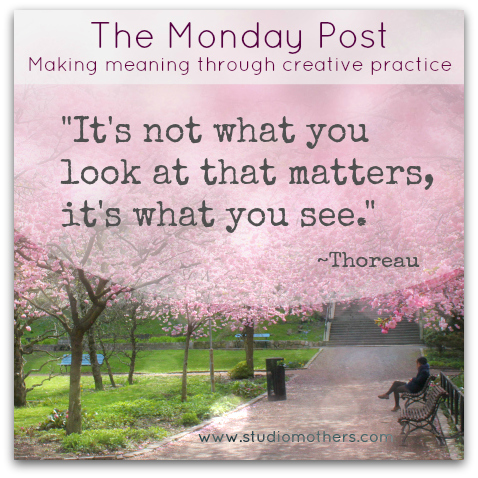
Thoreau quote

If you aren’t doing your creative work as often as you’d like, recommit to a regular creativity practice. Regularity — a daily practice, if possible — is one of the best ways to stay in touch with how you make meaning.

What are your plans for creative practice this week? Given the specifics of your schedule, decide on a realistic intention or practice plan — and ink that time in your calendar. The scheduling part is important, because as you know, if you try to “fit it in” around the edges, it generally won’t happen. An intention as simple as “I will write for 20 minutes every morning after breakfast” or “I will sketch a new still life on Wednesday evening” is what it’s all about. If appropriate, use time estimates to containerize your task. (Time estimates can make a daunting project feel more accessible.)

Share your intentions or goals as a comment to this post, and let us know how things went with your creative plans for last week, if you posted to last week’s Monday Post. We use a broad brush in defining creativity, so don’t be shy. We also often include well-being practices that support creativity, such as exercise and journaling.

Putting your intentions on “paper” helps you get clear on what you want to do — and sharing those intentions with this community leverages the motivation of an accountability group. Join us!

:::::::

If you’re an artist or writer with little ones, The Creative Mother’s Guide: Six Creative Practices for the Early Years is the essential survival guide written just for you. Concrete strategies for becoming more creative without adding stress and guilt. Filled with the wisdom of 13 insightful creative mothers; written by a certified creativity coach and mother of five. “Highly recommended.” ~Eric Maisel. 35 pages/$11.98. Available for download here.

Your Creative Intentions: The Monday Post ~ May 6, 2013

Ralph Waldo Emerson

If you aren’t doing your creative work as often as you’d like, recommit to a regular creativity practice. Regularity — a daily practice, if possible — is one of the best ways to stay in touch with how you make meaning.

What are your plans for creative practice this week? Given the specifics of your schedule, decide on a realistic intention or practice plan — and ink that time in your calendar. The scheduling part is important, because as you know, if you try to “fit it in” around the edges, it generally won’t happen. An intention as simple as “I will write for 20 minutes every morning after breakfast” or “I will sketch a new still life on Wednesday evening” is what it’s all about. If appropriate, use time estimates to containerize your task. (Time estimates can make a daunting project feel more accessible.)

Share your intentions or goals as a comment to this post, and let us know how things went with your creative plans for last week, if you posted to last week’s Monday Post. We use a broad brush in defining creativity, so don’t be shy. We also often include well-being practices that support creativity, such as exercise and journaling.

Putting your intentions on “paper” helps you get clear on what you want to do — and sharing those intentions with this community leverages the motivation of an accountability group. Join us!

:::::::

If you’re an artist or writer with little ones, The Creative Mother’s Guide: Six Creative Practices for the Early Years is the essential survival guide written just for you. Concrete strategies for becoming more creative without adding stress and guilt. Filled with the wisdom of 13 insightful creative mothers; written by a certified creativity coach and mother of five. “Highly recommended.” ~Eric Maisel. 35 pages/$11.98. Available for download here.

Your Creative Intentions: The Monday Post ~ April 29, 2013

George Bernard Shaw quote

If you aren’t doing your creative work as often as you’d like, recommit to a regular creativity practice. Regularity — a daily practice, if possible — is one of the best ways to stay in touch with how you make meaning.

What are your plans for creative practice this week? Given the specifics of your schedule, decide on a realistic intention or practice plan — and ink that time in your calendar. The scheduling part is important, because as you know, if you try to “fit it in” around the edges, it generally won’t happen. An intention as simple as “I will write for 20 minutes every morning after breakfast” or “I will sketch a new still life on Wednesday evening” is what it’s all about. If appropriate, use time estimates to containerize your task. (Time estimates can make a daunting project feel more accessible.)

Share your intentions or goals as a comment to this post, and let us know how things went with your creative plans for last week, if you posted to last week’s Monday Post. We use a broad brush in defining creativity, so don’t be shy. We also often include well-being practices that support creativity, such as exercise and journaling.

Putting your intentions on “paper” helps you get clear on what you want to do — and sharing those intentions with this community leverages the motivation of an accountability group. Join us!

:::::::

If you’re an artist or writer with little ones, The Creative Mother’s Guide: Six Creative Practices for the Early Years is the essential survival guide written just for you. Concrete strategies for becoming more creative without adding stress and guilt. Filled with the wisdom of 13 insightful creative mothers; written by a certified creativity coach and mother of five. “Highly recommended.” ~Eric Maisel. 35 pages/$11.98. Available for download here.
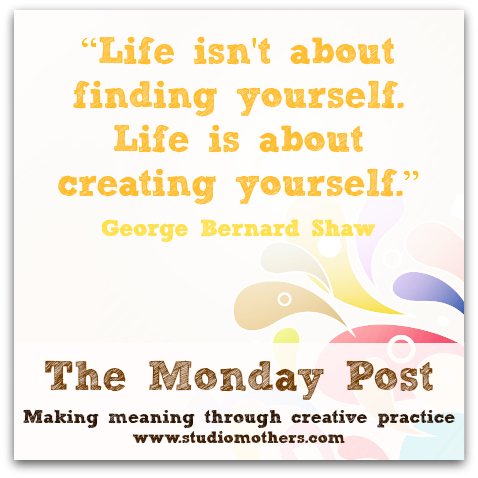
Your Creative Intentions: The Monday Post ~ April 22, 2013

We are greater than our suffering

If you aren’t doing your creative work as often as you’d like, recommit to a regular creativity practice. Regularity — a daily practice, if possible — is one of the best ways to stay in touch with how you make meaning.

What are your plans for creative practice this week? Given the specifics of your schedule, decide on a realistic intention or practice plan — and ink that time in your calendar. The scheduling part is important, because as you know, if you try to “fit it in” around the edges, it generally won’t happen. An intention as simple as “I will write for 20 minutes every morning after breakfast” or “I will sketch a new still life on Wednesday evening” is what it’s all about. If appropriate, use time estimates to containerize your task. (Time estimates can make a daunting project feel more accessible.)

Share your intentions or goals as a comment to this post, and let us know how things went with your creative plans for last week, if you posted to last week’s Monday Post. We use a broad brush in defining creativity, so don’t be shy. We also often include well-being practices that support creativity, such as exercise and journaling.

Putting your intentions on “paper” helps you get clear on what you want to do — and sharing those intentions with this community leverages the motivation of an accountability group. Join us!

:::::::

If you’re an artist or writer with little ones, The Creative Mother’s Guide: Six Creative Practices for the Early Years is the essential survival guide written just for you. Concrete strategies for becoming more creative without adding stress and guilt. Filled with the wisdom of 13 insightful creative mothers; written by a certified creativity coach and mother of five. “Highly recommended.” ~Eric Maisel. 35 pages/$11.98. Available for download here.

Your Creative Intentions: The Monday Post ~ April 15, 2013

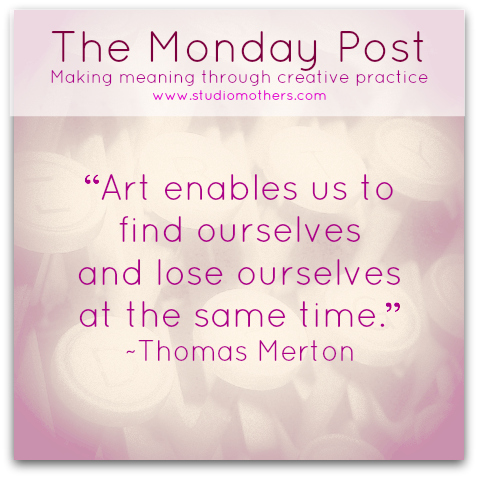
Monday Post Thomas Merton quote

If you aren’t doing your creative work as often as you’d like, recommit to a regular creativity practice. Regularity — a daily practice, if possible — is one of the best ways to stay in touch with how you make meaning.

What are your plans for creative practice this week? Given the specifics of your schedule, decide on a realistic intention or practice plan — and ink that time in your calendar. The scheduling part is important, because as you know, if you try to “fit it in” around the edges, it generally won’t happen. An intention as simple as “I will write for 20 minutes every morning after breakfast” or “I will sketch a new still life on Wednesday evening” is what it’s all about. If appropriate, use time estimates to containerize your task. (Time estimates can make a daunting project feel more accessible.)

Share your intentions or goals as a comment to this post, and let us know how things went with your creative plans for last week, if you posted to last week’s Monday Post. We use a broad brush in defining creativity, so don’t be shy. We also often include well-being practices that support creativity, such as exercise and journaling.

Putting your intentions on “paper” helps you get clear on what you want to do — and sharing those intentions with this community leverages the motivation of an accountability group. Join us!

:::::::

If you’re an artist or writer with little ones, The Creative Mother’s Guide: Six Creative Practices for the Early Years is the essential survival guide written just for you. Concrete strategies for becoming more creative without adding stress and guilt. Filled with the wisdom of 13 insightful creative mothers; written by a certified creativity coach and mother of five. “Highly recommended.” ~Eric Maisel. 35 pages/$11.98. Available for download here.

When Do Ideas Happen?

The Canadian painter Robert Genn writes a terrific, twice-weekly newsletter. While Genn writes primarily about painting, his thoughts apply to any creative pursuit, including writing — and we’ve reposted his letters here several times before. The gem below, which looks at the situations that generate ideas, is reprinted by permission.

Recent research, aimed at finding specific triggers that result in good ideas, better solutions and bouts of creativity, has confirmed my own favourite times when stuff happens. Here are a few:

When we step away: Focusing at your workstation doesn’t always work, particularly if you do too much of it. Leave your cubicle or studio and step into a new environment. Great stuff is ready to grab out there, floating in the ether.

When we’re in transition: Waking up, falling asleep, showering, tubbing, or going to the bathroom are hot times for new ideas. We need to trust the possibilities of fleeting brain waves at these times and take the trouble to knock them down for further study.

When we’re drinking: Moderate drinking gives confidence and gusto. A 2012 study at the University of Illinois at Chicago found that students who drank enough to raise their blood-alcohol level to 0.075 performed better on tests of insight than sober students.

When we’re doing chores: This may be one of the reasons why so many artists prefer to have their studios at home. I absolutely don’t want this sort of information passed around, but I personally find stimulation in washing cars, taking out the garbage, and helping our gardener move bags of manure.

When we’re satisfied: A relatively fulfilled life calms the mind and enriches the ground for idea growth. I’ve tried frustration, anger, disappointment, tiredness and misery, and they all work to a degree, but joyous satisfaction and a sense of élan work best.

When we’re daydreaming: It turns out that daydreaming is one of the most valuable things that creative people do. Even the fantasizing of chicks that bedevils a lot of men apparently hastens bubble-up ideas from the subconscious that have nothing to do with women. What women need to fantasize, I’m not sure.

When we see green: Green surroundings, whether green-painted walls or the green outdoors, suggest new growth, rebirth, fertility, and renewal — just one of the reasons why a walk in the park can be so fruitful. Feeling non-creative in the studio? Squeeze out some green.

Best regards,

Robert

PS: “When students were given creativity tests, those whose test-cover pages had a green background gave more creative answers than those whose pages were white, blue, red or grey.” (Sue Shellenbarger, reporting in the Wall Street Journal)

Esoterica: Personal and unique fetishes can be useful as well. For a steady flow of creativity, easel-time foot-massage has been recommended, as has military marching music played loudly. I notice slight rises when I consult or share minor triumphs with Dorothy the Airedale. She is non-confrontational, always eager, never critical, and I know she’s quite fond of me. Sometimes she likes my creativity so much she sleeps on it. In other words, she’s a low-maintenance muse. ‘Scuse me, she just came in, and now she wants out.

:::::

Don’t miss the treasure trove of Genn’s letters here.

Your Creative Intentions: The Monday Post ~ April 8, 2013

Melissa Jean quote

If you aren’t doing your creative work as often as you’d like, recommit to a regular creativity practice. Regularity — a daily practice, if possible — is one of the best ways to stay in touch with how you make meaning.

What are your plans for creative practice this week? Given the specifics of your schedule, decide on a realistic intention or practice plan — and ink that time in your calendar. The scheduling part is important, because as you know, if you try to “fit it in” around the edges, it generally won’t happen. An intention as simple as “I will write for 20 minutes every morning after breakfast” or “I will sketch a new still life on Wednesday evening” is what it’s all about. If appropriate, use time estimates to containerize your task. (Time estimates can make a daunting project feel more accessible.)

Share your intentions or goals as a comment to this post, and let us know how things went with your creative plans for last week, if you posted to last week’s Monday Post. We use a broad brush in defining creativity, so don’t be shy. We also often include well-being practices that support creativity, such as exercise and journaling.

Putting your intentions on “paper” helps you get clear on what you want to do — and sharing those intentions with this community leverages the motivation of an accountability group. Join us!

:::::::

If you’re an artist or writer with little ones, The Creative Mother’s Guide: Six Creative Practices for the Early Years is the essential survival guide written just for you. Concrete strategies for becoming more creative without adding stress and guilt. Filled with the wisdom of 13 insightful creative mothers; written by a certified creativity coach and mother of five. “Highly recommended.” ~Eric Maisel. 35 pages/$11.98. Available for download here.

Your Creative Intentions: The Monday Post ~ April 1, 2013

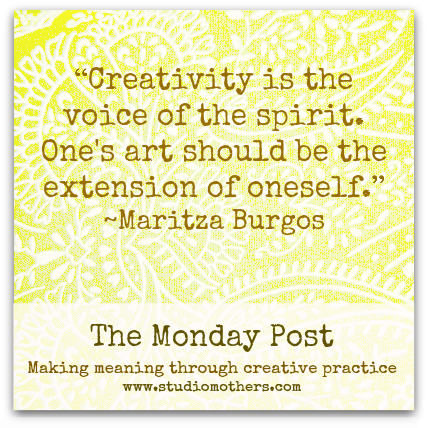
Maritza Burgos quote

If you aren’t doing your creative work as often as you’d like, recommit to a regular creativity practice. Regularity — a daily practice, if possible — is one of the best ways to stay in touch with how you make meaning.

What are your plans for creative practice this week? Given the specifics of your schedule, decide on a realistic intention or practice plan — and ink that time in your calendar. The scheduling part is important, because as you know, if you try to “fit it in” around the edges, it generally won’t happen. An intention as simple as “I will write for 20 minutes every morning after breakfast” or “I will sketch a new still life on Wednesday evening” is what it’s all about. If appropriate, use time estimates to containerize your task. (Time estimates can make a daunting project feel more accessible.)

Share your intentions or goals as a comment to this post, and let us know how things went with your creative plans for last week, if you posted to last week’s Monday Post. We use a broad brush in defining creativity, so don’t be shy. We also often include well-being practices that support creativity, such as exercise and journaling.

Putting your intentions on “paper” helps you get clear on what you want to do — and sharing those intentions with this community leverages the motivation of an accountability group. Join us!

:::::::

If you’re an artist or writer with little ones, The Creative Mother’s Guide: Six Creative Practices for the Early Years is the essential survival guide written just for you. Concrete strategies for becoming more creative without adding stress and guilt. Filled with the wisdom of 13 insightful creative mothers; written by a certified creativity coach and mother of five. “Highly recommended.” ~Eric Maisel. 35 pages/$11.98. Available for download here.
Your Creative Intentions: The Monday Post ~ March 25, 2013

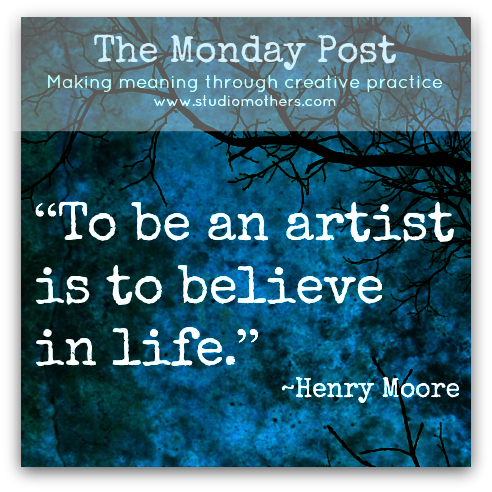
To be an artist is to believe in life.

If you aren’t doing your creative work as often as you’d like, recommit to a regular creativity practice. Regularity — a daily practice, if possible — is one of the best ways to stay in touch with how you make meaning. Can a regular creative practice be part of your intentions for 2013?

What are your plans for creative practice this week? Given the specifics of your schedule, decide on a realistic intention or practice plan — and ink that time in your calendar. The scheduling part is important, because as you know, if you try to “fit it in” around the edges, it generally won’t happen. An intention as simple as “I will write for 20 minutes every morning after breakfast” or “I will sketch a new still life on Wednesday evening” is what it’s all about.

Share your intentions or goals as a comment to this post, and let us know how things went with your creative plans for last week, if you posted to last week’s Monday Post. We use a broad brush in defining creativity, so don’t be shy. We also often include well-being practices that support creativity, such as exercise and journaling.

Putting your intentions on “paper” helps you get clear on what you want to do — and sharing those intentions with this community leverages the motivation of an accountability group. Join us!

:::::::

If you’re an artist or writer with little ones, The Creative Mother’s Guide: Six Creative Practices for the Early Years is the essential survival guide written just for you. Concrete strategies for becoming more creative without adding stress and guilt. Filled with the wisdom of 13 insightful creative mothers; written by a certified creativity coach and mother of five. “Highly recommended.” ~Eric Maisel. 35 pages/$11.98. Available for download here.

Your Creative Intentions: The Monday Post ~ March 18, 2013

Monday Post door

If you aren’t doing your creative work as often as you’d like, recommit to a regular creativity practice. Regularity — a daily practice, if possible — is one of the best ways to stay in touch with how you make meaning. Can a regular creative practice be part of your intentions for 2013?

What are your plans for creative practice this week? Given the specifics of your schedule, decide on a realistic intention or practice plan — and ink that time in your calendar. The scheduling part is important, because as you know, if you try to “fit it in” around the edges, it generally won’t happen. An intention as simple as “I will write for 20 minutes every morning after breakfast” or “I will sketch a new still life on Wednesday evening” is what it’s all about.

Share your intentions or goals as a comment to this post, and let us know how things went with your creative plans for last week, if you posted to last week’s Monday Post. We use a broad brush in defining creativity, so don’t be shy. We also often include well-being practices that support creativity, such as exercise and journaling.

Putting your intentions on “paper” helps you get clear on what you want to do — and sharing those intentions with this community leverages the motivation of an accountability group. Join us!

:::::::

If you’re an artist or writer with little ones, The Creative Mother’s Guide: Six Creative Practices for the Early Years is the essential survival guide written just for you. Concrete strategies for becoming more creative without adding stress and guilt. Filled with the wisdom of 13 insightful creative mothers; written by a certified creativity coach and mother of five. “Highly recommended.” ~Eric Maisel. 35 pages/$11.98. Available for download here.

Your Creative Intentions: The Monday Post ~ March 11, 2013

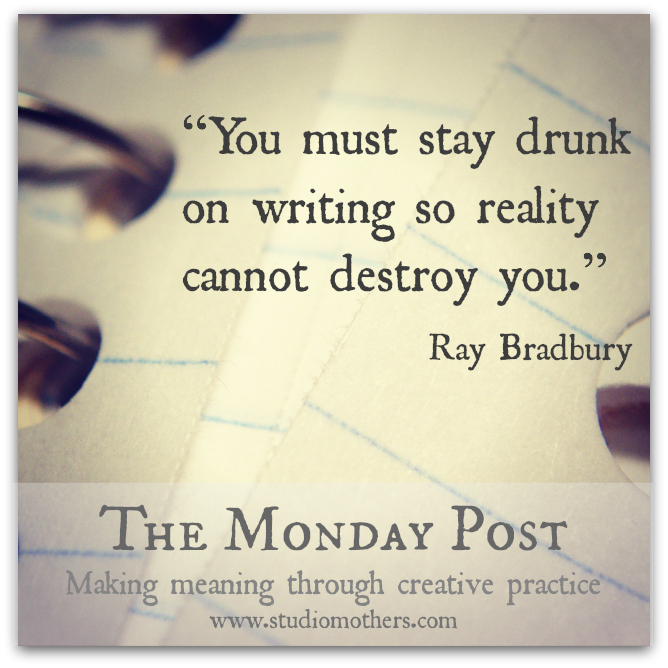
Ray Bradbury quote writing

If you aren’t doing your creative work as often as you’d like, recommit to a regular creativity practice. Regularity — a daily practice, if possible — is one of the best ways to stay in touch with how you make meaning. Can a regular creative practice be part of your intentions for 2013?

What are your plans for creative practice this week? Given the specifics of your schedule, decide on a realistic intention or practice plan — and ink that time in your calendar. The scheduling part is important, because as you know, if you try to “fit it in” around the edges, it generally won’t happen. An intention as simple as “I will write for 20 minutes every morning after breakfast” or “I will sketch a new still life on Wednesday evening” is what it’s all about.

Share your intentions or goals as a comment to this post, and let us know how things went with your creative plans for last week, if you posted to last week’s Monday Post. We use a broad brush in defining creativity, so don’t be shy. We also often include well-being practices that support creativity, such as exercise and journaling.

Putting your intentions on “paper” helps you get clear on what you want to do — and sharing those intentions with this community leverages the motivation of an accountability group. Join us!

:::::::

If you’re an artist or writer with little ones, The Creative Mother’s Guide: Six Creative Practices for the Early Years is the essential survival guide written just for you. Concrete strategies for becoming more creative without adding stress and guilt. Filled with the wisdom of 13 insightful creative mothers; written by a certified creativity coach and mother of five. “Highly recommended.” ~Eric Maisel. 35 pages/$11.98. Available for download here.

Your Creative Intentions: The Monday Post ~ March 4, 2013

Pablo Picasso quote

If you aren’t doing your creative work as often as you’d like, recommit to a regular creativity practice. Regularity — a daily practice, if possible — is one of the best ways to stay in touch with how you make meaning. Can a regular creative practice be part of your intentions for 2013?

What are your plans for creative practice this week? Given the specifics of your schedule, decide on a realistic intention or practice plan — and ink that time in your calendar. The scheduling part is important, because as you know, if you try to “fit it in” around the edges, it generally won’t happen. An intention as simple as “I will write for 20 minutes every morning after breakfast” or “I will sketch a new still life on Wednesday evening” is what it’s all about.

Share your intentions or goals as a comment to this post, and let us know how things went with your creative plans for last week, if you posted to last week’s Monday Post. We use a broad brush in defining creativity, so don’t be shy. We also often include well-being practices that support creativity, such as exercise and journaling.

Putting your intentions on “paper” helps you get clear on what you want to do — and sharing those intentions with this community leverages the motivation of an accountability group. Join us!

:::::::

If you’re an artist or writer with little ones, The Creative Mother’s Guide: Six Creative Practices for the Early Years is the essential survival guide written just for you. Concrete strategies for becoming more creative without adding stress and guilt. Filled with the wisdom of 13 insightful creative mothers; written by a certified creativity coach and mother of five. “Highly recommended.” ~Eric Maisel. 35 pages/$11.98. Available for download here.