Skip to content

Posts tagged ‘Creativity’

Your Creative Intentions: The Monday Post ~ December 16, 2013

Red Haircrow quote

Commit to a regular creativity practice. Regularity — a daily practice, if possible — is key to staying in touch with how you make meaning.

What are your plans for creative practice this week? Given the specifics of your schedule, decide on a realistic intention or practice plan — and ink that time in your calendar. The scheduling part is important, because as you know, if you try to “fit it in” around the edges, it generally won’t happen. An intention as simple as “I will write for 20 minutes every morning after breakfast” or “I will sketch a new still life on Wednesday evening” is what it’s all about. If appropriate, use time estimates to containerize your task, which can make a daunting project feel more accessible.

Share your intentions or goals as a comment to this post, and let us know how things went with your creative plans for last week, if you posted to last week’s Monday Post. We use a broad brush in defining creativity, so don’t be shy. We also often include well-being practices that support creativity, such as exercise and journaling.

Putting your intentions on “paper” helps you get clear on what you want to do — and sharing those intentions with this community leverages the motivation of an accountability group. Join us!

:::::::

If you’re an artist or writer with little ones, The Creative Mother’s Guide: Six Creative Practices for the Early Years is the essential survival guide written just for you. Concrete strategies for becoming more creative without adding stress and guilt. Filled with the wisdom of 13 insightful creative mothers; written by a certified creativity coach and mother of five. “Highly recommended.” ~Eric Maisel. 35 pages/$11.98. Available for download here.

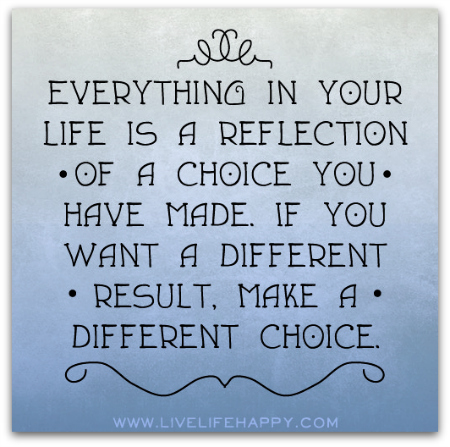
Meme of the Week

choices

Happy Friday.

:::::

Your Creative Intentions: The Monday Post ~ December 9, 2013

Stephen King On Writing

Commit to a regular creativity practice. Regularity — a daily practice, if possible — is key to staying in touch with how you make meaning.

What are your plans for creative practice this week? Given the specifics of your schedule, decide on a realistic intention or practice plan — and ink that time in your calendar. The scheduling part is important, because as you know, if you try to “fit it in” around the edges, it generally won’t happen. An intention as simple as “I will write for 20 minutes every morning after breakfast” or “I will sketch a new still life on Wednesday evening” is what it’s all about. If appropriate, use time estimates to containerize your task, which can make a daunting project feel more accessible.

Share your intentions or goals as a comment to this post, and let us know how things went with your creative plans for last week, if you posted to last week’s Monday Post. We use a broad brush in defining creativity, so don’t be shy. We also often include well-being practices that support creativity, such as exercise and journaling.

Putting your intentions on “paper” helps you get clear on what you want to do — and sharing those intentions with this community leverages the motivation of an accountability group. Join us!

:::::::

If you’re an artist or writer with little ones, The Creative Mother’s Guide: Six Creative Practices for the Early Years is the essential survival guide written just for you. Concrete strategies for becoming more creative without adding stress and guilt. Filled with the wisdom of 13 insightful creative mothers; written by a certified creativity coach and mother of five. “Highly recommended.” ~Eric Maisel. 35 pages/$11.98. Available for download here.

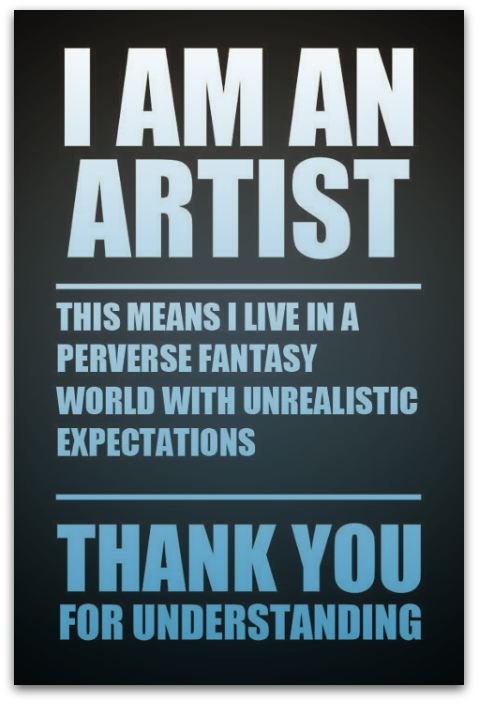
Meme of the Week

I am an artist

Happy Friday.

:::::

*2014 Create Your Incredible Year*

I’m pleased to once again promote Leonie Dawson’s “Create Your Incredible Year” workbook, planner, and calendar.

Create_Your_Amazing_YearIf you’re a planning junkie like I am, you can’t wait to get your hands on a new tool and wring every bit of awesomeness out of it: time-management, goal-setting, redefining what’s possible.

The 2014 Create Your Incredible Year workbook, planner, and calendar is a popular and extremely useful tool to help you plan and realize your most incredible year in life or business (or both!). Over the last five years, thousands of women have used this workbook with the most amazing results. It’s the best planning tool available to help you make your year your most exceptional yet!

Used by entrepreneurs, artists, mamas, creatives, coaches, teachers, and women of all ages, the Creating Your Incredible Year workbooks are filled with dozens of pages of powerful worksheets and a printable calendar to help you create your amazing new year. Oh, and they’re gorgeous and inspiring (no boring spreadsheets here).

This resource is available in a life edition ($9.95), business edition ($9.95), or combo edition ($17.90). This year, you can get the Life AND Biz editions of the workbook as a large-size, full-color paperback from Amazon (with PDF download for the calendars) for $25. Yes!

I’ve used the combo edition personally, and highly recommend Leonie’s work. I’m looking forward to digging in with my own 2014 combo edition.

Click here to find out more/to order.

:::::

Your Creative Intentions: The Monday Post ~ December 2, 2013

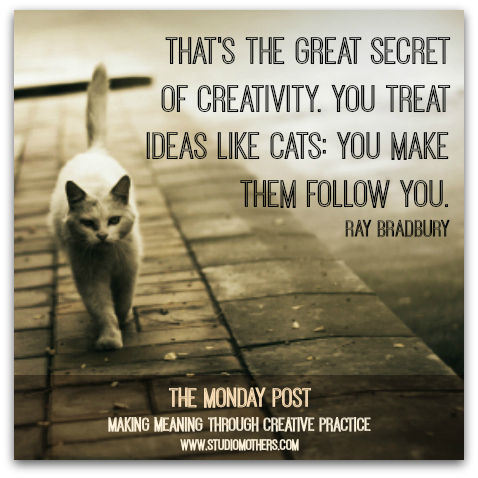
Ray Bradbury Creativity Cats

Commit to a regular creativity practice. Regularity — a daily practice, if possible — is key to staying in touch with how you make meaning.

What are your plans for creative practice this week? Given the specifics of your schedule, decide on a realistic intention or practice plan — and ink that time in your calendar. The scheduling part is important, because as you know, if you try to “fit it in” around the edges, it generally won’t happen. An intention as simple as “I will write for 20 minutes every morning after breakfast” or “I will sketch a new still life on Wednesday evening” is what it’s all about. If appropriate, use time estimates to containerize your task, which can make a daunting project feel more accessible.

Share your intentions or goals as a comment to this post, and let us know how things went with your creative plans for last week, if you posted to last week’s Monday Post. We use a broad brush in defining creativity, so don’t be shy. We also often include well-being practices that support creativity, such as exercise and journaling.

Putting your intentions on “paper” helps you get clear on what you want to do — and sharing those intentions with this community leverages the motivation of an accountability group. Join us!

:::::::

If you’re an artist or writer with little ones, The Creative Mother’s Guide: Six Creative Practices for the Early Years is the essential survival guide written just for you. Concrete strategies for becoming more creative without adding stress and guilt. Filled with the wisdom of 13 insightful creative mothers; written by a certified creativity coach and mother of five. “Highly recommended.” ~Eric Maisel. 35 pages/$11.98. Available for download here.

Your Creative Intentions: The Monday Post ~ November 25, 2013

Rollo May quote

Commit to a regular creativity practice. Regularity — a daily practice, if possible — is key to staying in touch with how you make meaning.

What are your plans for creative practice this week? Given the specifics of your schedule, decide on a realistic intention or practice plan — and ink that time in your calendar. The scheduling part is important, because as you know, if you try to “fit it in” around the edges, it generally won’t happen. An intention as simple as “I will write for 20 minutes every morning after breakfast” or “I will sketch a new still life on Wednesday evening” is what it’s all about. If appropriate, use time estimates to containerize your task, which can make a daunting project feel more accessible.

Share your intentions or goals as a comment to this post, and let us know how things went with your creative plans for last week, if you posted to last week’s Monday Post. We use a broad brush in defining creativity, so don’t be shy. We also often include well-being practices that support creativity, such as exercise and journaling.

Putting your intentions on “paper” helps you get clear on what you want to do — and sharing those intentions with this community leverages the motivation of an accountability group. Join us!

:::::::

If you’re an artist or writer with little ones, The Creative Mother’s Guide: Six Creative Practices for the Early Years is the essential survival guide written just for you. Concrete strategies for becoming more creative without adding stress and guilt. Filled with the wisdom of 13 insightful creative mothers; written by a certified creativity coach and mother of five. “Highly recommended.” ~Eric Maisel. 35 pages/$11.98. Available for download here.

Is Your Environment Helping or Hurting You Creatively?

creative thoughtYour environment — whether it’s your office, studio, or family room — is full of cues that can have a significant impact on how you feel, what you think, and how you behave. As Malcolm Gladwell details in his bestseller Blink, our brains constantly decode information and influence our thoughts and actions in ways that may or may not support our goals. Is your environment continually sending you messages that undermine your creative process or self-confidence?

Gladwell cites a now-classic 1996 priming experiment wherein New York University researchers asked participants to rearrange scrambled words to form sentences. The control group received random sentences and the experimental group received sentences containing words we associate with the elderly, such as “Florida,” “old,” “forgetful,” “wrinkle,” and “bingo.” If you were among the experimental group, after finishing the test you would have walked down the hallway more slowly than the control group.

This experiment was just one of many that reveal our brains’ susceptibility to the subtle (but not subliminal) signals we receive. The unconscious mind guides us in ways we can’t control. It is for this reason that classical music has adopted the practice of blind auditions, using a screen to separate auditioners from the audition committee. It is simply too difficult to ignore information from visual cues — information that can support incorrect conclusions, such as the formerly widespread belief that women are inferior musicians. As Gladwell notes, in the three decades since the use of audition screens became commonplace, the number of women in top US orchestras has increased five-fold.

What does this mean for you, as a creative? It means that you need to ensure that what you see every day is empowering and inspiring. Take a hard look at what you’ve surrounded yourself with — and get rid of the things that don’t serve you. Be ruthless. Then invite in only the objects and cues that support your intentions, increase your productivity, and make you feel good. A few simple starters:

  • Clean up your desk: Piles of clutter may perpetuate feeling overwhelmed and disorganized.
  • Go green: Having a plant nearby can improve attentiveness, productivity, and well-being.
  • Use creative visualization: Make a vision board and hang it where you can see it daily.
  • Stick ’em up: Write your goals on Post-It notes and hang them in obvious places.

In the words of Napoleon Hill: “We begin to see, therefore, the importance of selecting our environment with the greatest of care, because environment is the mental feeding ground out of which the food that goes into our minds is extracted.”

What kinds of things do you keep in your environment that support your creativity?

:::::

A version of this piece was originally published in Creativity Calling, the newsletter of the Creativity Coaching Association.

Your Creative Intentions: The Monday Post ~ November 18, 2013

Lau Tzu

Commit to a regular creativity practice. Regularity — a daily practice, if possible — is key to staying in touch with how you make meaning.

What are your plans for creative practice this week? Given the specifics of your schedule, decide on a realistic intention or practice plan — and ink that time in your calendar. The scheduling part is important, because as you know, if you try to “fit it in” around the edges, it generally won’t happen. An intention as simple as “I will write for 20 minutes every morning after breakfast” or “I will sketch a new still life on Wednesday evening” is what it’s all about. If appropriate, use time estimates to containerize your task, which can make a daunting project feel more accessible.

Share your intentions or goals as a comment to this post, and let us know how things went with your creative plans for last week, if you posted to last week’s Monday Post. We use a broad brush in defining creativity, so don’t be shy. We also often include well-being practices that support creativity, such as exercise and journaling.

Putting your intentions on “paper” helps you get clear on what you want to do — and sharing those intentions with this community leverages the motivation of an accountability group. Join us!

:::::::

If you’re an artist or writer with little ones, The Creative Mother’s Guide: Six Creative Practices for the Early Years is the essential survival guide written just for you. Concrete strategies for becoming more creative without adding stress and guilt. Filled with the wisdom of 13 insightful creative mothers; written by a certified creativity coach and mother of five. “Highly recommended.” ~Eric Maisel. 35 pages/$11.98. Available for download here.
Your Creative Intentions: The Monday Post ~ November 11, 2013

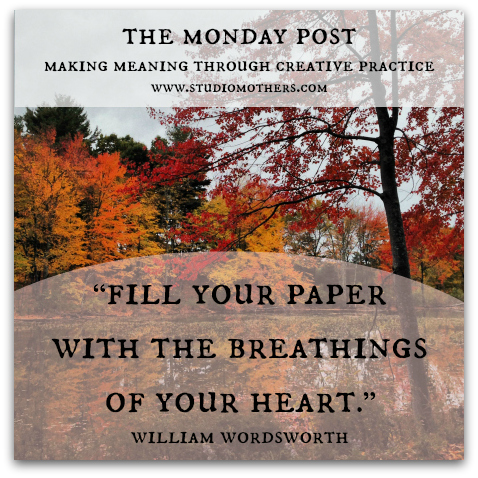
William Wordsworth

Commit to a regular creativity practice. Regularity — a daily practice, if possible — is key to staying in touch with how you make meaning.

What are your plans for creative practice this week? Given the specifics of your schedule, decide on a realistic intention or practice plan — and ink that time in your calendar. The scheduling part is important, because as you know, if you try to “fit it in” around the edges, it generally won’t happen. An intention as simple as “I will write for 20 minutes every morning after breakfast” or “I will sketch a new still life on Wednesday evening” is what it’s all about. If appropriate, use time estimates to containerize your task, which can make a daunting project feel more accessible.

Share your intentions or goals as a comment to this post, and let us know how things went with your creative plans for last week, if you posted to last week’s Monday Post. We use a broad brush in defining creativity, so don’t be shy. We also often include well-being practices that support creativity, such as exercise and journaling.

Putting your intentions on “paper” helps you get clear on what you want to do — and sharing those intentions with this community leverages the motivation of an accountability group. Join us!

:::::::

If you’re an artist or writer with little ones, The Creative Mother’s Guide: Six Creative Practices for the Early Years is the essential survival guide written just for you. Concrete strategies for becoming more creative without adding stress and guilt. Filled with the wisdom of 13 insightful creative mothers; written by a certified creativity coach and mother of five. “Highly recommended.” ~Eric Maisel. 35 pages/$11.98. Available for download here.

Lucy: Cultivating Creativity in the Midst of Motherhood

Editor’s note: In the fall issue of The Creative Times, I previewed The Rainbow Way by Lucy H. Pearce, a positive, nurturing, practical book that will help you unlock your creative potential within the constraints of motherhood. I was glad to provide Lucy with advance praise for her work — and invited Lucy to share her story with the Studio Mothers audience, as I know you will relate. *In celebration, we’re giving away two free e-books! To enter, leave a comment below before 5:00 pm eastern time on November 15, 2013.* And don’t miss Lucy’s invitation to join her blogging carnival of creative women!


Lucy PearceMany of us dream of becoming writers, or artists, or dancers. And then, one day, when babies come along, whether by accident or design, out go the books or paintings with the baby’s bath water — whether through busyness, lack of support, or the misguided belief that we should now dedicate ourselves entirely to our children.

I know. Because it happened to me.

There I was in No-Woman’s Land. Tattered creative dreams in one hand. Children in the other. With little support and no way of knowing how to move forward, how to reclaim my lost self and dreams.

Over the years I have created a new dream for myself: that of the creative mother — writer, artist, editor, and entrepreneur. Out of necessity and a need for sanity. Sometimes the balance has tipped further towards motherhood, at other times creativity. But both elements have been constants in my life. No matter how tired, how overwhelmed, I was never willing to relinquish either my almost-fulltime mothering role, or my creative work. It has been an adventure, and one for which I had few real-life role models.

When I first started out in motherhood, I kept comparing myself to other women who seemed content in their role as stay-at-home mothers, and concluded that I must be doing it wrong. I was happy and recharged when I had my creative time; impatient and mean when I didn’t. But this need, this urge, was not a whim. It would not go away. And so I learned, little by little, to honor it and build my life around it.

The Rainbow WayAt the time I thought I was the only one feeling this way. But in researching my book, and talking to other mothers, I found I was not alone. We are not celebrated by our society. But we are here, wiping little bottoms and writing poetry. Making sculpture and breastfeeding. Writing books late at night and on the bottom of shopping lists. We are here. And we matter.

I wrote The Rainbow Way: Cultivating Creativity in the Midst of Motherhood for myself, for the mother I had been, and all the creative mothers who contact me every week feeling stuck and unsure, lost and confused about how to be both mothers and creative souls in this busy modern world. It came to me and demanded to be written. And so I scribbled notes on any piece of paper I had on hand, wherever I was, in doctor’s offices, car parks, and at the kitchen table. Read more

Your Creative Intentions: The Monday Post ~ November 4, 2013

Samuel Beckett

Commit to a regular creativity practice. Regularity — a daily practice, if possible — is key to staying in touch with how you make meaning.

What are your plans for creative practice this week? Given the specifics of your schedule, decide on a realistic intention or practice plan — and ink that time in your calendar. The scheduling part is important, because as you know, if you try to “fit it in” around the edges, it generally won’t happen. An intention as simple as “I will write for 20 minutes every morning after breakfast” or “I will sketch a new still life on Wednesday evening” is what it’s all about. If appropriate, use time estimates to containerize your task, which can make a daunting project feel more accessible.

Share your intentions or goals as a comment to this post, and let us know how things went with your creative plans for last week, if you posted to last week’s Monday Post. We use a broad brush in defining creativity, so don’t be shy. We also often include well-being practices that support creativity, such as exercise and journaling.

Putting your intentions on “paper” helps you get clear on what you want to do — and sharing those intentions with this community leverages the motivation of an accountability group. Join us!

:::::::

If you’re an artist or writer with little ones, The Creative Mother’s Guide: Six Creative Practices for the Early Years is the essential survival guide written just for you. Concrete strategies for becoming more creative without adding stress and guilt. Filled with the wisdom of 13 insightful creative mothers; written by a certified creativity coach and mother of five. “Highly recommended.” ~Eric Maisel. 35 pages/$11.98. Available for download here.