Skip to content

Posts tagged ‘art’

Your Creative Intentions: The Monday Post ~ January 28, 2013

Monday Post frost

Now is the time to recommit to a regular creativity practice. Regularity — a daily practice, if possible — is one of the best ways to stay in touch with how you make meaning. Can a regular creative practice be part of your intentions for 2013?

What are your plans for creative practice this week? Given the specifics of your schedule, decide on a realistic intention or practice plan — and ink that time in your calendar. The scheduling part is important, because as you know, if you try to “fit it in” around the edges, it generally won’t happen. An intention as simple as “I will write for 20 minutes every morning after breakfast” or “I will sketch a new still life on Wednesday evening” is what it’s all about.

Share your intentions or goals as a comment to this post, and let us know how things went with your creative plans for last week, if you posted to last week’s Monday Post. We use a broad brush in defining creativity, so don’t be shy. We also often include well-being practices that support creativity, such as exercise and journaling.

Putting your intentions on “paper” helps you get clear on what you want to do — and sharing those intentions with this community leverages the motivation of an accountability group. Join us!

:::::::

If you’re an artist or writer with little ones, The Creative Mother’s Guide: Six Creative Practices for the Early Years is the essential survival guide written just for you. Concrete strategies for becoming more creative without adding stress and guilt. Filled with the wisdom of 13 insightful creative mothers; written by a certified creativity coach and mother of five. “Highly recommended.” ~Eric Maisel. 35 pages/$11.98. Available for download here.

The One-Thing Sketching Practice

The piece below, which appeared in this month’s Creative Times newsletter, was written by my friend and former business partner Ellen Olson-Brown. Enjoy!


One Thing Sketching Practice

On the first of the month, I choose one familiar household object — a toy, a necklace, a clock on the wall — to sketch every morning of that month. I draw every day because I want to draw well, and I believe in the power of consistent practice, for two minutes or an hour, or an entire morning. I draw because I find the nonverbal work of visual observation and moving the pencil on the page to be meditative and centering. I draw because anchoring myself in wordless observation and movement ultimately helps me access my writing (the word-soaked centerpiece of the creative work that I do) from a more honest and flexible place.

Drawing the same object every morning means that I eliminate “but I don’t know what to draw!” as a barrier to getting started. It allows me to zoom in, sometimes drawing a tiny portion of an object, or to zoom out and include context and surroundings. It allows me to try and fail and try again to capture curves and shadows and relationships, to be playful, with the knowledge that I can give it another go the next day.

At the end of the month, I flip back through my journal and review the drawings I’ve done. I literally stack up evidence that I have met my commitment to myself, and this deepens my belief (and the self-fulfilling prophecy) that I’ll be able to show up again in the future, for drawing and other projects. I’m often surprised by the quality of what I’ve drawn, especially on the mornings where I recall feeling frustrated or stuck. And I’m never able to look at the objects I’ve drawn for 28 or 20 or 31 days without feeling that they’re not just props in my life, but friends I know intimately.

Would this practice work for you? Give it a try and let us know!

::::::

Ellen Olson-Brown, M.Ed., is a teacher, author of four children’s books, yoga teacher, and enthusiastic consumer of art and office supplies. Positive psychology, mindfulness, and the science of human flourishing are her current fascinations, and she loves supportively daring people to amaze themselves. Ellen lives in Groton, Mass., with her husband and twin sons.

Your Creative Intentions: The Monday Post ~ January 21, 2013

“Sometimes life is hard. Things go wrong — and in life, and in love, and in business, and in friendship, and in health, and in all the other ways in which life can go wrong. And when things get tough, this is what you should do: Make good art. I’m serious. Husband runs off with a politician? Make good art. Leg crushed and then eaten by a mutated boa constrictor? Make good art. IRS on your trail? Make good art. Cat exploded? Make good art. Someone on the internet thinks what you’re doing is stupid, or evil, or it’s all been done before? Make good art.”
~Neil Gaiman

Monday_Post_January_21_2013

Now is the time to recommit to a regular creativity practice. Regularity — a daily practice, if possible — is one of the best ways to stay in touch with how you make meaning. Can a regular creative practice be part of your intentions for 2013?

What are your plans for creative practice this week? Given the specifics of your schedule, decide on a realistic intention or practice plan — and ink that time in your calendar. The scheduling part is important, because as you know, if you try to “fit it in” around the edges, it generally won’t happen. An intention as simple as “I will write for 20 minutes every morning after breakfast” or “I will sketch a new still life on Wednesday evening” is what it’s all about.

Share your intentions or goals as a comment to this post, and let us know how things went with your creative plans for last week, if you posted to last week’s Monday Post. We use a broad brush in defining creativity, so don’t be shy. We also often include well-being practices that support creativity, such as exercise and journaling.

Putting your intentions on “paper” helps you get clear on what you want to do — and sharing those intentions with this community leverages the motivation of an accountability group. Join us!

:::::::

If you’re an artist or writer with little ones, The Creative Mother’s Guide: Six Creative Practices for the Early Years is the essential survival guide written just for you. Concrete strategies for becoming more creative without adding stress and guilt. Filled with the wisdom of 13 insightful creative mothers; written by a certified creativity coach and mother of five. “Highly recommended.” ~Eric Maisel. 35 pages/$11.98. Available for download here.

Your Creative Intentions: The Monday Post ~ January 14, 2013

“Finally, if you want to write, you have to just shut up, pick up a pen, and do it. I’m sorry there are no true excuses. This is our life. Step forward. Maybe it’s only for ten minutes. That’s okay. To write feels better than all the excuses.”
~Natalie Goldberg

Monday_Post_Jan_14_2013

Now is the time to recommit to a regular creativity practice. Regularity — a daily practice, if at all possible — is one of the best ways to stay in touch with how you make meaning. Can a regular creative practice be part of your intentions for 2013?

What are your plans for creative practice this week? Given the specifics of your schedule, decide on a realistic intention or practice plan — and ink that time in your calendar. The scheduling part is important, because as you know, if you try to “fit it in” around the edges, it generally won’t happen. An intention as simple as “I will write for 20 minutes every morning after breakfast” or “I will sketch a new still life on Wednesday evening” is what it’s all about.

Share your intentions or goals as a comment to this post, and let us know how things went with your creative plans for last week, if you posted to last week’s Monday Post. We use a broad brush in defining creativity, so don’t be shy. We also often include well-being practices that support creativity, such as exercise and journaling.

Putting your intentions on “paper” helps you get clear on what you want to do — and sharing those intentions with this community is a great way to leverage the motivation of an accountability group. Join us!

:::::::

If you’re an artist or writer with little ones, The Creative Mother’s Guide: Six Creative Practices for the Early Years is the essential survival guide written just for you. Concrete strategies for becoming more creative without adding stress and guilt. Filled with the wisdom of 13 insightful creative mothers; written by a certified creativity coach and mother of five. “Highly recommended.” ~Eric Maisel. 35 pages/$11.98. Available for download here.

Your Creative Intentions: The Monday Post ~ January 7, 2013

“I know you’ve heard it a thousand times before. But it’s true: hard work pays off. If you want to be good, you have to practice, practice, practice. If you don’t love something, then don’t do it.”
~Ray Bradbury

Monday_Post_January_6_typewriter

Welcome to the first Monday Post of 2013! There’s no better time to recommit to a regular creativity practice. Regularity — a daily practice, if at all possible — is one of the best ways to stay in touch with how you make meaning. Can a regular creative practice be part of your intentions for 2013?

What are your plans for creative practice this week? Given the specifics of your schedule, decide on a realistic intention or practice plan — and ink that time in your calendar. The scheduling part is important, because as you know, if you try to “fit it in” around the edges, it generally won’t happen. An intention as simple as “I will write for 20 minutes every morning after breakfast” or “I will sketch a new still life on Wednesday evening” is what it’s all about.

Share your intentions or goals as a comment to this post, and let us know how things went with your creative plans for last week, if you posted to last week’s Monday Post. We use a broad brush in defining creativity, so don’t be shy. We also often include well-being practices that support creativity, such as exercise and journaling.

Putting your intentions on “paper” helps you get clear on what you want to do — and sharing those intentions with this community is a great way to leverage the motivation of an accountability group. Join us!

:::::::

If you’re an artist or writer with little ones, The Creative Mother’s Guide: Six Creative Practices for the Early Years is the essential survival guide written just for you. Concrete strategies for becoming more creative without adding stress and guilt. Filled with the wisdom of 13 insightful creative mothers; written by a certified creativity coach and mother of five. “Highly recommended.” ~Eric Maisel. 35 pages/$11.98. Available for download here.

Quantity versus Quality: A Tale of Two Artists

Canadian painter Robert Genn has a twice-weekly newsletter that I always enjoy. While Genn writes primarily about painting, his thoughts apply to any creative pursuit, including writing — and we’ve reposted his letters here several times before. The gem below, which illustrates the importance of practice and gets to the heart of what “success” really means, is reprinted by permission.

Because this is a bit personal, I’m not using their real names. They’re both about 40 years old.

“Jack” got a BFA and then an MFA from a Midwestern University. He’s visited many of the major contemporary art museums and follows the work of several “important” contemporary painters. He’s written articles on Philip Guston and others. He subscribes to several art magazines and is “the most knowledgeable art-guy in any discussion.” After university he worked for a while in a commercial art gallery. He sometimes writes me long, well-informed letters. He’s painted eleven large paintings (two unfinished) since leaving school. He’s not represented by any gallery. He thinks you need to move to New York and “get lucky” with a dealer who “really represents you.”

“Jill” took two years of art school and then quit. She pays little attention to other artists. She subscribes to no art magazines but has taken several workshops. Her hobbies include bowling and travelling. At one time she also worked in a commercial art gallery. On two or three occasions she’s written to me. She’s painted “approximately two thousand paintings” since leaving school. She’s represented by four commercial galleries in four, well-separated mid-sized cities.

There’s a great story in David Bayles and Ted Orland’s Art and Fear. Here it is: 

“The ceramics teacher announced on opening day that he was dividing the class into two groups. All those on the left side of the studio, he said, would be graded solely on the quantity of the work they produced, all those on the right solely on its quality. His procedure was simple: On the final day of class he would bring in his bathroom scales and weigh the work in the “quantity” group: fifty pounds of pots rated an “A,” forty pounds a “B,” and so on. Those being graded on “quality,” however, needed to produce only one pot — albeit a perfect one — to get an “A”. Well, came grading time and a curious fact emerged: the works of the highest quality were all produced by the group being graded for quantity. It seems that while the “quantity” group was busy turning out piles of work — and learning from their mistakes — the “quality” group had sat theorizing about perfection, and in the end had little more to show for their efforts than grandiose theories and a pile of dead clay.”

Best regards,

Robert

PS: “Artists get better by sharpening their skills or by acquiring new ones; they get better by learning to work, and by learning from their work.” (David Bayles and Ted Orland)

Esoterica: Both subscribers Jack and Jill are thoughtful and enthusiastic artists. Art is central to their lives. And while success and “being able to function as a full time artist” may not be important to some of us, their current situations are quite different. Jack rents an apartment and makes $2,150 per month (plus tips and benefits) as an airport porter. Jill works daily in her converted garage in a home she now owns. These days she’s averaging $18,000 per month. She has “no benefits.”

:::::

Don’t miss the treasure trove of Genn’s letters here.

Writer’s Block? Meet NaNoWriMo

It’s November 1, which means that thousands of writers around the world are throwing themselves into the month-long writing marathon known as National Novel Writing Month, or NaNoWriMo. This group of participants — improbable as it might seem — include people with children, people with jobs, and people with far too many other commitments to even consider doing such a thing. They do it anyway. This project has given birth to several New York Times bestsellers, so it’s not just an exercise in frustration. Although it may certainly be that too, as evidenced by a perusal of Instagram photos from Day 1 (a few highlights seen below).

Blocked or not, nothing cures procrastination like a massive deadline and public accountability, both of which NaNoWriMo provides, if you so choose.

(If you’re an artist but would like to take advantage of this kind of inspiration-on-steroids, check out November’s Art Every Day Month, the initiative of Leah Piken Kolidas.)


What is NaNoWriMo, really? Here’s the organization’s press release on this year’s festivities:

If on November 1 you hear furious keyboard pounding echoing around the world, fear not. It is the sound of more than 250,000 people beginning a literary challenge of epic proportions: 30 days, 50,000 words, and one original novel.
Why? Because November is National Novel Writing Month, or NaNoWriMo, the world’s largest writing event and nonprofit literary crusade. Participants pledge to write 50,000 words in a month, starting from scratch and reaching “The End” by November 30. There are no judges, no prizes, and entries are deleted from the server before anyone even reads them.
“NaNoWriMo is the writing world’s version of a marathon,” said Grant Faulkner, executive director of National Novel Writing Month. “Writers exit the month with more than a novel; they’ve experienced a transformative creative journey.” More than 650 regional volunteers in more than 60 countries will hold write-ins, hosting writers in coffee shops, bookstores, and libraries. Write-ins offer a supportive environment and surprisingly effective peer pressure, turning the usually solitary act of writing into a community experience.
“Not only did I write 50,000 words by November 30, I also had cheerleaders from the next block, from across the Atlantic and from NaNoWriMo daily blogs,” said participant Twana Biram. “Imagine getting pep talks through the heavy irony and hilarity of Lemony Snicket, and the clarity and appreciation of fan fiction from Mercedes Lackey.”
With NaNoWriMo’s Young Writers Program, that community crosses age boundaries into K-12 classrooms around the globe. The YWP allows kids and teens to set their own word-count goals, and offers educators high-quality free resources to get nearly 100,000 students writing original, creative works.
Although the event emphasizes creativity and adventure over creating a literary masterpiece, more than 90 novels begun during NaNoWriMo have since been published, including Water for Elephants by Sara Gruen, The Night Circus by Erin Morgenstern, and Cinder by Marissa Meyer, all #1 New York Times Best Sellers.
“You can’t revise what isn’t written yet, right? This novel-in-a-month challenge is such a fantastic way to jump-start your story,” said Lindsey Grant, NaNoWriMo’s Program Director. “Plus it is officially the most fun—and effective—way to shed the constant self-doubts and inner-criticisms and simply pour that story onto the page.”
For more information on National Novel Writing Month, or to speak to NaNoWriMo participants in your area, visit www.nanowrimo.org.

I’d heart it more if I didn’t have writers block #nanowrimo
Thu, Nov 01 2012 02:31:40

Well this has started well. #book #writing #nanowrimo #sarcasm
Thu, Nov 01 2012 01:37:26

#nanowrimo #writing #nojoke #50kin30days
Thu, Nov 01 2012 02:44:43

Already up and over day 1 goal. Can’t wait to wake up and write more. Goodnight, and good luck. #NaNoWriMo
Thu, Nov 01 2012 02:51:28

Christine: Fearing the Blank Page

Christine Brandel is a Studio Mothers contributor. She also blogs at A Hot Piece of Glass.

I treated myself to a nice, new journal the other day. I’ve been wanting to try art journaling for a long time, and I can never seem to get started. So many choices, I was always overwhelmed! What type of paper? Should I bind the journal myself, or purchase one? What should I write about? What if I can’t really draw? But I admired so many artists’ pages and secretly wished I could express myself in the same media… I blog, so journaling in and of itself isn’t really a problem, but facing that blank page was terrifying!

Surfing on Amazon the other day, I looked through my wishlist and found that I had placed a Moleskin watercolor art journal on the list a couple of years ago. Impulsively, I put it in my shopping cart, added a copy of Harry Potter and the Sorcerer’s Stone (to read to my kids!), and checked out. The journal and the rest of my order arrived yesterday, and this morning, I removed the shrink wrap, fully intending to dive in immediately.

Instead, I find myself thinking about the journal rather than creating in it. I’m trying to decide what (if any) particular subject matter I want this journal to be about — a travel story about our epic family road trip to Miami in June? Or a journal about my recent return to riding horses, and all the emotion and significance that brings forth? Or a journal about my everyday life here with my family? Or, I know! How about a journal with a theme of inspirational quotes and images that are inspired by them? The options are endless!

Probably the best course of action is to just open the journal and go for it. I tend to like heavily text-based journaling, so I’m thinking I am going to choose a favorite quote as the subject for my first page, and break out my paints and pens and get on with it. I know I want to write about horses and riding, and it only occurred to me today that I can use images of the horses I ride — I don’t have to be able to draw them to include them! What a relief that is! 😉 Once I get started, I know things will roll along; it’s making that very first mark on the first page of my heretofore untouched journal book that strikes fear into the hearts of not-so-confident new art journalers like me. I know I also have to quit thinking in terms of “wasting” my materials or somehow “ruining” my journal book. It doesn’t have to be perfect, it just has to be mine. I can’t wait to get started!

How do you handle the “fear of the blank page”?

Carmen Torbus: The Artist Unique

Long-time readers of this blog — as well as those who are hooked up to the creative blogosphere at large — are likely acquainted with artist and mother Carmen Torbus. Last year, Carmen’s book, The Artist Unique, was published. It’s apparent — just a few pages in — that Carmen’s book is different from other hands-on guides in the “use creativity to express yourself” category. (If you don’t have a copy already, I highly recommend that you add this book to your creative toolkit.) I asked Carmen to join us for a belated stop on her book tour. Enjoy!

Q: What inspired your book? How did you develop your clear message?

The Artist Unique was inspired by the realization that something was missing in my artwork… me.

I was spending a ton of time creating. I was in awe of many of the mixed-media artists I was seeing in books and magazines and I was giddy about the art projects I was completing. I was so excited when my work came out looking as good as theirs, but they never really felt like they were mine. They were replicas. Knock-offs.

When I realized something was missing, I started exploring. I wanted to take inventory of all the little things that make me unique and then incorporate them into my work. I like to describe signature style as, “You, on canvas.” Soon after I felt my style was emerging, I developed an online workshop called Spill It. The class description was as follows:

Emotion.
Ink.
Thoughts.
Paint.
Words.
Sketches.
Poetry.
Writing.
Photography.
Intuition.

All the little things that makes you unique
will make your creative endeavors unique.
And in this workshop,
you will put all of those little things
that make you, you
on your palette
and Spill It onto canvas.
We will explore Mixed Media technique combinations to help you
discover and project personal creative style.

While teaching that workshop, I realized that there was more to this idea than a small online workshop and so the idea for a book was born. I wanted to stick to inspiration and techniques and encourage exploration. I did not want to write a book with step-by-step projects because I wanted to empower creative play and allow room for improvising, brainstorming, and light-bulb moments.

Q: What was the process of writing a book — expanding your workshop framework into a full-on manuscript — like for you?

It was interesting because I didn’t just pull from my own experiences. I really wanted the book to focus on the reader and empowering them to play and try new things so their signature style can emerge. To do that, I asked 15 artists who I feel have a distinct style to share one of their favorite techniques. I shared their artwork and the steps for using the technique. Then I used the technique in my artwork to illustrate the different outcomes that came come from using the same technique.

I also wanted to inspire the reader and give them hope that regardless of their skill level or where they are in their artistic journey, they are becoming a unique artist — just like the contributing artists. The stories of each contributor were a joy to share.

The process of writing and pulling all of the information together was a bit of a challenge for me. Truth be told, I don’t do well with deadlines. They paralyze me. Especially when they are months away. Once you have a contract to write a book, there are several deadlines set. There have to be. It feels like you have all the time in the world when a deadline is months or even a year out.

I’m a bit of a procrastinator. (Who am I kidding, I’m a complete procrastinator!) I do my best work when time is crunched. I prefer shorter deadlines if I have to have them at all. I did most of the writing literally a week or two before each deadline.

My publisher and editor were wonderful to work with. I highly recommend Northlight for any creative folks that dream of writing a creative book.

Q: What do you most want your readers to take away from your book?

Inspiration and the belief that they can develop their own style as a creative person or artist. My hope is that readers will take inspiration from the contributors and explore their creative desires.

Q: What’s on deck?

I’m not sure what’s in my future. I’m exploring a few options right now. And to be completely honest, the unsureness (is that even a word?) is leaving me feeling a little vulnerable and uneasy, but sort of free at the same time.

My dream is to encourage, inspire, and empower big dreamers to actively pursue their wildest dreams. I’m not 100% sure what the best avenue is for me to support my tribe, but I’m bound and determined to keep trying until I figure it out. I’m about to begin formal life coach training and I’m currently working with a limited number of coaching clients.

I’ve spent the last three months focusing inward, specifically on my health and happiness. Which has taken the form of regular exercise and a better diet, resulting in weight loss, feeling better, more self-confidence and an overall healthier, happier me. The best ripple effect of this happier healthier me is improvement in my most important relationships. I love it and it’s inspiring me to expand my vision and dream a little bigger — even to the point of incorporating health and wellness into my coaching practice along with a healthy dose of creativity.

:::::

Please join me in wishing Carmen the very best in her future adventures. You can stay in the loop at www.carmentorbus.com.
Project: Family Mailbox

By Ellen Olson-Brown

mailboxThis project hits all the bases. Using recycled and very inexpensive materials? Check! Encouraging kids to create, decorate, and bedazzle to their heart’s content? Check! Motivating kids to write? Check! Strengthening family collaboration and communication? Check! Fun for kids aged 1-111? Check!
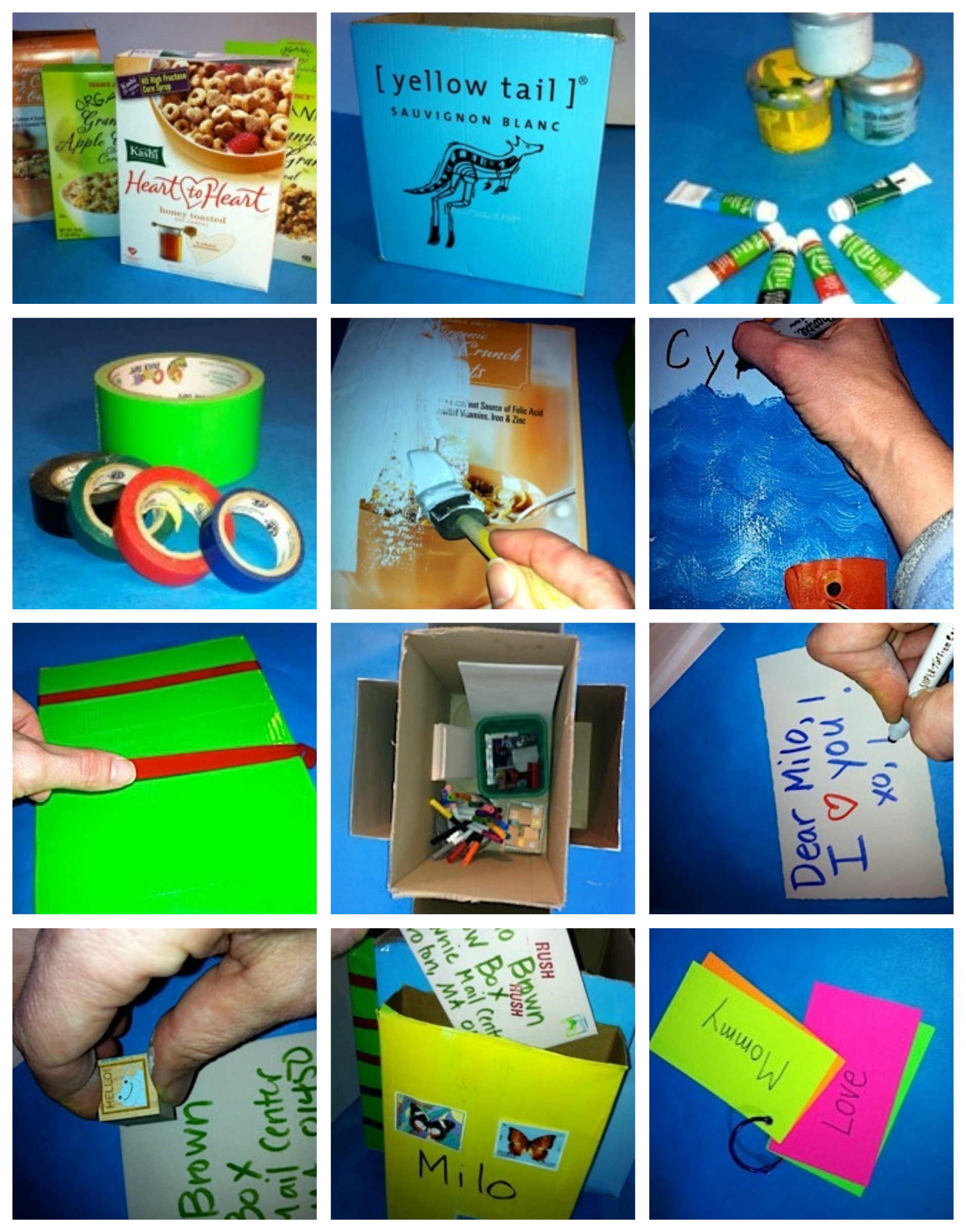
Remember when the daily snail-mail occasionally included an actual letter, handwritten, from a loved one? Oh, the satisfaction of real stationery, a personal message, familiar handwriting! Delicious!

Bring back the magic by building your own family post office. The project itself will absorb your family’s attention for an hour or two (perfect for a snow day!), but once you’ve created the post office, you can use it for years.

What you need:

  • One empty cereal or cracker box per family member. These will become mailboxes.
  • One larger cardboard box, which will become the post office (see image in opening paragraph). If your family is larger than four people, you’ll need a box with enough surface area to hold a cereal or cracker box for each family member.
  • Paint, tape in various colors (duct, masking, and electrical tape work especially well!), contact or wrapping paper to cover the cereal/cracker boxes.
  • Decorating supplies: permanent markers, magazine clippings, yarn, glue, fabric scraps, beads, glitter, doo-dads — any cool stuff you have lying around.
  • Paper, envelopes, markers, pens, rubber stamps, stickers, and other fun items for letter-writing.
  • A hot-glue gun (for grownups only!)

Directions:

  1. Cut the top flaps off the boxes.
  2. Decorate each cereal box. These will become the individual mailboxes. Make sure each family member’s box is labeled with his or her name. Hint: If you’d like to paint each box ahead of time to cover up the printing on the box, then children won’t have to wait through drying time to add their own artistic touches.
  3. Hot-glue each mailbox to one side of the larger box. Hint: Decorating the larger box is also fun!
  4. Load the inside of the large box with writing supplies. This is now your post office!
  5. Write a letter!
  6. Address an envelope.
  7. Mail your letter, and wait for a reply!

A few more helpful hints:

  • Younger children might like a set of cards with familiar words on them, so they can write letters\ on their own. Write words on index cards, punch a hole in the corners, and connect with a binder ring.
  • A quick letter can be a great way to let your child (or spouse/partner) know that you appreciate something they’ve done that day. “Dear Mikey, I noticed that you put your pajamas in the laundry basket after you got dressed this morning. Thank you so much! Love, Mom.”
  • Sometimes older children deflect direct discussions about feelings. Sending them a letter reminds them that you care — and opens up communication — without putting them on the spot. “Dear Katie, I noticed that you seemed a little sad when Jill couldn’t come over to play today. I’m sure you’ll find something else that’s fun to do, but if you need a hug, come find me in the kitchen. Love you! Mom.”

Enjoy!

Ellen Olson-Brown

Ellen Olson-Brown is a teacher, author of four children’s books, aspiring yogi, Minervan, and enthusiastic consumer of art and office supplies. Positive psychology, mindfulness, and the science of human flourishing are her current fascinations, and she loves supportively daring people to amaze themselves. Ellen lives in Groton, Mass., with her husband and twin sons. 

::: This piece is reprinted from the most recent issue of the Creative Times — subscribe and join the fun!

Christine: Stepping Out on a New Journey….to Where, Exactly?

This evening, I will attend the first official function for new docents-in-training at the Virginia Museum of Fine Arts. I am about to become a volunteer tour guide for our state museum, one that just hosted the largest exhibit of Picasso works seen in the United States in years. I am so very excited about this step on a potential journey to….some place I don’t know yet.

I love going to school. I love learning, I love the process, and I love intellectual discussion. It’s been 15 years since I got my graduate degree in speech pathology, and I have been itching to go back to school for a long, long time. I don’t want to study speech pathology though, and I don’t want to get a PhD in a health-related field. I want to go back and do what I originally wanted to do before I got sidetracked by “good career potential” and other aspects of my chosen work. Truth is, I love to teach people, and as a therapist, I do get that opportunity every day in one way or another. But my real passion lies in art and history. It’s only taken me, oh, 25 or so years to finally figure that out and own it. One would think that would be a simple matter, right? Go get a degree in history or art and embark on a new career.

History is not a particularly revenue-generating field at the moment. Neither is art.

But as the saying goes, ‘Life is short’, and I might actually be in a position to do something with the passions that have been peripheral for the past 20 years. I make jewelry. I adore working with my hands, and producing works of art that people want to own and wear. But whenever people stop by my booth at an art show or a market, I find myself teaching about the origins of lampworking and how techniques haven’t changed in hundreds of years — only the equipment has. I talk about my design inspiration and how lower-class Romans used glass to imitate the precious jewels worn by the ruling classes. I talk about Viking women and their strands of glass beads, of hoards of jewelry found in England, and about the development of glassblowing and production-line work in the first few centuries of recorded history. I teach people that Murano is not the only source of glass or glassworking in the history of the world.

THAT just stokes my fires. (Ha!)

It has gotten to the point that just chatting people up at an art show isn’t enough. I do participate in a medieval living history group, but even that isn’t enough to satisfy the desire to educate people about these aspects of the world’s rich cultural history. I have spent a decent amount of time perusing the Master’s degree offerings at Virginia Commonwealth University. For a while, I thought I wanted to train to be an art teacher. It’s my deep love for museums, though, that keeps bringing me back to the Art History pages, where there is a concentration in Museum Education. But how can I get there, lacking an initial degree in Art History? Especially with my husband working on his bachelor’s, and me with three kids, one of whom is not yet school-age, returning to a rigorous graduate program is not feasible right now.

I patronize our state museum frequently, and I knew they used tour guides, so when the application process opened earlier this year, I eagerly applied. After one LONG written application and an in-person interview, I was accepted to train for the next year to become a VMFA docent. While I have been creative all my life, and have done many things that were outside my career field, this is probably the first “job” I have applied for and gotten (aside from being a Girl Scout leader) that has nothing to do with my being a speech therapist. It’s beyond thrilling!

So, tonight I start out on a journey in which I am not sure of the destination. Will the yearlong training program satisfy my yearning to go back to school? Will conducting tours of the museum’s fantastic exhibits satisfy my desire to teach and excite people about our cultural history? Will I end up at the local community college next summer, taking prerequisite classes and studying for the GRE? I don’t know. I’m going to find out, though, and I am so excited.

The Art of Summer

Summertime brings inevitable changes to our daily routines. Whether it’s the longer days, kids out of school, vacation plans, or simply the warmer weather, you may be finding it difficult to focus on your creative work. Here’s how to get the most out of the summer months without losing creative momentum.

  • Use the outdoors to your advantage. If your creative work is portable, take it outside. Paint outside, play music outside, work on your laptop outside. Allow yourself to soak up the intensity of summer and invite the season to permeate your creative work. For those in northern climates, summer is gone in the blink of an eye — so get out there and enjoy it, while being creative to boot. Click here for more on making the most of the outdoors.
  • Chose a creative goal to complete before autumn. Consider the framework of your summer and decide on a reasonable objective. Your goal might be “finish five chapters in my novel,” “complete three canvases,” or simply “be creative every day.” Share your goal with others, as accountability will help you stay on track. You might also consider an external endpoint, such as a contest deadline, to add focus.
  • Set a minimum daily requirement. Summer seems to require an extra dose of flexibility — and the last thing you want is more “shoulds” in your life. That said, it’s helpful to set a “bare minimum” daily requirement as a target. Being creative every day keeps the pump primed and will make it much easier for you to resume your regular creative practice when the time comes. So decide that no matter what, every day you will write 100 words, sketch for 10 minutes, sing for half an hour — whatever makes sense.
  • Take a creative staycation. If budget and/or logistics prohibit going on a creative retreat, make your own. Pick a long weekend, design your own program, and send the kids to grandma’s. Your retreat can include a trip to a museum, a long solitary walk, browsing art magazines or an inspiring book, and of course, plenty of creative practice.

This article originally appeared in the June 2011 newsletter of the Creativity Coaching Association. Reprinted by permission.