Skip to content

Your Creative Intentions: The Monday Post ~ April 22, 2013

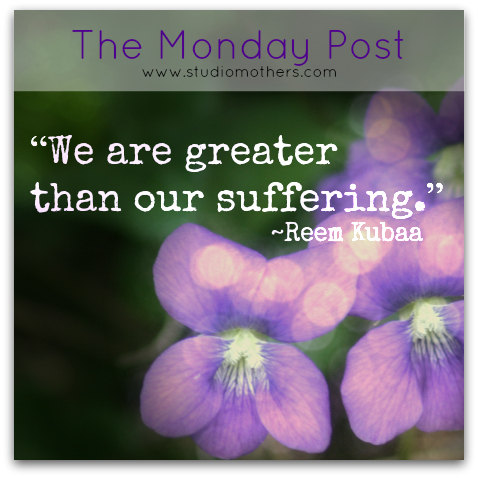
We are greater than our suffering

If you aren’t doing your creative work as often as you’d like, recommit to a regular creativity practice. Regularity — a daily practice, if possible — is one of the best ways to stay in touch with how you make meaning.

What are your plans for creative practice this week? Given the specifics of your schedule, decide on a realistic intention or practice plan — and ink that time in your calendar. The scheduling part is important, because as you know, if you try to “fit it in” around the edges, it generally won’t happen. An intention as simple as “I will write for 20 minutes every morning after breakfast” or “I will sketch a new still life on Wednesday evening” is what it’s all about. If appropriate, use time estimates to containerize your task. (Time estimates can make a daunting project feel more accessible.)

Share your intentions or goals as a comment to this post, and let us know how things went with your creative plans for last week, if you posted to last week’s Monday Post. We use a broad brush in defining creativity, so don’t be shy. We also often include well-being practices that support creativity, such as exercise and journaling.

Putting your intentions on “paper” helps you get clear on what you want to do — and sharing those intentions with this community leverages the motivation of an accountability group. Join us!

:::::::

If you’re an artist or writer with little ones, The Creative Mother’s Guide: Six Creative Practices for the Early Years is the essential survival guide written just for you. Concrete strategies for becoming more creative without adding stress and guilt. Filled with the wisdom of 13 insightful creative mothers; written by a certified creativity coach and mother of five. “Highly recommended.” ~Eric Maisel. 35 pages/$11.98. Available for download here.

Your Creative Intentions: The Monday Post ~ April 15, 2013

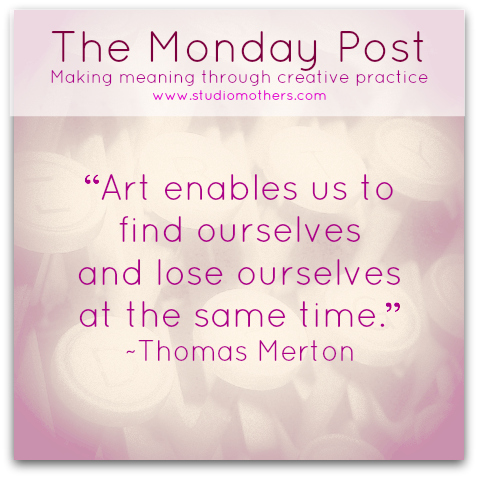
Monday Post Thomas Merton quote

If you aren’t doing your creative work as often as you’d like, recommit to a regular creativity practice. Regularity — a daily practice, if possible — is one of the best ways to stay in touch with how you make meaning.

What are your plans for creative practice this week? Given the specifics of your schedule, decide on a realistic intention or practice plan — and ink that time in your calendar. The scheduling part is important, because as you know, if you try to “fit it in” around the edges, it generally won’t happen. An intention as simple as “I will write for 20 minutes every morning after breakfast” or “I will sketch a new still life on Wednesday evening” is what it’s all about. If appropriate, use time estimates to containerize your task. (Time estimates can make a daunting project feel more accessible.)

Share your intentions or goals as a comment to this post, and let us know how things went with your creative plans for last week, if you posted to last week’s Monday Post. We use a broad brush in defining creativity, so don’t be shy. We also often include well-being practices that support creativity, such as exercise and journaling.

Putting your intentions on “paper” helps you get clear on what you want to do — and sharing those intentions with this community leverages the motivation of an accountability group. Join us!

:::::::

If you’re an artist or writer with little ones, The Creative Mother’s Guide: Six Creative Practices for the Early Years is the essential survival guide written just for you. Concrete strategies for becoming more creative without adding stress and guilt. Filled with the wisdom of 13 insightful creative mothers; written by a certified creativity coach and mother of five. “Highly recommended.” ~Eric Maisel. 35 pages/$11.98. Available for download here.

Meme of the Week

10 things that should never be said to artists

Happy Friday.

:::::

When Do Ideas Happen?

The Canadian painter Robert Genn writes a terrific, twice-weekly newsletter. While Genn writes primarily about painting, his thoughts apply to any creative pursuit, including writing — and we’ve reposted his letters here several times before. The gem below, which looks at the situations that generate ideas, is reprinted by permission.

Recent research, aimed at finding specific triggers that result in good ideas, better solutions and bouts of creativity, has confirmed my own favourite times when stuff happens. Here are a few:

When we step away: Focusing at your workstation doesn’t always work, particularly if you do too much of it. Leave your cubicle or studio and step into a new environment. Great stuff is ready to grab out there, floating in the ether.

When we’re in transition: Waking up, falling asleep, showering, tubbing, or going to the bathroom are hot times for new ideas. We need to trust the possibilities of fleeting brain waves at these times and take the trouble to knock them down for further study.

When we’re drinking: Moderate drinking gives confidence and gusto. A 2012 study at the University of Illinois at Chicago found that students who drank enough to raise their blood-alcohol level to 0.075 performed better on tests of insight than sober students.

When we’re doing chores: This may be one of the reasons why so many artists prefer to have their studios at home. I absolutely don’t want this sort of information passed around, but I personally find stimulation in washing cars, taking out the garbage, and helping our gardener move bags of manure.

When we’re satisfied: A relatively fulfilled life calms the mind and enriches the ground for idea growth. I’ve tried frustration, anger, disappointment, tiredness and misery, and they all work to a degree, but joyous satisfaction and a sense of élan work best.

When we’re daydreaming: It turns out that daydreaming is one of the most valuable things that creative people do. Even the fantasizing of chicks that bedevils a lot of men apparently hastens bubble-up ideas from the subconscious that have nothing to do with women. What women need to fantasize, I’m not sure.

When we see green: Green surroundings, whether green-painted walls or the green outdoors, suggest new growth, rebirth, fertility, and renewal — just one of the reasons why a walk in the park can be so fruitful. Feeling non-creative in the studio? Squeeze out some green.

Best regards,

Robert

PS: “When students were given creativity tests, those whose test-cover pages had a green background gave more creative answers than those whose pages were white, blue, red or grey.” (Sue Shellenbarger, reporting in the Wall Street Journal)

Esoterica: Personal and unique fetishes can be useful as well. For a steady flow of creativity, easel-time foot-massage has been recommended, as has military marching music played loudly. I notice slight rises when I consult or share minor triumphs with Dorothy the Airedale. She is non-confrontational, always eager, never critical, and I know she’s quite fond of me. Sometimes she likes my creativity so much she sleeps on it. In other words, she’s a low-maintenance muse. ‘Scuse me, she just came in, and now she wants out.

:::::

Don’t miss the treasure trove of Genn’s letters here.

Your Creative Intentions: The Monday Post ~ April 8, 2013

Melissa Jean quote

If you aren’t doing your creative work as often as you’d like, recommit to a regular creativity practice. Regularity — a daily practice, if possible — is one of the best ways to stay in touch with how you make meaning.

What are your plans for creative practice this week? Given the specifics of your schedule, decide on a realistic intention or practice plan — and ink that time in your calendar. The scheduling part is important, because as you know, if you try to “fit it in” around the edges, it generally won’t happen. An intention as simple as “I will write for 20 minutes every morning after breakfast” or “I will sketch a new still life on Wednesday evening” is what it’s all about. If appropriate, use time estimates to containerize your task. (Time estimates can make a daunting project feel more accessible.)

Share your intentions or goals as a comment to this post, and let us know how things went with your creative plans for last week, if you posted to last week’s Monday Post. We use a broad brush in defining creativity, so don’t be shy. We also often include well-being practices that support creativity, such as exercise and journaling.

Putting your intentions on “paper” helps you get clear on what you want to do — and sharing those intentions with this community leverages the motivation of an accountability group. Join us!

:::::::

If you’re an artist or writer with little ones, The Creative Mother’s Guide: Six Creative Practices for the Early Years is the essential survival guide written just for you. Concrete strategies for becoming more creative without adding stress and guilt. Filled with the wisdom of 13 insightful creative mothers; written by a certified creativity coach and mother of five. “Highly recommended.” ~Eric Maisel. 35 pages/$11.98. Available for download here.

Meme of the Week

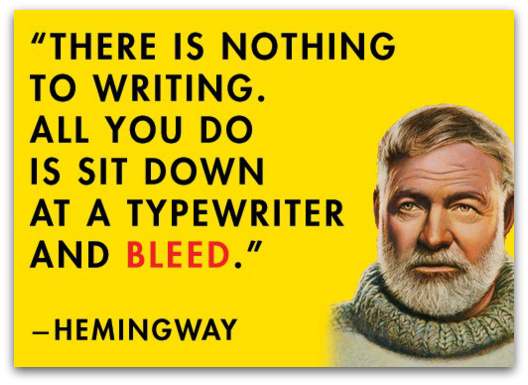
Hemingway_meme

Happy Friday.

:::::

From the Archives: The Creative Family Bathroom

This piece, which was originally published in 2010, is one of the most accessed posts in the Studio Mothers archives. We’re dusting it off today for those of you who haven’t seen it before — and those of you who have a soft spot for before-and-afters, like we do.
 

Let’s face it. When you add up all the minutes, most of us spend quite a lot of time in the bathroom. Especially when you have young children who need help wiping and washing, the bathroom can be a busy place.

Here’s a glimpse of what our little half-bathroom looked like when we bought our house:

And this is what it looks like now:

When I stumbled across this wallpaper last year, I had to have it. And I don’t even like wallpaper. But the idea of being able to write on the walls — permanently — filled me with excitement. One wall of paper would do it. (I trash-picked the mirror hanging above the sink, so that added a few dollars to the budget.) Bright paint would go on the other walls. The only “rule” for writing on this wall is not to create anything obscene. (I have teenagers, so a rule like this is actually necessary.) Other than that, anything goes. I’ve added a few collage pieces, and I look forward to creating a few mini paintings. The wall has become something of a guest book, too. We encourage guests to add something to the wall as a remembrance of their visit. And of course, all ages are welcome to contribute. (Yesterday I overhead one of my 14-year-old daughter’s friends exclaim: “You mean you can just come in here and write on the walls any old time you feel like it??” And my daughter’s response — slightly smug — “Yup!”)

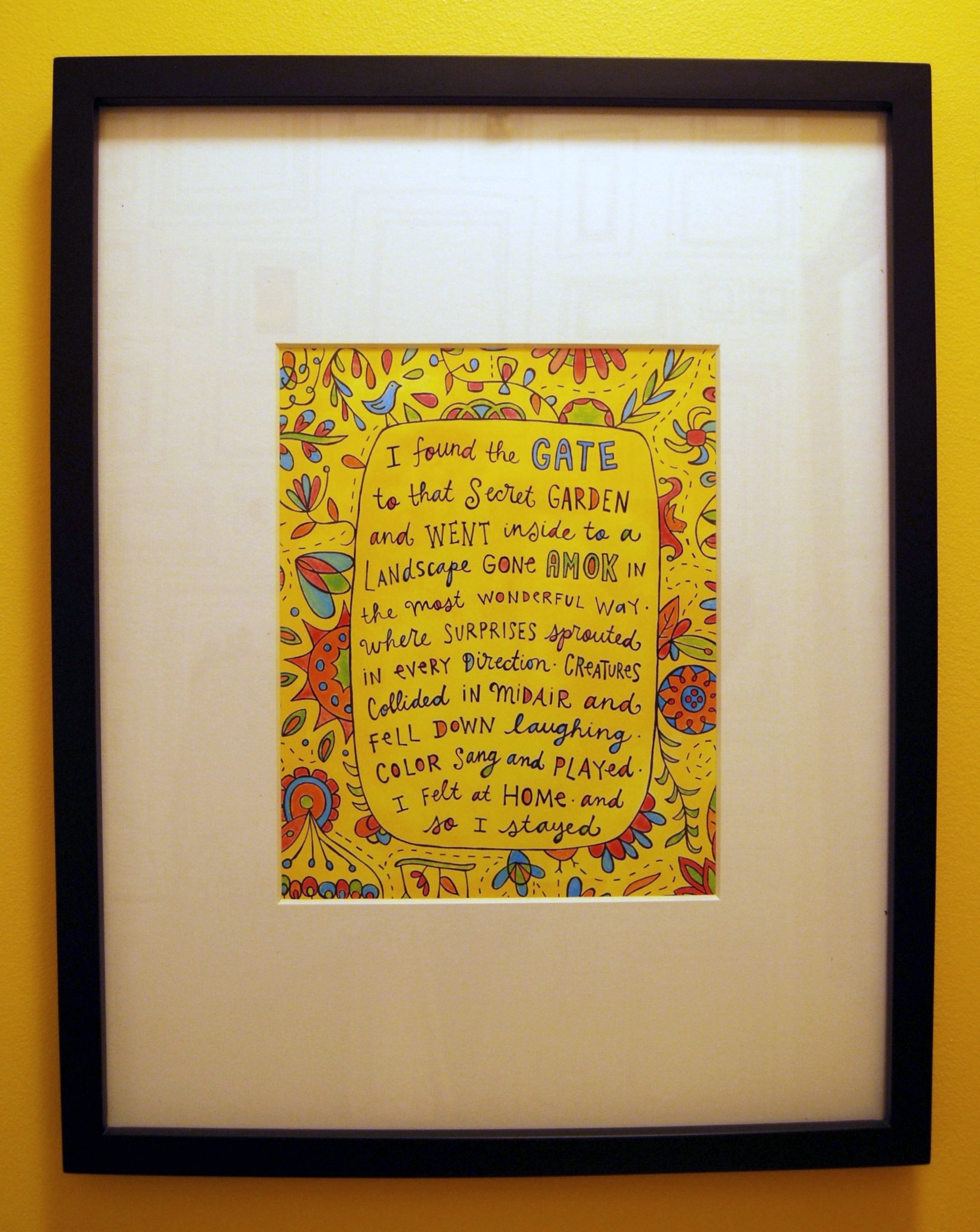
You’ll see that this little room features two of my recent acquisitions from Aimee Myers Dolich of Artsyville. I love her work — and I especially love how the “doodles” and black frames (inexpensive frames from Target) echo the intention and inspiration of our create-it-yourself wallpaper, as well as the color of the painted walls. (And per the doodle, there ARE stacks of books in this room too — well, a shelf full, anyway!) A beautiful fit.

Future owners of our house will either love the wall and embrace it for themselves, or rip it all off (and God forbid, return it to the original, boring off-white). I imagine that wherever I live, I’ll always want to have a wall like this somewhere in my house.

So there you have it — the creative family bathroom. Any of you who ever come for a visit are eagerly encouraged to add your creative signature to our bathroom wall!

Your Creative Intentions: The Monday Post ~ April 1, 2013

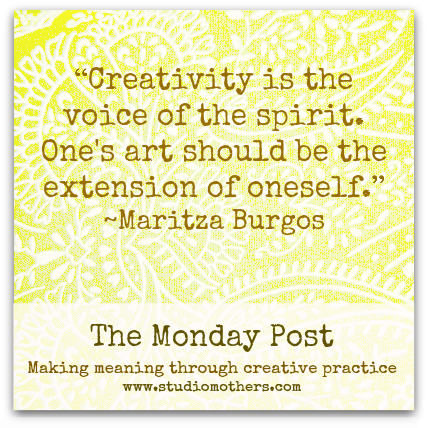
Maritza Burgos quote

If you aren’t doing your creative work as often as you’d like, recommit to a regular creativity practice. Regularity — a daily practice, if possible — is one of the best ways to stay in touch with how you make meaning.

What are your plans for creative practice this week? Given the specifics of your schedule, decide on a realistic intention or practice plan — and ink that time in your calendar. The scheduling part is important, because as you know, if you try to “fit it in” around the edges, it generally won’t happen. An intention as simple as “I will write for 20 minutes every morning after breakfast” or “I will sketch a new still life on Wednesday evening” is what it’s all about. If appropriate, use time estimates to containerize your task. (Time estimates can make a daunting project feel more accessible.)

Share your intentions or goals as a comment to this post, and let us know how things went with your creative plans for last week, if you posted to last week’s Monday Post. We use a broad brush in defining creativity, so don’t be shy. We also often include well-being practices that support creativity, such as exercise and journaling.

Putting your intentions on “paper” helps you get clear on what you want to do — and sharing those intentions with this community leverages the motivation of an accountability group. Join us!

:::::::

If you’re an artist or writer with little ones, The Creative Mother’s Guide: Six Creative Practices for the Early Years is the essential survival guide written just for you. Concrete strategies for becoming more creative without adding stress and guilt. Filled with the wisdom of 13 insightful creative mothers; written by a certified creativity coach and mother of five. “Highly recommended.” ~Eric Maisel. 35 pages/$11.98. Available for download here.

Meme of the Week

the_book_meme

Happy Friday.

:::::

Molly: Honoring Your Creativity

Molly Tinsley recently posted several comments here at Studio Mothers, and I was intrigued by her creative process. I knew you’d enjoy hearing more from this Australian, home-schooling mother of three. Enjoy!

::::: 

My “studio.” I did have one in the garage, but it got engulfed when my parents moved house!

My “studio.” I did have one in the garage, but it got engulfed when my parents moved house!

I double-guessed my creative impulse for far too many years. I’ve always been “crafty”; always decorated the edges of my school notes with complex designs that were far more interesting than what I was writing down. I studied art, particularly ceramics, all the way through high school, but was told quite seriously at the age of 15 that creativity was something that I would “grow out of” and so being a good girl I shelved it away and studied to become a lawyer. (That was an absolute disaster — its own saga.)

But now, 25 years after that unhelpful advice, I find myself struggling back towards that creativity — back towards a creative life, a life in which I take my creativity seriously, in which I listen to it and honor its impulses. This is how I found Studio Mothers — looking for someone who could help me with this re-focusing while homeschooling three energetic little boys! I found the advice to do something creative every day, even if it’s just jotting down an idea on an index card, to be incredibly helpful and inspirational. I find it very hard to find and honor my creative impulse and this is a way of acknowledging this part of my life on a daily basis.
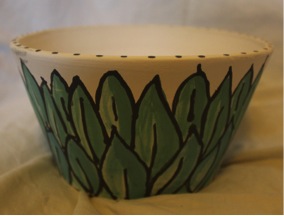
“Gum Leaf” bowl. Stoneware, underglaze and underglaze inks.

“Gum Leaf” bowl. Stoneware, underglaze, underglaze inks.

I often liken my creativity to listening for a faint sound of music on a windswept beach. I need to turn carefully to hear the thread of sound and to follow it. I’ve found that the second I try to force something — to do what I “should” — the sound dries up and I have to start at the beginning again.

Some people are born with the equivalent of full-blown marching bands: they’ve always known what they wanted to do and have never doubted their calling or their path. For the rest of us, particularly those of us who have had our creative leanings deliberately discouraged, the process is a little more tenuous. I’d like to add that that discouragement isn’t necessarily cruel. It’s simply that most people don’t understand how a living can be made from artistic pursuits, and so assume it can’t be done and try to discourage the budding artist “for their own good.”

Leonie Dawson has a wonderful, and quite different, way of describing the creative process. She calls it Riding the Wild Donkey. Actually, being Leonie, she calls it “Riding Ze Wild Donkey” and it’s a much more robust way of framing the issue than “Listening for the Windsong of the Universe.” 🙂

“Bushfire Sunset.” Acrylic on MDF.

“Bushfire Sunset.” Acrylic on MDF.

Her take is that a Wild Donkey of an idea shows up in your paddock and you jump on and ride that thing until it’s done. She has periods of intense creativity and yeehahs her way through until the project is finished, then has periods of recuperation. She calls the stuff she’s tried to do slowly “Mount Project” as it’s piled up into a heap on her desk and slowly gets bigger.

I think that the key to this approach is that you just go at it until it’s done. This may well work better with e-books and courses than with 15-foot canvases or epic photography series. In those cases, you have to find a greater depth of stamina and commitment to see the project through. Or, alternatively, you may need to find some way of chunking the project down so that you can throw yourself at each part with mad abandon.

This approach also has echoes of The Cult of Done Manifesto, which is, as it sounds, about finishing work. I don’t agree with all of it. Number 5, for example: “Banish procrastination. If you wait more than a week to get an idea done, abandon it.” That wouldn’t work for me. I tend to pick things up, do them for a bit, put them down again, then pick up something else. Eventually, I work my way back around to something that I put down and finally finish it. This is where the bit about honoring my creativity comes in. The urge is to finish at all costs, but I just don’t work like that and I need to trust in my process — that I *will* circle back around to those pots and finish them; but right now I’m sticking seashells to my collage (isn’t acrylic medium AMAZING?!).

“Gum Leaf” platter. Porcelain, underglaze. ceramic inks.

“Gum Leaf” platter. Porcelain, underglaze, and ceramic inks.

I’ve also found it unbelievably annoying that the second I try to monetize my art, the creative impulse just dries up completely. I have an Etsy shop that has held the same scarves for the last year. I have a studio FULL of art that I keep putting off photographing and popping up for sale. I have a wide selection of rather cute ceramic dishes (if I do say so myself!) that have been waiting for 4 months to have their bottoms waxed and to be dipped in clear glaze and given their final firing.

I’m lucky in that my family is not dependent on my ability to make money from what I love. I have the opportunity to experiment widely both within and across genres and media. In the last year I have experimented with photography, stamp carving, reduction lino printing, ceramics, acrylic and watercolor painting, needle felting, and collage. In the past I have also experimented with papier-mâché, mosaics, garden design, acid etching, dying, and sewing.

Without a supportive partner, I’d currently be working as a librarian and checking out craft books from the library on the weekends! When I was working fulltime, I had absolutely no time or energy left for my art. Homeschooling has its own set of challenges, but I can set the boys up with paints and paper and they can splosh away while I try to get some painting or glazing done.

Actually, while I have my librarian’s hat on, I can highly recommend the book “Creating a Life Worth Living” by Carol Lloyd. It’s not a quick read, but the book is worth dipping into and out of as Lloyd covers a huge number of the issues to do with both having a creative life and paying the bills at the same time.
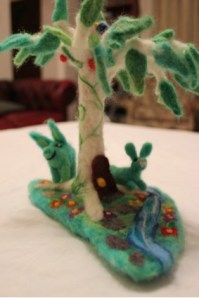
Needle-felted Fairy Tree with Bluebird of Happiness & Zombie Pig & Rabbit. Wool.

Needle-felted Fairy Tree with Bluebird of Happiness & Zombie Pig & Rabbit. Wool.

She’s also a great believer in daily creativity — whatever that may mean to you. I find Morning Pages a bit daunting these days, but can always find time to do a Zentangle. I also find needle-felting in the evenings while listening to documentaries (I MUST get into podcasts!) to be both relaxing and a good way to express my creativity. It’s turning to winter here in Australia and so I suspect that I will circle back around to my knitting needles and start again on the Bolero I put down last October.

Its difficult to trust in this process — to accept that its not an efficient way to get art done, but that it’s *my* way to get art done and if I don’t honor it, the desire to make art at all just dries up completely.

I’d be very interested to hear of your approaches to honoring your creativity. Do you work slowly or do you get things done fast in a fury of inspiration? Does getting paid for your art change the way you approach it? If you get paid for your art, do you approach paid and unpaid work differently? If you are a mother, how does caring for your family impact on your ability to honor your creativity? If you work, what affect does that have? We all have so many roles to play that it can sometimes be difficult to honor our creativity and still get everything else done! I’d love to hear how you do it!
Your Creative Intentions: The Monday Post ~ March 25, 2013

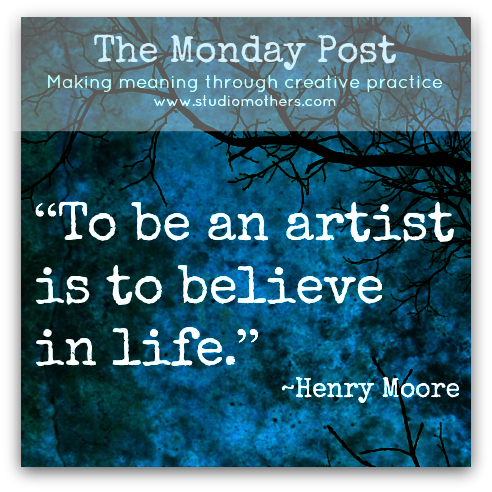
To be an artist is to believe in life.

If you aren’t doing your creative work as often as you’d like, recommit to a regular creativity practice. Regularity — a daily practice, if possible — is one of the best ways to stay in touch with how you make meaning. Can a regular creative practice be part of your intentions for 2013?

What are your plans for creative practice this week? Given the specifics of your schedule, decide on a realistic intention or practice plan — and ink that time in your calendar. The scheduling part is important, because as you know, if you try to “fit it in” around the edges, it generally won’t happen. An intention as simple as “I will write for 20 minutes every morning after breakfast” or “I will sketch a new still life on Wednesday evening” is what it’s all about.

Share your intentions or goals as a comment to this post, and let us know how things went with your creative plans for last week, if you posted to last week’s Monday Post. We use a broad brush in defining creativity, so don’t be shy. We also often include well-being practices that support creativity, such as exercise and journaling.

Putting your intentions on “paper” helps you get clear on what you want to do — and sharing those intentions with this community leverages the motivation of an accountability group. Join us!

:::::::

If you’re an artist or writer with little ones, The Creative Mother’s Guide: Six Creative Practices for the Early Years is the essential survival guide written just for you. Concrete strategies for becoming more creative without adding stress and guilt. Filled with the wisdom of 13 insightful creative mothers; written by a certified creativity coach and mother of five. “Highly recommended.” ~Eric Maisel. 35 pages/$11.98. Available for download here.

Meme of the Week

Creativity Takes No Excuses

Happy Friday.

:::::