Skip to content

Posts from the ‘Miranda’ Category

Is Your Environment Helping or Hurting You Creatively?

creative thoughtYour environment — whether it’s your office, studio, or family room — is full of cues that can have a significant impact on how you feel, what you think, and how you behave. As Malcolm Gladwell details in his bestseller Blink, our brains constantly decode information and influence our thoughts and actions in ways that may or may not support our goals. Is your environment continually sending you messages that undermine your creative process or self-confidence?

Gladwell cites a now-classic 1996 priming experiment wherein New York University researchers asked participants to rearrange scrambled words to form sentences. The control group received random sentences and the experimental group received sentences containing words we associate with the elderly, such as “Florida,” “old,” “forgetful,” “wrinkle,” and “bingo.” If you were among the experimental group, after finishing the test you would have walked down the hallway more slowly than the control group.

This experiment was just one of many that reveal our brains’ susceptibility to the subtle (but not subliminal) signals we receive. The unconscious mind guides us in ways we can’t control. It is for this reason that classical music has adopted the practice of blind auditions, using a screen to separate auditioners from the audition committee. It is simply too difficult to ignore information from visual cues — information that can support incorrect conclusions, such as the formerly widespread belief that women are inferior musicians. As Gladwell notes, in the three decades since the use of audition screens became commonplace, the number of women in top US orchestras has increased five-fold.

What does this mean for you, as a creative? It means that you need to ensure that what you see every day is empowering and inspiring. Take a hard look at what you’ve surrounded yourself with — and get rid of the things that don’t serve you. Be ruthless. Then invite in only the objects and cues that support your intentions, increase your productivity, and make you feel good. A few simple starters:

  • Clean up your desk: Piles of clutter may perpetuate feeling overwhelmed and disorganized.
  • Go green: Having a plant nearby can improve attentiveness, productivity, and well-being.
  • Use creative visualization: Make a vision board and hang it where you can see it daily.
  • Stick ’em up: Write your goals on Post-It notes and hang them in obvious places.

In the words of Napoleon Hill: “We begin to see, therefore, the importance of selecting our environment with the greatest of care, because environment is the mental feeding ground out of which the food that goes into our minds is extracted.”

What kinds of things do you keep in your environment that support your creativity?

:::::

A version of this piece was originally published in Creativity Calling, the newsletter of the Creativity Coaching Association.

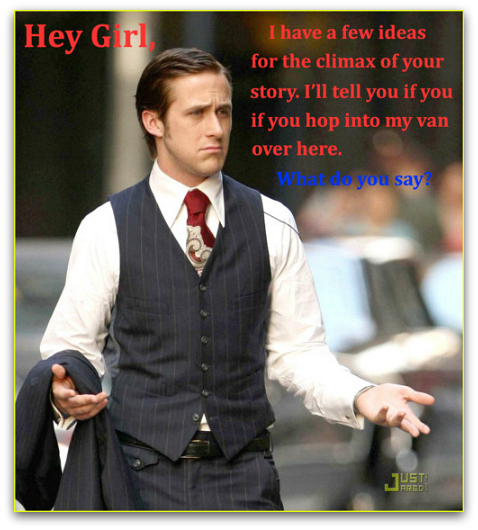
Meme of the Week

Ryan Gosling

Ryan Gosling FTW, whether you’re doing NaNoWriMo or not, I say!

:::::

Meme of the Week

South Park NaNoWriMo

NaNoWriMo means no editing! Just writing! Remember, you can take care of revisions during NaNoEdMo (March) if you need to 😉

:::::

Lucy: Cultivating Creativity in the Midst of Motherhood

Editor’s note: In the fall issue of The Creative Times, I previewed The Rainbow Way by Lucy H. Pearce, a positive, nurturing, practical book that will help you unlock your creative potential within the constraints of motherhood. I was glad to provide Lucy with advance praise for her work — and invited Lucy to share her story with the Studio Mothers audience, as I know you will relate. *In celebration, we’re giving away two free e-books! To enter, leave a comment below before 5:00 pm eastern time on November 15, 2013.* And don’t miss Lucy’s invitation to join her blogging carnival of creative women!


Lucy PearceMany of us dream of becoming writers, or artists, or dancers. And then, one day, when babies come along, whether by accident or design, out go the books or paintings with the baby’s bath water — whether through busyness, lack of support, or the misguided belief that we should now dedicate ourselves entirely to our children.

I know. Because it happened to me.

There I was in No-Woman’s Land. Tattered creative dreams in one hand. Children in the other. With little support and no way of knowing how to move forward, how to reclaim my lost self and dreams.

Over the years I have created a new dream for myself: that of the creative mother — writer, artist, editor, and entrepreneur. Out of necessity and a need for sanity. Sometimes the balance has tipped further towards motherhood, at other times creativity. But both elements have been constants in my life. No matter how tired, how overwhelmed, I was never willing to relinquish either my almost-fulltime mothering role, or my creative work. It has been an adventure, and one for which I had few real-life role models.

When I first started out in motherhood, I kept comparing myself to other women who seemed content in their role as stay-at-home mothers, and concluded that I must be doing it wrong. I was happy and recharged when I had my creative time; impatient and mean when I didn’t. But this need, this urge, was not a whim. It would not go away. And so I learned, little by little, to honor it and build my life around it.

The Rainbow WayAt the time I thought I was the only one feeling this way. But in researching my book, and talking to other mothers, I found I was not alone. We are not celebrated by our society. But we are here, wiping little bottoms and writing poetry. Making sculpture and breastfeeding. Writing books late at night and on the bottom of shopping lists. We are here. And we matter.

I wrote The Rainbow Way: Cultivating Creativity in the Midst of Motherhood for myself, for the mother I had been, and all the creative mothers who contact me every week feeling stuck and unsure, lost and confused about how to be both mothers and creative souls in this busy modern world. It came to me and demanded to be written. And so I scribbled notes on any piece of paper I had on hand, wherever I was, in doctor’s offices, car parks, and at the kitchen table. Read more

Meme of the Week

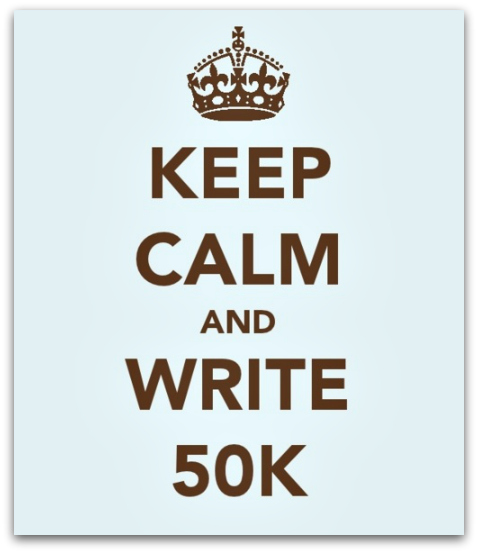
Keep Calm and Write 50K

A big salute to everyone who’s embarking on NaNoWriMo today. Woohoo!

:::::

Distracted? Frustrated? Wasting Your Time?

The importance of goalsLast month, I came across this quote by the writer Robert Heinlein: “In the absence of clearly defined goals, we become strangely loyal to performing daily trivia until ultimately we become enslaved by it.”

These words resonated deeply.

I was frustrated at the time. I’d become overwhelmingly “busy” with things that didn’t really matter to me. Unrewarding projects were taking too long; I was working inefficiently. The lure of Facebook, Instagram, Pinterest, Reddit, and Words With Friends had become almost irresistible. What had happened? I used to be good at keeping distractions in a box. I’d long ago learned not to check e-mail outside of the workday; why was I suddenly having so much trouble with these other distractions?

The quote reminded me of what I already knew, a few layers down. I’d drifted away from some of my big-picture goals. My daily writing practice had been disrupted. My planning system was in flux and not yet fully supporting my focus. In the absence of my goals, trivia had become my master. I had enslaved myself to things I didn’t care about.

Naming the situation for what it was had an almost immediate effect. I reconnected with my self-discipline and created boundaries where I needed them. I started rewiring the bad habits I’d developed.

If you too find yourself “procrastinating” more than seems reasonable, ask yourself: Do I know what I really want to be doing right now? What is it that I’d planned to accomplish this year? What can I do to move toward my big-picture goals before the calendar flips to 2014?

Robert Heinlein, the author of this quote, was an American science fiction writer. According to Wikipedia, Heinlein was “often called the ‘dean of science fiction.’ He was one of the most influential and controversial authors of the genre in his time. He set a standard for scientific and engineering plausibility, and helped to raise the genre’s standards of literary quality.”

Heinlein had quite a few smart things to say. A few of my favorites:

  • Writing is not necessarily something to be ashamed of, but do it in private and wash your hands afterwards.
  • Everything is theoretically impossible, until it is done.
  • Women and cats will do as they please, and men and dogs should relax and get used to the idea.

But lest I take up more of your time with delightful quotes, step away from the trivia, and spend your hours where they count.

:::::

More trivia, if you’re still reading: It appears that Heinlein’s original quote had an errant hyphen between “clearly” and “defined.” Compound adjectives are hyphenated (the green-eyed monster), but adverbs combined with adjectives do not create a compound. Adverbs are inherently modifiers, so their meaning in a series is clear without the hyphen. I took editorial license (as is permissible) and corrected Heinlein’s quote in this post, and went so far as to correct the meme above too (the source of which I am unable to credit). Oh, you didn’t know that my editorial business fills the bulk of my non-coaching daytime hours? (And you wonder why I’m so easily distracted!)

:::

Meme of the Week

How to be an artist

As seen at Gwarlingo.

Happy Friday.

:::::

Meme of the Week

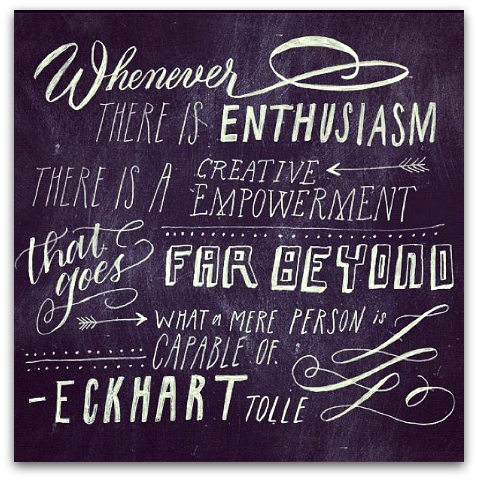
Eckhart Tolle quote

Happy Friday.

:::::

Meme of the Week

Inspiring creativity

Happy Friday.

:::::

Meme of the Week

The Creative Process

Happy Friday.

:::::

Meme of the Week

Meme_Joseph_Campbell

Happy Friday.

:::::

How to Think Less and Do More

The Canadian painter Robert Genn writes a terrific, twice-weekly newsletter. While Genn writes primarily about painting, his thoughts apply to any creative pursuit, including writing. The gem below, which looks at ways to stop wasting time in the abyss of decision-making, is reprinted by permission.

Choreographer Twyla Tharp’s The Creative Habit describes her morning routine of rising early and going through the same morning rituals; same coffee, same bun. She puts on the same leotards, goes down the same elevator to the same street corner, puts her same arm up in the air and gets into the first cab that comes along.

By the time she gets to the studio she has made no significant decisions. Stepping out onto the dance floor, her dancers await. It’s eight in the morning and her first decision is yet to come. It will be a creative one.

We painters also need to save our decision-making for things of importance. “Don’t,” as they say, “sweat the small stuff.” I figure an average 11″ x 14″ uses up several hundred thousand decisions. Compound that over a day of painting and it’s in the millions. Even the small decisions in a painting, some of them so micro and seemingly insignificant, are the building blocks of what we are to become.

Fact is, some lives are so filled with impedimentary drama and ancillary decision-making that there is little time left over for work.

While I sympathize with those who find it difficult to eliminate some workaday decisions, the idea is to step ASAP into the happy hunting ground. Here are a few ideas:

  • Simplify morning rituals.
  • Keep regular habits by day and week.
  • Have your workplace nearby and handy.
  • Work in a space unsullied by impedimenta.
  • Use a day-timer — plan your work; work your plan.
  • Always ask — “Is this action necessary?”
  • Be businesslike — discourage time-wasters and interlopers.
  • Be efficient and mindful of wasted motion in your space.
  • Drive your car mainly for pleasure.
  • As far as possible, get stuff delivered and taken away.
  • Be modern — pay bills, bank, book flights, etc., online.
  • Keep your dress code practical and simple. You don’t need to look good in a studio.
  • Quit your day and move to a relatively decision-free mode: Play well, laugh much, love much, sleep well.
  • Finally, and most important, with every non work-related decision, you need to decide: “Is the decision I’m making truly needed, or is it just another excuse?”

Best regards,

Robert

PS: “We cannot directly choose our circumstances, but we can choose our thoughts, and so indirectly, yet surely, we shape our circumstances.” (self-help pioneer James Allen)

Esoterica: The cosmetics tycoon and women’s advocate Mary Kay Ash said, “There are three types of people: those who make things happen, those who watch things happen and those who wonder what happened… You can decide which type of person you want to be.” We artists, in particular, need to be among those who make things happen. Self-starting, self-motivating and self-critical, we focus our energy on thought, planning, observation, quality control and production. Difficult decisions–lots of them–are both the joy and the burden of creative folks. “Those who avoid the tough choices of life,” said author Robert Brault, “live a life they never chose.”

:::::

Don’t miss the treasure trove of Genn’s letters here.