Kirsty: Taking the Lazy Road
 I am lazy.
“What’s that?’, I hear you cry, ‘you spend months patiently tying knots in string, sticking pins through fabric or drawing every day for a year, how can you possibly call yourself lazy?’
Ah, but it’s a very specific kind of laziness and over the years — as I have come to understand it — I have adjusted my art practice to accommodate it.
I know myself and if I worked with the sort of materials that needed a specialist working environment like a forge or a foundry, I wouldn’t get much art made. If I undertook huge expensive projects that involved lots of paperwork, funding bids and meetings with planners and architects, I would never get any art made.
Heck, even if my studio was in another building, I would struggle. When I graduated, I hired a studio space on the other side of town because I thought that’s what you were meant to do. I kept it for a couple of months before recognising that I was working extra hours to pay for it but was hardly ever there and even when I was, I found it an uninviting place to work.
Eventually I realised that when I’d been a student, I used to make most of my work at home and then take it into college when it was finished. I tended to use my studio in college as an experimental installation space or somewhere to think, rather than somewhere to physically make work. I’m sure this is partly because I’d grown accustomed to fitting my art around parenting when my son was young. Having evolved as an artist whilst making work in the evenings on the kitchen table, a separate studio space felt like a barren and alien environment to me.
So now my studio is on the top floor of my house. Yet even that is not close enough and I tend to make my art in my study, my bedroom, my living room, my garden, on the dining room table and only occasionally in my studio.
I do enjoy the quiet and contemplative space of my studio, especially when I need to think, draw or make more mess than usual. But I also need my art to be part of my daily life; something I can pick up and put down as easily as the morning paper or my cup of tea. So art, for me, is largely a domestic affair and you’ll often find me making my more repetitive pieces in front of the TV or while listening to a podcast on my computer.
In addition, the sort of materials I use in my art — small, unregarded things like matches, pins, sequins or envelopes — are easily available, safe to use and relatively cheap. This is a deliberate choice on my behalf. Partly because I’m very interested in everyday objects that are so commonplace that they become effectively invisible but also because I am passionate about ‘owning the means of production’. I hate to be dependent on other people before I can even start to make my art.
I’ve never done well if I have to go through multiple steps to get something done and so wherever possible, my practice is organised to minimise that. For example, when I graduated I took out a loan so that I could upgrade my computer equipment and digital camera because I wanted access to the technology I’d used at college without having to go off to a library or rent out office premises.
My materials are a continuation of that desire for independence. I don’t need to work a day job to buy the sort of materials I use. Nor do I need to scrabble around for grants or sponsorship or jump through anyone else’s hoops before my work can come into being. I’ve learnt from experience that projects that do need access to specialist knowledge or equipment or more funding than I can provide myself are the ones that invariably end up on on the backburner.
Again, I’m sure my formative years of trying to combine art with parenting also informed my preference for cheap, readily available materials. Although I always bought the best I could afford, I was on a low income and got used to making do with what I had. And I found that I actually preferred it because it was easier to be loose and experimental with thousands of cheap, everyday things than with very rare or precious materials.
Some artists need the heroic struggle; it motivates and inspires them and forms a vital part of their practice. Others find that getting out of the house and into a separate studio space makes them more focused and dedicated. Yet others relish the challenge of working in very expensive materials.
But for me that stuff just gets in the way.
I need the path of least resistance because I find making good, meaningful art quite difficult enough without adding extra obstacles. I am perfectly capable of putting mental road blocks in the way of my own art practice and I realised early on that it would be disastrous if I added further restrictions such as the need for funding, planning permission, specialist studio requirements or expensive materials. So I have consciously set up my practice so that the only thing standing in the way of my art is myself — and believe me, that’s usually more than enough!
It’s vital as an artist to recognise your strengths and weakness and to play to both of them. Don’t make it any harder than it needs to be.
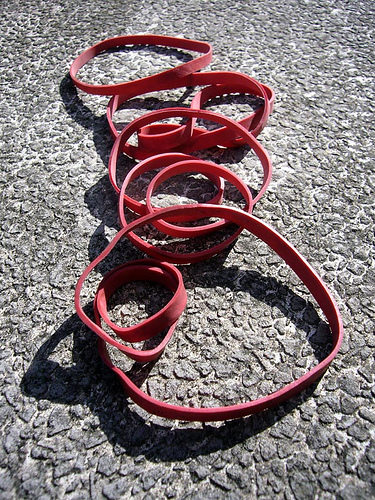
[Reposted from Kirsty’s website. Image (Rubber Bands 02) courtesy Kirsty Hall under a Creative Commons license.]





 Studio Mothers: Life & Art