Skip to content

Posts by Miranda

Mom Bloggers Club: Timing is everything

mombloggersclubaprilbannerfallNo offense, Mom Bloggers Club, but the recent post on My Favorite Writing Habits and Approaches left a few rather gaping holes.

This part was reasonable enough: “To develop your writing and/or passion, first make your presence with it a priority. It is simple. Make time and space for it.”

But this is all that the author has to offer for making that time and space:

TIME
Find the ideal pocket of time in your usual routine. Whether you develop a little bit of it daily or focus on it once every week, find the spot that is just right; one that flows with your energy.

Use this as a “rock” in your flow. Allow other things to move around it; keep it your priority.

I prefer mornings when the energy is fresh and it is more likely to be nice and quiet so that I can really be with my self and am not as easily distracted.

SPACE
Set up a space customized for developing your passion; one that is attractive to you and draws you in. Place all the essential tools customized for you and this project within easy reach. Make it so that it prompts your creative flow and feels great to be in.

Visit it every day, a few times. Even if just for a check in. Allow it to serve as a keystone to always keep you connected.

Uhm….what about the kids who are climbing up onto your lap with peanut-butter fingers, impaling their thumbs on your stapler and trying to electrocute themselves by sucking on the end of your PC’s power cord?

I think the topics of time and space merit more exposition. For content geared specifically to mothers, we need HELP. Well, I do, anyway. Perhaps, given that this post was directed toward bloggers, not “writers,” I’m being too harsh. I probably shouldn’t critique ANY attempt to be helpful. I’m sure the author has the best of intentions, and judging from the comments, there were those who found inspiration in the post. But considering that this piece was featured in the Mom Bloggers newsletter, I think there is room for a little more exploration.

Glossing over this terrain only adds to my existing frustration. There are mothers who want desperately to express themselves creatively — mothers who are crying in the frozen food aisle right this second, because they are so painfully separated from the creative part of themselves and can’t figure out how to reconcile the dichotomous pieces of their lives — and this kind of advice doesn’t really apply to them. When you have very young children at home — and limited resources — I don’t think that it’s as easy as finding a pocket of time in your usual routine (let alone a pocket that actually optimizes your biorhythms), and setting up some space for your work. Isn’t that the whole reason why this blog — our blog — has the following that it has? This stuff isn’t easy or simple, even though we wish it were. Maybe, for some women, it isn’t so complicated. Those are probably the women who have FINISHED their novels, too.

<sigh….>

The Divided Heart: Art and Motherhood

dividedheartLast year, while trawling the web, I came across mention of Rachel Power’s The Divided Heart: Art and Motherhood. The book’s scope was clearly related to my own work, so I immediately ordered a copy even though I had to order it directly from Red Dog, the Australian publisher. The book arrived in good stead — fat and enticing — but it took me nearly a year before making the time to read it while on vacation this August. I only wish I hadn’t waited so long.

Rachel Power explores the painful dichotomy that is inherent in being both a mother and an artist: “A divided heart; a split self; the sense that to succeed at one means to fail at the other.” Through profiles of professional creative women — many of whom are familiar names to an American audience — Rachel explores how the divided heart manifests for each artist. While every situation is different, there are undeniable — and affirming — commonalities. Rachel’s book is not prescriptive; rather it is an intimate exploration of what it means to be an artist and a mother.

The profiles are fascinating, but the most compelling parts of the book are the author’s introduction, first chapter, and conclusion — which are all personal and expository. Rachel Power is a beautiful writer, and her prose is brilliant and honest. Ultimately, I wished the book had included more of her own thoughts and analysis.

Here is an excerpt that will sell the book to this particular audience more than any reviewer’s pontification:

“I looked at the other mothers in the part in the hope of recognising something. But we were smiling, smiling, all noble silence. Inside, are you crushed? I wanted to ask them. Are you gazing at the planes that fly overhead with a barely disguised yearning? Are your legs restless to run? And then, do you see your child grinning proudly at you from the top of the slide and does your heart lurch? Does love storm through your body and cuase you to run toward that darling face as if you’ve never wanted anything more in your life?” (p. 15)

This, dear reader, is the divided heart. I know that you know it well. Fortunately, the book rings with optimism without glossing over the author’s premise: being an artist and a mother is inherently painful, but you CAN turn the experience into something beautiful and successful, if you try hard enough — and surrender to the rocky landscape. Rachel quotes Susan Rubein Suleiman: “…Any mother of young children…who wants to do serious creative work — with all that such work implies of the will to self-assertion, self-absorption, solitary grappling — must be prepared for the worst kind of struggle, which is the struggle against herself.”

The Aussie writer and blogger MamaMia (Mia Freedman) described The Divided Heart as “A book that changed my life” and posted a terrific interview with Rachel. In-depth blogger reviews abound; my favorites include Loobylu, PickleMeThis, and You can now order the book in hardcover through third parties at amazon, or a paperback via the publisher.

Rachel Power has her own blog, The Rachel Papers, which continues the conversation.

Without question, The Divided Heart is an important resource in our discussion and contemplation of motherhood and art.

London Evening Standard: Motherhood need not spell the end of literature

From the London Evening Standard‘s Sebastian Shakespeare:

There is no more sombre enemy of good art than the pram in the hall, wrote Cyril Connolly. Britain’s latest Nobel Laureate for Literature, Doris Lessing [at left], would doubtless agree. Lessing abandoned her two infant children (both under five) after leaving her first husband. “I had these two children and just couldn’t afford to keep them,” she said. Her two prams were not only enemies of promise but became emblematic of female poverty.

Some of the best female writers of the 20th century found it difficult to combine motherhood and creativity. Dame Muriel Spark walked out on her son when he was six to write novels and seek fame and fortune. She eventually cut her estranged son out of her multi-million pound will, leaving every penny of her assets to the female friend she lived with for 40 years.

Colette, who never wanted children, hardly ever saw her daughter, whom she left in the hands of an English nanny. She chillingly, albeit rather brilliantly, described children as “those happy unconscious little vampires who drain the maternal heart”. And as for Virginia Woolf, well, we all know what happened to her. The author of A Room of One’s Own, who argued that “a woman must have money and a room of her own if she is to write fiction”, ended up without children and committed suicide.

My wife, who is writing a book, recites this litany of names above as proof positive that motherhood and creativity do not go hand in hand — and the reason why she is putting procreation on hold. And Lessing’s Laureateship is now the icing on her anti-natal cake. Doris has set my breeding programme back by five years. However, for every bad egg there are plenty of examples of model literary mothers. What about Toni Morrison (1993 Nobel Prize winner), who continues to collaborate with her musician son Slade on children’s books?

Motherhood, far from being a hindrance, can be a spur to creativity. Look at JK Rowling, one of the most successful writers of the modern (or any) era, worth £500 million, who was a single mother when she embarked on writing her Harry Potter books.

Connolly’s maxim is not only out of date — in my block of flats I can’t keep a pram in the communal hallway — but plain wrong. The whole point of the perambulator is that you should push it around. JK Rowling took her baby out for a walk in the pram because it was the only way to get her child to fall asleep while she scribbled away in various Edinburgh cafés. You could argue that there is no better friend of good art than the pram in the mall. And, if you are lucky, the little blighter might actually get round to reading your book as well. At least that is what I’ll be telling my wife. Will my argument change her mind? I’ll get back to you.

Sebastian seems to be trying to convince himself, doesn’t he? I don’t feel comforted. Is this little piece uplifting, or just depressing?

Miranda: For the love of books

Warning. This post contains an unusually intense degree of navel-gazing and otherwise raving on and on about one’s home library and related minutiae. If you find such material nauseating, turn away now. I warned you!

On Friday, I posted this on Facebook:

Miranda Hersey Helin is staging a serious overhaul of the home library/office today, with Mom’s help. The question is — and please don’t cringe, fellow bibliophiles — shelve the books by author last name, or by jacket color? I know, I know….but I peruse and admire many design blogs and must admit that books shelved by color look fabulous. Although I’m not sure I can bring myself to mix genres…..help!

I was amused by the considerable volume of responses. People feel VERY strongly about how to organize their books — as well they should. This is serious business, people!

rainbowWhen I first heard of organizing books by color, I thought the premise was among the most ridiculous things I’d ever heard of. Not to mention sacrilegious. The whole idea sounded like “book as prop,” in the way that a professional decorator might buy small decorative things for a client’s room simply because they look nice against the wallpaper; nothing whatsoever to do with the item’s meaning or symbolism or its emotional value to the owner. Just “stuff.” Books, of course, are not “stuff.” Ew.

But over time, I came across more instances of books organized by color that really looked beautiful. Not just a stack of three yellow books next to a yellow vase, but shelves organized wholesale by color. Still, how would you ever find anything if you didn’t organize all of your books by genre and then by author last name?

When we moved into our new home in February of this year, I was thrilled to unpack my books and various possessions into our new library. I very vaguely segregated the books by nonfiction and fiction, intending to properly sort out the shelves, alphabetize my collection, and arrange all of my non-book items in the near future. Eight months later, the time finally arrived. My mother had given me a birthday coupon for a day’s worth of organizational help (and, most importantly, moral support) so I booked my sitter for an extra day, and on Friday my mother and I tackled the library. (It seemed indulgent to pay for babysitting in order to overhaul my library/home office, but considering that my mother and I worked all day long on Friday, and then I spent the better part of the weekend finishing the job myself, I know that this never would have happened if I hadn’t paid for the extra help.)

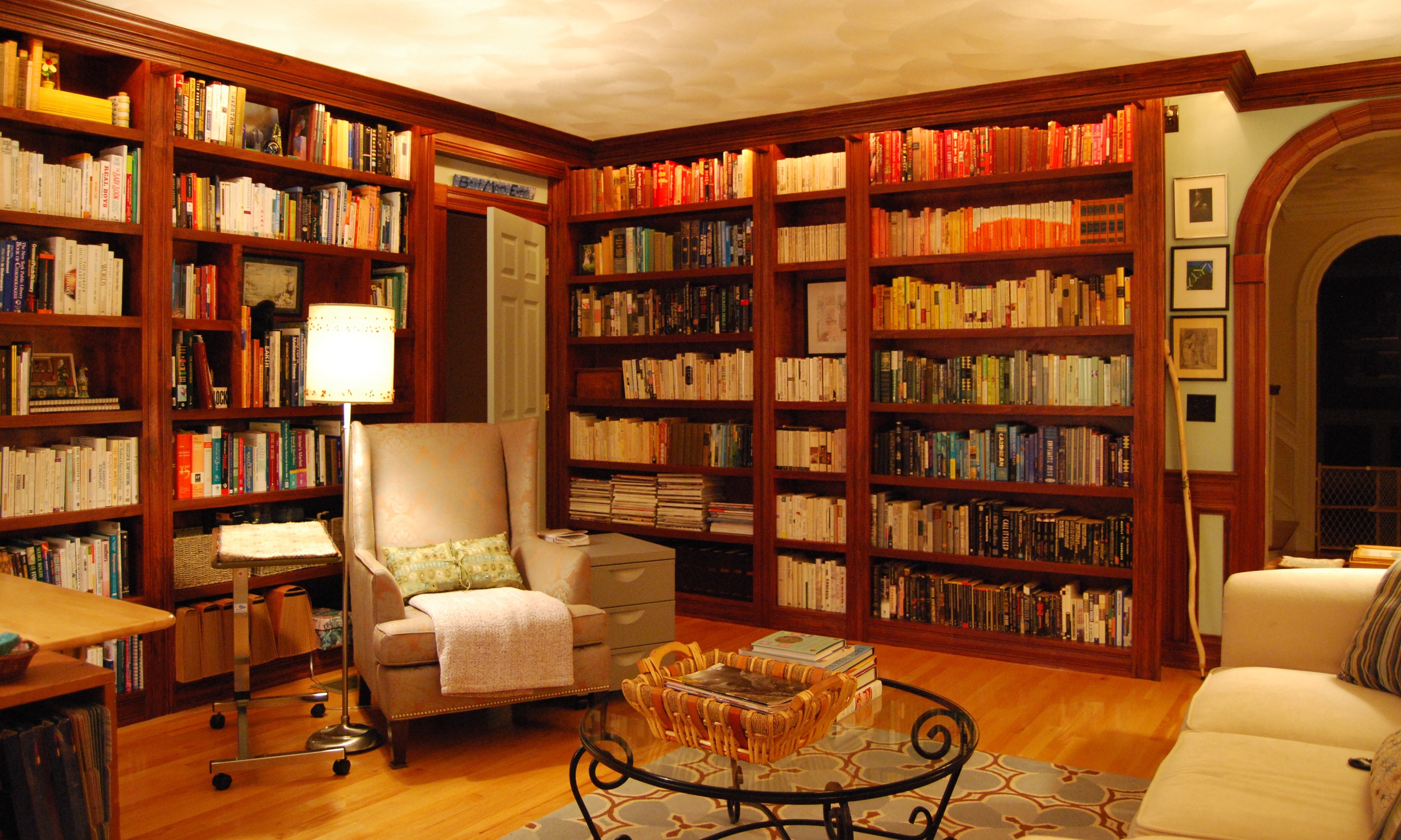
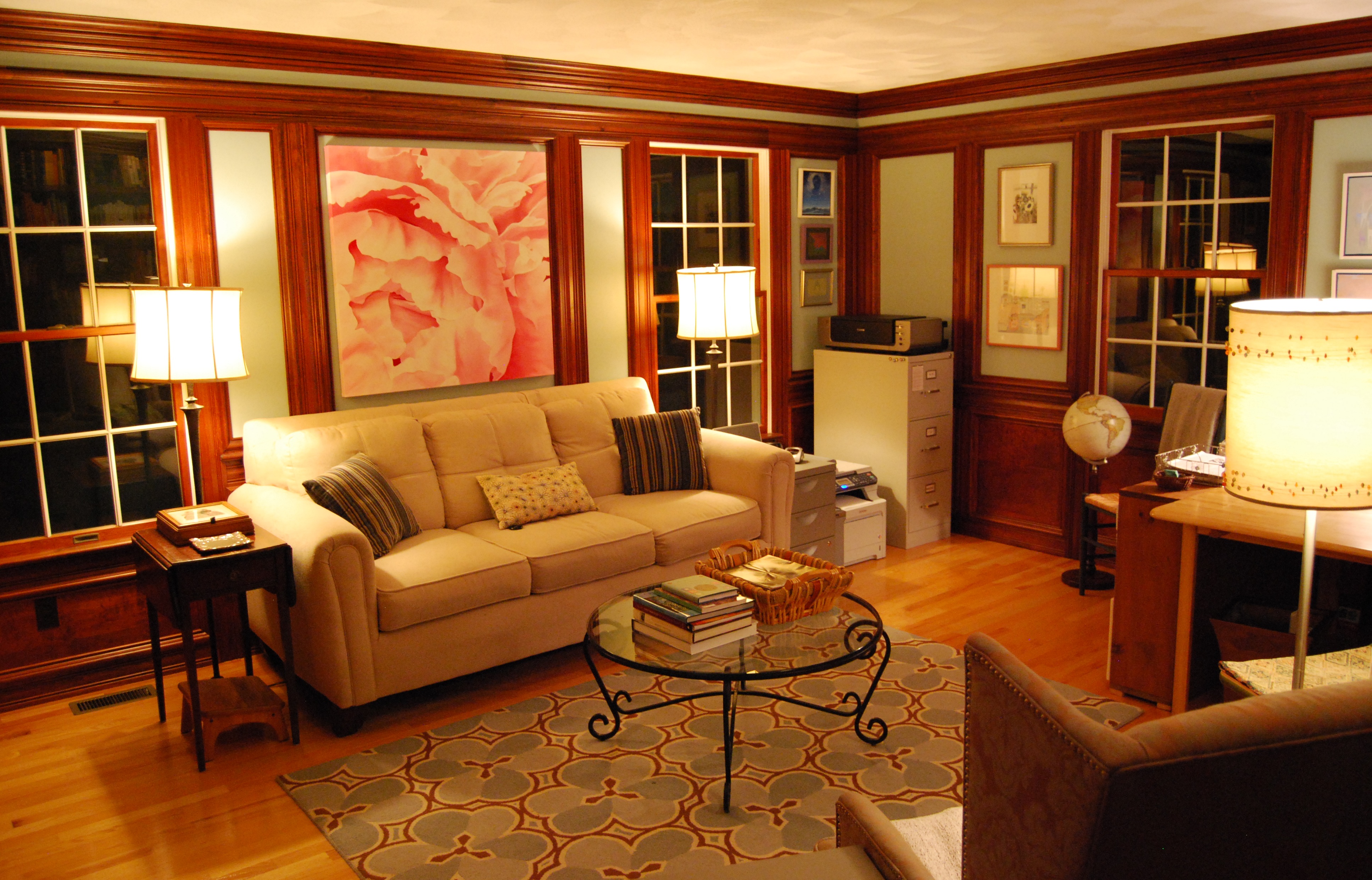
So, alphabet or color? I was intrigued by the color principle, and I had to try it. (Obviously, by the photo I ran above, there isn’t much question about which way I went.) I can’t believe HOW LONG it took to sort all the books, but we did it. (All those “taupe” books — are they gray? Are they brown? Are they off-white?) It was a LOT of fun, I have to admit. And I came to realize fairly early on that finding a specific book was not going to be a problem. But more on that later.

I also went through ever drawer and bin, sorting out all of my office supplies. I weeded out tons of stuff I don’t need or want. I filed every stack of paper. I found (or created) logical homes for all those little things that you pick up and say “what do I do with THIS?”

I now have a desk that I can actually use! I paid bills sitting at the desk last night, and everything I needed was in arm’s reach. My art supplies are organized in the hall closet around the corner, as there just isn’t room for everything in one place. But it all works.

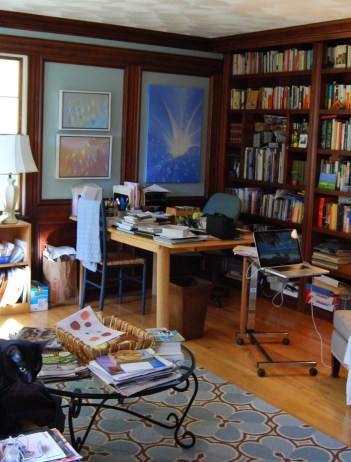
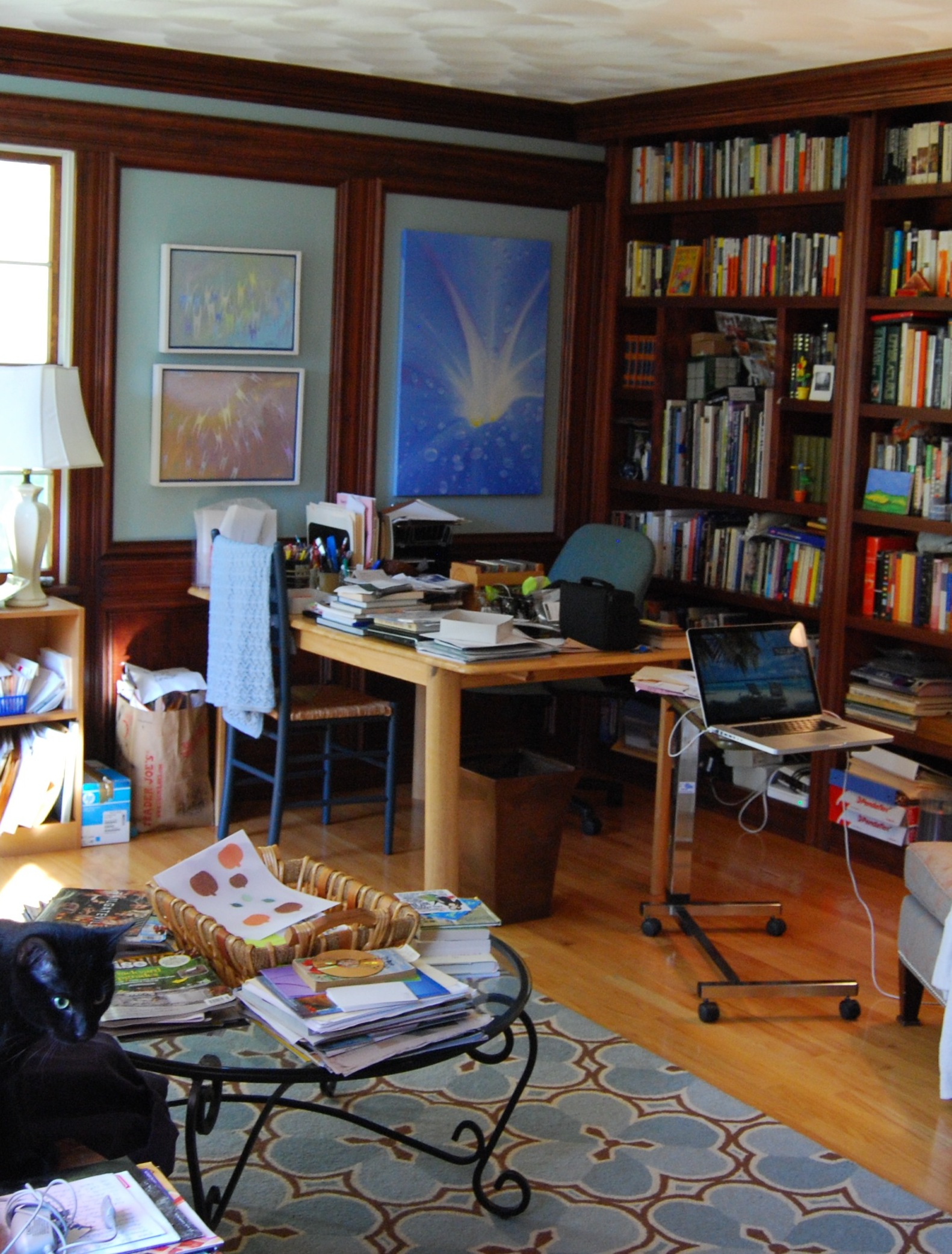
The basic footprint of the room hasn’t changed (months ago, we tried many different arrangements of the furniture, but nothing else worked). I did change out a yucky fiberboard bookshelf for a marginally better, longer bookshelf made by my ex-husband. (No, you can’t have it back!) Please ignore the hospital-style table on wheels (it’s one of the most practical things I own, and I use it all the time).

BEFORE

B_before

AFTER

B_after

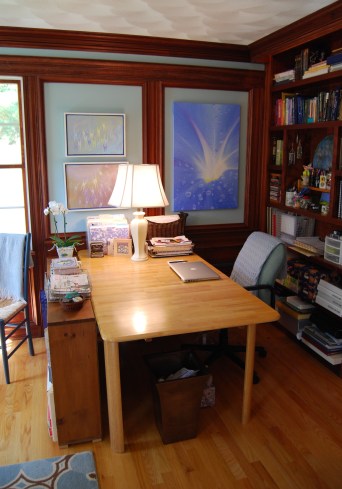
Desk corner before:

Desk_before

Desk corner after:

Desk_after

Considering that relatively little actually changed, aside from clearing out all the clutter, I can’t entirely explain the magic that this room now holds. I FREAKING LOVE IT. I want to be in here all the time. Yes, I’m in here now, typing on my laptop at my desk. I swear, it’s as if Mr. Roy G. Biv turned the room into a bowl of M&M’s. Very cozy at night, too:

night1

night2

So here’s my case for organizing books by color. In the first “after” photo above, fiction comprises the vertical shelf on the far right and the white shelf up the middle. That’s not really so many books. If I’m looking for a particular title, it’s not going to be hard to find even if I can’t remember the color of its spine. This is the only place I have adult fiction aside from my “to read” shelf on the other wall. The books to the left in the same photo are general nonfiction (biography, autobiography, and history). Again, these are mixed together, but it’s not a lot of shelf space for me to peruse if I need something. The fifth shelf is poetry.

On the other wall, books are broken down by genre. I have a shelf for editorial reference, a shelf for art reference, a shelf for books about writing, a shelf for books about creativity, a shelf for parenting, a shelf for self-help & metaphysical (yes, I have that many self-help and metaphysical books). There’s another shelf of semi-mixed nonfiction; a little chunk of current political books, a chunk of animal-related training books, a chunk of sports-related books, a section for gardening. Then there is the to-read shelf, as well a short fiction and plays. And so on.

For each of these subsections, I organized books by color and shape, depending on what looked best for each shelf. Again, I’m not going to have trouble finding anything because I know what each subsection is, and no single subsection is more than a shelf long.

So, now that I’ve dealt with the question of “how will you find anything?” I’ll get to why I think this is such a fabulous way to organize your books. First, a book is so much more than words on a page, or the author’s position in an alphabet. A book is a piece of art — even an old Bantam mass-market paperback — and to my mind, organizing books this way is something that honors each book as art. Positioning each book on a shelf in a way that maximizes its beauty (almost as “paint”) rather than by the name of the person who wrote it seems to me a more potent way to celebrate the beauty of a personal library. The shelves are pleasing and peaceful, without losing the vaguely chaotic and cozy look that is inherent in any library. The color progression is so eye-catching that I think it actually calls more attention to the books, not less — without dominating. What do you think?

The downside to having a dream library/work environment is this: There is pretty much no excuse left on the planet for not coming up with something brilliantly creative. I seem to have run out of excuses. And I DID just use an entire weekend’s worth of “free” moments to finish the room. Time to get to back to the writing 🙂

WOW! Women on Writing

wowWOW! (Women on Writing) is a useful website and complementary blog that the writers among us may enjoy browsing. The website hosts a flash fiction contest and a collection of useful articles, including:

From the site’s About page:

WOW! is a global magazine, designed to support women’s creativity, energy, blood, sweat and tears, throughout all stages of the writing process. We envision Wow! being a favorite watering hole for professionals, the up-and-coming, and the recipients of our labors — the avid readers.

Our concept is unique, as it fills in the missing gap between writing websites and women’s magazines. We are dedicated to raising the overall standards within the writing community, and devote an active profile within writing industry associations, organizations and websites.

Ultimately, WOW! hopes to contribute to the love, enjoyment and excitement of producing quality writing — so that the reader in all of us will never want for good material, in any form.

On Being a Vessel

A beautiful and interesting post on motherhood and creativity at WishStudio from guest blogger Suzanne Sperl. An excerpt:

i believe somewhere i read a quote from goldie hawn in which she referred to motherhood as being a vessel for your children to pass through — both literally and figuratively. being on the cusp of the birth of our second child, i can see the wisdom in her words. our children are separate of us the moment they greet this world. our job as mothers is to nurture, guide, teach, listen, and expose them to the beauty and wonders of this world — but they will always experience this in their own unique and individual ways.

as i started thinking about this, i realized creativity too passes through us in much the very same way. some seedling of an idea, a thought, a poem, photograph or painting begins within us but quickly becomes much bigger than us and we must ‘birth’ those ideas into reality — but they are never truly our own nor do we control them. they are born from us, contain pieces of us, but they are separate of us — and greet the world this way.

so in thinking about all of this, i wondered why it is that creative people (more personally, this creative person) tend to fear the creation of their ideas? when i started to think about creativity in the same way that i have come to view motherhood — i was reminded that we truly control so little in our lives. and some of the most successful moments we face are those when we are brave enough to step out of our own way, let go of the invisible leash of control, and just allow the moments to pass through us without resistance. in doing so, we seem to find strength, wisdom, and creative courage.

Read the full post here.

Blog Spotlight: And Her Head Popped Off

The only thing better than discovering another very cool blog written by a creative mother is realizing that I actually KNOW the blogger, even if I use the term “know” rather loosely, as in, friend of a friend of a friend whose name rings a familiar bell.

terri3Such was the case with And Her Head Popped Off, the blog of photographer, writer, and mother of four Terri Fischer. Terri is a friend of Suzanne Révy, who you’ve met in these pages, and I think we have another connection as well.

Terri is the real deal. You’ve got to admire a woman whose About page goes like this:

Mine is a charmed and a blessed life, filled with beauty and lessons and joy.  Here I share my journey with you, as I precariously balance motherhood and creativity–two words that are at once both a paradox and a oneness.  I tend to alternate between obsessions, generally those that include writing, photography, and drawing, but…  these four (Kiki-9; Dimples-6; Mowgli-4; Shortcake-1) hoard most of my attention.

This is me, losing my fucking mind.

Maybe one or two of us can relate.

Check out Terri’s motherhood and creativity categories. Enjoy!

Miranda: Life, art, and friendship — in the flesh

On Friday, I had the pleasure of hanging out with Cathy Coley and Mary Duquette for the afternoon. Cathy’s husband and a boisterous selection of all of our children rounded out the group. We had such fun, despite the difficulty of completing a sentence with five small children running around.

We didn’t get our posed shot until the visit’s end, at which point Cathy’s Baby C and Mary’s daughter were BOTH exhausted and in tears. In these pictures, the little girls are both screaming in stereo. (OK, so that just made us laugh.)

friends1

DSC_0019

My connection with Cathy and Mary demonstrates the power of the internet — blogging and social networking. Cathy and I went to college together, but we didn’t know each other that well and we never would have become friends as “grown ups” without this blog. And I likely would have never met Mary without this blog (although it turns out we have several “real-life” connections and perhaps would have met anyway, as it seems we were intended to develop a friendship).

In our rambling discussions of life and art, I spent a fair amount of time bemoaning my current state of affairs — work work work — and trying to figure out how to change things. Cathy said something that really stuck with me. She explained that at this point in her life she no longer does things that she doesn’t want to do. Wherever possible, she chooses to do what she wants, in life and domesticity. That doesn’t mean that she never has to do the dishes, of course, but the point was that she filters out whatever she can, if it doesn’t make the grade.

I started thinking about what I might be able to excise from the considerable list of things that I really don’t want to do anymore. The first step is to look at the list of “things I have to do” and really look at which things are mandatory and which things might be just masquerading as mandatory.

I’m working on that right now. Thanks, Cathy.

Writers changed by motherhood

From the Milwaukee Journal Sentinel, highly recommended reading on writing and motherhood, including finding the time, missing the kids, and integrating the experience of being a mother. A brief excerpt from the article, written by Geeta Sharma-Jensen:

When Milwaukee poet laureate Susan Firer’s son was young, she’d often determine the length of her poems by his fingers.

Holed up alone in her writing room, she’d look up to see his fingers running back and forth in the space beneath her door. From the other side of the closed door, she says, he was wordlessly signaling that “it was time to come out and play.”

Her poems, then, were necessarily short; she never knew how long it’d be before the little fingers would slip under her door.

“I tend to be pretty obsessive about my writing, so my children have brought more balance to how I live,” Firer says. “Both my life and, consequently, my poems would be something very different, in fact unimaginable, without my children, who have greatly impacted both what I write about and how I write.”

Writing moms, like all writers, take life in all its aspects and use their imaginations to transform it into art. But motherhood does things to writers – from stealing their time to swelling their emotions to making them silly and dizzy with this strange, overwhelming protective love for another human. They’d often rather be with this human who’s taken over their life, their thoughts, their fears. And yet, there is their artistic impulse, a call so strong they cannot go long without yielding to its siren song.

Somehow, then, they have made time for their work, and the children are there, too – in their art, the result of the twinning of maternal instinct and artistic impulse.

The full article is here. Whatever you do, don’t miss reading this essay by novelist Alice Mattison (opens as a PDF), which is linked within the article. It’s an absolute gem.

Writing with the family around

From Mom Bloggers Club, a post by Rosemary O’Brien on writing from the domestic trenches: “Writing with the Family Around“:

I don’t know why, but I have a difficult time writing even a blog post when my family is around. Maybe it’s because when they come home from school and work, I may as well hang up my keyboard and give up until they go to sleep. If it’s not breaking up a dispute about a ball that magically flew threw the air and knocked something over in a house where balls are not allowed to be thrown, then it’s to stop and feed someone because they are “staaaaaaaarrrrrrrving!” even if they had a snack and it’s almost time for dinner (that I have to stop and make).

That is why I look forward to bedtime. It is when I creep back to my computer, which I left on, and create with abandon. I find I am more productive at night for some reason. Mornings rarely only happen for me because my kids need to get to school. It seems to be a law in this country. Before I had them, I woke up at 9 and began writing at 9:30 with my jammies on and a strong cup of coffee in my hand. At that point, I skimmed and answered simple emails, deleted files and was not required to speak to anyone about anything unless I wanted to. It was not until early afternoon when my writing would come alive and I would write with abandon. Some of my best work was written during this time. In fact, this is when my first novel was produced and found a publisher.

Read Rosemary’s full post here, and check out Mom Bloggers Club while you’re at it. I joined about a year and a half ago — and the newsletter often has an interesting tidbit or two.

Many of this blog’s readers rely on evening time for creativity (definitely works for Kristine) but by the end of the day, others among us feel less like Edith Wharton and more like dog meat. Of course, our schedules and rhythms adapt with the ever-changing needs of our children as the grow — and start sleeping, or stop sleeping.

In my own experience, I’ve found that my little ones are now reliably asleep by 8:30 every night — but my older ones are often just waking up at that time, in terms of being interested in interaction. On Saturday night, I stayed up until 4:00 a.m. talking with my oldest son, who will be leaving for college in a matter of weeks. I hadn’t intended to stay up that late, of course, but the conversation — important conversation — just happened. Some things can’t be rescheduled. Did I note the irony that I finally had the baby tucked up in his crib, weaned and sleeping through the night — but the firstborn had me up all until all hours? I sure did, but still managed to feel like a kid in a candy store. Now, if only I could steal some of those wee hours for my writing….

Boston Globe: Five Laws of the Novelist

An article in this morning’s Boston Globe picks up rather nicely where we left off last week. On Thursday, Brittany expressed her frustration with the process of finding a publisher and I wrote a rather lengthy comment about publishing in general (which hopefully helps spur our writers to action, rather than prompts them jump out the window). In the Globe, Stephen Bergman wryly illuminates the publishing process in “Five Laws of the Novelist“:

Law Two: Editors Are Ephemeral and Don’t Edit. The editor of my first novel moved to another publishing house for my second. In the middle of my third, at another publishing house, she was fired, and my new editor, after sending me terrific edits, was fired the next day. The editor on my fourth novel, at still another publishing house, said, “I love this novel. I won’t change a word.’’ But when I got the manuscript back she had marked it up with so much red pencil that each page was pink. We struggled. I took few of her suggestions. In our final conversation she said, “You’ve ruined this book. It will get bad reviews,’’ and then she was fired. As one editor told me: “We no longer edit, we acquire and market.’’

Law Three: Publishers Don’t Publish. When my first novel was about to come out, I asked my publisher if it would sell. “No, your novel won’t sell.’’ This startled me. “It’s about medicine, and that’s good, and it’s funny and sexy, and that’s good.’’ Why won’t it sell? “Because it’s a good book. Good books don’t sell.’’ Bookstores can return any book for a full refund, a business model that spells doom for publishing. Only about 5 percent of books pay back their advance. Those hardcover remainders piled up in stores mean that the publishers overpaid, overprinted, and undersold.

Law Four: There Is No Humiliation Beneath Which a Writer Cannot Go. My second novel had come out in paperback, and my wife and I were on a hiking trip in New Hampshire. We stopped in a mom-and-pop store for lunch. There, in a spindle bookrack, were two copies of my novel. I immediately suspected my wife had placed them there, to make me feel good. Nope. I took both books off the rack and went up to the little old lady at the counter, and announced, “I wrote this book.’’

“Oh, you wrote that book?’’ she asked.

I averred yes. I asked if she would like me to sign the copies.

“Oh no, our folks would never buy a book that was writ in.’’

Another standard humiliation: At an author-signing in a bookstore, sitting at a desk near the window, facing a wall of Grishams, watching people hurrying past as if you are a child molester. Not fun, especially if your publisher has overlooked advertising the event.

Law Five: There Is Only One Reason To Write. During a post-second-novel depression, I spent six months, more or less, in the bathtub, trying to give up being a writer. Finally I realized that while I disliked publishing, I still loved writing. But if you want to respect what you write (rather than write for cash), you need a day job. Luckily, decades previously I faced a choice: between Vietnam or Harvard Med. I became a psychiatrist because I might learn about character and story, and could leave mornings free to write. Not as good a day job as my first, working the graveyard shift as a toll collector on the Rip Van Winkle Bridge – you can learn pretty much everything from what goes on at night in cars – but still.

Only write if you can’t not.

Read the full piece here. Then, get back to work!

WishMamas: On Creative Work and Motherhood

From the lovely blog WishStudio, a post on creative work and motherhood by writer and storyteller Jen Lee. Here’s an excerpt:

When my artist friends are deliberating about becoming mothers, I don’t say, “Oh, just go for it–it will be fine.” I know this dilemma well. It took me five years to make my decision–to choose motherhood–and I wasn’t even doing creative work before I became a mother. The decision to begin writing and travel down a creative path came out of the kind of moment I’ve often had since becoming a parent: I wouldn’t take this risk for myself, I would just settle for something here. But I will take this risk for my girls, because I want them to know anything is possible. I want to show them how to find and follow dreams. Now my creative work and my mothering are intertwined like a double helix.

There are greater demands on me as a parent than there were before–physically and mentally. I have so much less solitude and silence, and that has chafed at times. I find ways to build-in solitude, for my mental health as much as for my work. When my husband worked in an office, this meant that I left every Thursday night to go to the Chocolate Room. I could write, or read, or just stare at the wall–whatever I needed. Best of all, I could watch the humanity all around me without distractions and interruptions. Sundays were my day off. Still, I take Sundays to go on artist dates, go to yoga class, eat a meal alone, and then when I come home at dinner, I’m happy to see my children and ready to dive into another week.

Lots more in this post — read it here. You’ll definitely want to add WishStudio to your regular blog reading list.