Creative resolutions, one week later?

Courtesy WillWriteForChocolate.com
Jan 8
Jan 6
 Thanks to Cathy Coley for sending me a link to Lucy Kaylin’s interesting interview with Elizabeth Gilbert, author of Eat, Pray, Love and Committed (as well as three other books). The interview is good reading for any writer or Gilbert fan, but the bits about motherhood — and choosing not to become a mother — are of special interest. Here are a few excerpts.
LK: While the book is fundamentally about marriage, you are also quite frank about not wanting children, which had been a big problem in your first marriage. How did you reach that decision?
LG: Where other women hear that tick, tick, tick and they’re like, “Must have baby,” for me, it was like, tick, tick, tick, “boom.” [Laughs] It was a biological clock, but it was attached to a bunch of C-4 explosives. I’ve often thought that if I had been married to somebody who wanted to be a mom, I could have done it. I used to say, “Man, I think I’d be a really good dad. I’ll be a great provider. I’m funny; I’ll go on trips with them — I’ll do all sorts of stuff.” But the momming? I’m not made for that. I have a really good mom; I know what she put into it. I didn’t think I had the support to both have that and continue on this path that was really important to me. I wasn’t married to a man who wanted to stay home and raise kids. So…
LK: You tell a story in the book that is pivotal for you, about your grandmother. She was born with a cleft palate and thought to be unmarriageable, so she got an education and took care of herself, one day rewarding herself with a $20 fur-trimmed, wine-colored coat, which she adored. Eventually she does marry. And when she gives birth to her first daughter, she cuts up the coat to make something for the child.
LG: That’s the story of motherhood, in a large way. You take the thing that is most precious to you, and you cut it up and give it to somebody else who you love more than you love the thing. And we tend to idealize that, and I’m not sure we should. Because the sacrifice that it symbolizes is also huge. Her marriage and her seven children, in a life of constant struggle and deprivation — it was heavy. And that beautiful mind, that beautiful intellect, that exquisite sense of curiosity and exploration, was gone.
I went to Africa when I was 19, and when I came back, I was showing her pictures. And I remember her stopping me and just — she had to collect herself. And she said, “I cannot believe that a granddaughter of mine has been to Africa. I just can’t imagine how you got there.” I think that her story is so central to my story. To be able to choose the shape of your own life — you sort of must do that, as an act of honor to those who couldn’t. There were times, especially when I was traveling for Eat, Pray, Love, when, I swear to God, I would feel this weight of my female ancestors, all those Swedish farmwives from beyond the grave who were like, “Go! Go to Naples! Eat more pizza! Go to India, ride an elephant! Do it! Swim in the Indian Ocean. Read those books. Learn a language. Do it!” I could just feel them. They were just like, “Go beat the drum.”
LK: Now that you’ve been hit with this tsunami of cash, is there any threat that it might insulate you from the kind of rugged, spontaneous travel that made you famous?
LG: I’ve actually never traveled less than since I got hit with a tsunami of cash. When I was in Mexico when I was 20, I remember meeting this American couple who were in their 60s, and they said, “Oh, it’s so great that you’re traveling now, before you have kids, because you won’t be able to then.” I know this is a thing that people do; they go traveling for a year, and then they hitch their leash to the wall and put their face in their feed bag and that’s the end of it. And I thought, “But I might want to keep doing this,” you know?
You can read the full interview here.
Gilbert clearly believes that banging the drum and having children would not be compatible. I can understand that perspective. I can also understand how suburban inertia can look very much like being hitched to the wall with your face in a feedbag. <shiver>
I have to admire Gilbert for knowing who she is, what she wants, and what she doesn’t want. And I have to thank her for reminding me that I DO NOT want to waste my life face-down in a bag of oats. (A bag of Entenmann’s chocolate-chip cookies, maybe.) But really. It’s a good thing I read this interview while still full of New-Year adrenaline. I’m considering posting pictures of feed bags all around my desk just to make sure I stay on track.
What about you? Have you banged any drums recently? Is drum-banging compatible with your brand of motherhood? Or are you too occupied cutting up your treasured coat in order to fashion something new for your children?
Jan 4
 I hope that everyone had a fabulous holiday and New Year’s celebration. The new year is always full of promise and optimism, isn’t it?
With the turning of the calendar, we mark our second anniversary here at Studio Mothers (formerly Creative Construction). It is deeply rewarding to see how our community has strengthened and grown over time. LOVE. IT.
If you haven’t joined our new Facebook page, please do. This new page replaces our old Facebook “group,” as the page functionality is much more user-friendly. We’ll be sharing lots of tidbits to keep you inspired and motivated.
I look forward to another year of sharing our successes and challenges, drawing strength from our shared experiences to blend motherhood and creativity as happily as possible. Each year the kids get a little bit older, and it gets a little bit easier. The demands of motherhood never dissipate completely, of course — even my 19-year-old needs mothering — but as we have observed here on many occasions, caring for very young children requires a level of utter self-sacrifice constant nurturing and vigilance that is often incompatible with creating art. For those of us who are still in those trenches, the passing of each year makes a big difference.
Your stories and support have kept me going through my own periods of difficulty. It is such a comfort to know that we are all, in many ways, in the same boat. To that end, as always, if you would ever like to cross-post a related item from your personal blog, just let me know. We love cross-posts.
Lastly, has anyone made any New Year’s resolutions on the creative front? I made one of my own — a big one. I’m going to finish my novel by May 31. I realize that this feat won’t be nearly as impressive as writing a 50,000-word novel in a single month (congrats to all of our NaNoWriMo winners!), but this book is probably going be closer to 80,000 words, and I wanted to target a pace that I can maintain. I’m at 23,500 right now. I’m in that groove where I’m thinking about the book all the time, even when I’m not working on it — and it’s not hard to get my butt in the chair and actually produce because I WANT to be writing. I’m not wasting all my time thinking about how I SHOULD be writing and the procrastinating my time into nothingness. (This relief I owe in part to abandoning my goal of being “literary.” It is what it is.) I do plan to make use of the Monday Page 2010, and I hope you will as well!
I’m also getting much better about surrendering myself to the present moment, even when that moment isn’t exactly what I “want” it to be. (This is big progress for a Type-A-Control-Freak-Virgo like myself.) I’m starting to see that this peaceful current is available to me at any time, if I just remember to plug into it. Ah….that’s more like it.
How about you? What’s on deck for 2010? What will make this year the best one yet?
[Image courtesy Smithi1 under a Creative Commons license.]
Dec 21
Understanding that this is a very busy time of year for most of us, regardless of which particular holiday you may or may not celebrate, we’ll be on blog hiatus until the New Year. I hope everyone has (or has had) a fabulous holiday — and for those of you who celebrate Christmas, here’s a little video you’re sure to enjoy. See you in 2010!
Dec 17
Stephanie Stambaugh, a blogger and writer living in Colorado, is a friend of Studio Mothers via Twitter. I had noted that Stephanie — also a mother of two — successfully completed NaNoWriMo, and I asked her how she pulled off that feat. Stephanie recently posted a blog-post response, which you may enjoy: Finally, My Post-NaNoWriMo Debriefing. Stephanie’s process actually involved her oldest child, and was facilitated by the younger one. I love the concept of working with your children around, rather than working around your children, as in, circumventing an obstracle. The more we can blend creativity and motherhood the more likely we are to feel “whole”; less compartmentalized. This strategy wouldn’t quite translate to parenting toddlers, but at least it gives the mothers of little ones something to look forward to.
An excerpt from Stephanie’s post:
Over the course of the writing month and over the past few weeks I have been asked by numerous people, “How’d you do it? How did you find time to write a novel?” First, It would be easy enough to answer those questions by simply saying I made time to write it because that’s what writers do, they give up their ideas of being in the so called “real world” to sit and hold words in their mind’s eye and in the palm of their hands for hours on end. That’s our job and so that’s what I did, to a point.
What I actually did was give myself permission to do what I wanted to do instead of sabotaging myself by that nagging voice that plagues all writers. You know what it says? It screams out daily at you too, right? It says, ”What’s the point? I’ve got better things to do, don’t I? Besides, it’ll never be published anyway.” Now I am not saying that voice wasn’t lurking out there just outside my door, waiting for me to invite it in. What I am saying is that I nodded my head to its shrill little demanding attitude and then told it politely to go to hell. I made a conscience choice not to let the dirty bugger into my office on November 1st and now that it is December 14th it won’t ever show its sick little face here again if it knows what’s good for it.
But there was also three other things that helped me “do it.” The first was that I had the greatest motivation any writer can have and that motivation was from my teenage son who did NaNoWriMo right along with me. I did not have to force him to do it as I am lucky enough to have given birth to not just one but two kiddos who have a wonderful passion for stories. But when my oldest said he wanted to do NaNoWriMo with me, it gave me more backbone than I knew I had because I stood a little taller and prouder just by his commitment to do it.
Secondly, I could not have done it without the support of my youngest child who kept busy for hours writing his own comic books and playing quietly until his brother and I were finished writing for the day. Then right along with him was my husband who actually didn’t knock on my office door for once. I think he saw that determined look in my eye and actually liked it or maybe he just feared it too like the way the dirty little nagging voice of doubt feared it.
Read the full post here. Congratulations on your accomplishment, Stephanie! We look forward to hearing more from you in future.
Dec 15
Our long-time blogmate Brittany Vandeputte was recently published in the Petigru Review! I stole the following from Brittany’s blog:
Yesterday I received my two free author copies of The Petigru Review. It felt good to hold a big chunk of a book in my hands, flip to the table on contents, and see my name listed three times. The $15 I made in “royalties” felt good, too. It brought the total profits from my writing to date up to $115. What a lucrative career choice I’ve made for myself…
Obviously I’m not in it for the money. It’s more the satisfaction of knowing someone else read my writing and thought other people would like it, too. That feels good. And it also feels good to be published in a literary journal named for James L. Petigru, SC stateman, who famously said “South Carolina is too small to be a republic, and too large to be an insane asylum.” I love my adopted state, but as a born and bred Tarheel, I do snicker (quietly) to myself whenever I hear that quote.
I had hoped that I could brag that it was now available on amazon.com, but it isn’t yet. It is, however, available at a local bookstore, Fiction Addiction.
I’m only doing my due dilligence by pointing out that it would fill a stocking nicely and would most certainly impress all your book-loving friends with its sophisticated, artsy, literary-journalness. Plus, I have it on good authority that you might even persuade one of the contibutors to autograph your copy. 🙂
Brava, Brittany! We’re so proud!
Dec 9
A roundup of recent mentions of Studio Mothers on the interwebs!
New friends = lots more blog reading to catch up on! 🙂
Dec 7
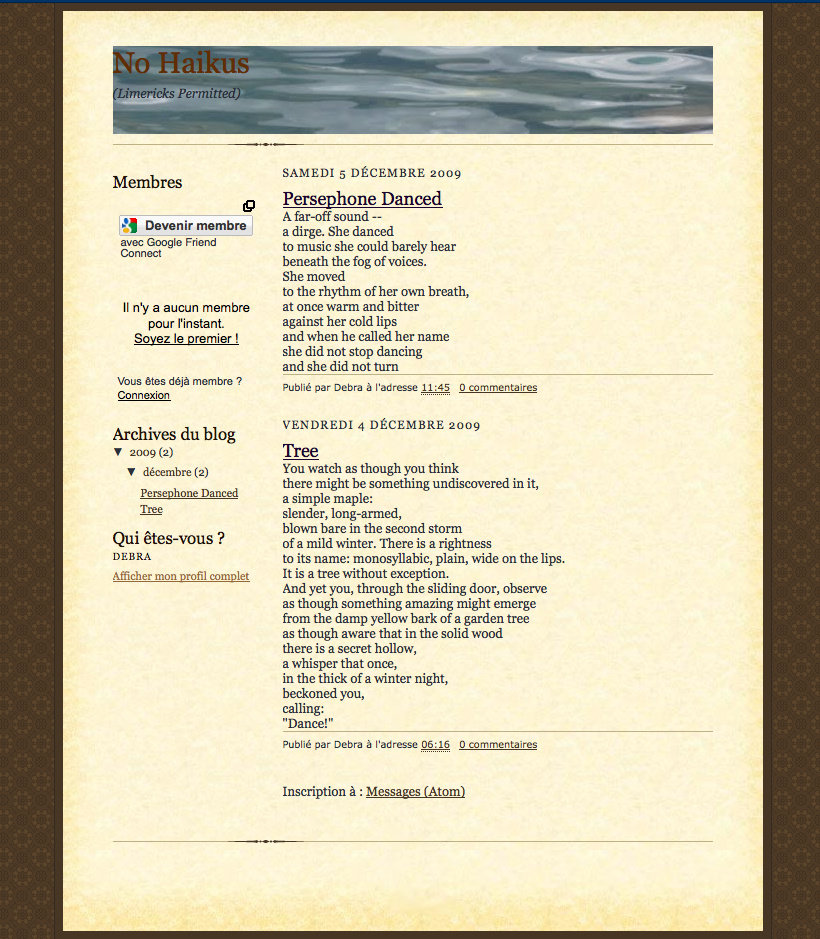 Our friend Debra Bellon, a writer and filmmaker who lives in Toulouse, has a two-year-old son and a brand-new baby girl. Debra has been creatively percolating during the past couple of years, as many of us do while we’re otherwise occupied caring for little ones. To that end, Debra just launched a new blog site for her poetry: No Haikus. Debra says, “I’m going to see if I can write a poem a day, with each poem using a word from the last, if that makes any sense.” She has asked for support and encouragement from the Studio Mothers community — so please visit Debra’s blog from time to time. You know how having an audience helps to keep us honest and committed!
Félicitations, Debra! We much look forward to seeing more of your work.
Dec 4
My husband often forwards me tidbits from the interwebs that he knows I’ll find interesting. Last week he sent me an article about time management that really blew my mind. In some ways I think it’s the paradigm shift I’ve been looking for, as I often feel lost in the vortex of caring for young children and stepping between motherhood and work.
The answer to feeling overwhelmed and overbooked is NOT throwing more time at your workload — it’s about prioritizing and working in a more condensed framework. It’s about working smarter, not working MORE. Just what busy mothers need, right? We can’t add more hours to our day, but we can use what we have more efficiently WITHOUT running around like maniacs.
This article was truly an eye-opener for me. There’s even discussion of synthesizing parenthood, domestic life, and work. Here’s an excerpt (although I do hope you read the whole thing):
I must emphasize that I’m not some laid-back lifestyle entrepreneur who monitors an automated business from a hammock in Aruba. I have a normal job (I’m a postdoc) and a lot on my plate. This past summer, for example, I completed my PhD in computer science at MIT. Simultaneous with writing my dissertation I finished the manuscript for my third book, which was handed in a month after my PhD defense and will be published by Random House in the summer of 2010. During this past year, I also managed to maintain my blog, Study Hacks, which enjoys over 50,000 unique visitors a month, and publish over a half-dozen peer-reviewed academic papers.
Put another way: I’m no slacker. But with only a few exceptions, all of this work took place between 8:30 and 5:30, only on weekdays. (My exercise, which I do every day, is also included in this block, as is an hour of dog walking. I really like my post-5:30 free time to be completely free.)
I call this approach fixed-scheduled productivity, and it’s something I’ve been following and preaching since early 2008. The idea is simple:
Fix your ideal schedule, then work backwards to make everything fit — ruthlessly culling obligations, turning people down, becoming hard to reach, and shedding marginally useful tasks along the way.
The beneficial effects of this strategy on your sense of control, stress levels, and amount of important work accomplished, is profound.
<snip>
Michael Simmons’ [business] expanded quickly in the years following college graduation. Around the time I was reading The 4-Hour Work Week, I started to discuss the possibility that Simmons tone down the hours. It was his company, I argued, so why not take advantage of this fact to craft an awesome life.
Among the specific topics we discussed, I remember suggesting that Simmons cut down the time spent on e-mail and social networks.
“This isn’t optional for me,” he explained. “Any of these contacts could turn into a important partner or sale.”
But then Simmons’ daughter, Halle, was born.
Simmons’ work schedule reduced from 10 to 12 hours days to 3 to 5 hour days. He took care of the baby in the morning, then worked in the afternoon while his wife, and company co-founder, took over the childcare responsibilities. Evenings were family together time.
Halle forced Simmons into the type of constrained schedule that he had previously declared impossible. And yet the business didn’t flounder.
“The baby turns ’shoulds’ into ‘musts’,” Simmons explained to me. “In the past I used to put off key decisions, or saying ‘no’, because I didn’t want to deal with the discomfort. Now I have no choice. I have to make the decisions because my time has been slashed in half.”
“Since out daughter was born about a year ago, our business has more than doubled.”
The Fixed-Schedule Effect
Collins, Saunders, and Simmons all share a similar discovery. When they constrained their schedule to the point where non-essential work was eliminated and colleagues and clients had to retrain their expectations, they discovered two surprising results.
First, the essentials — be it making sales calls, or focusing on the core research behind a book — are what really matter, and the non-essentials — be it random e-mail conversations, or managing an overhaul to your blog template — are more disposable than many believe.
Second, by focusing only the essentials, they’ll receive more attention than when your schedule was unbounded. The paradoxic effect, as with Collins’ bestsellers, or Saunders and Simmons’ fast-growing businesses, you achieve more results.
Living the Fixed-Scheduled Lifestyle
The steps to adopting fixed-schedule productivity are straightforward:
This sounds simple. But of course it’s not. Satisfying rule 2 is non-trivial. If you took your current projects, obligations, and work habits, you’d probably fall well short of satisfying your ideal schedule.
Here’s a simple truth that you must confront when considering fixed-schedule productivity: sticking to your ideal schedule will require drastic actions. For example, you may have to:
In the abstract, these are all hard goals to accomplish. But when you’re focused on a specific goal — “I refuse to work past 5:30 on weekdays!” — you’d be surprised by how much easier it becomes to deploy these strategies in your daily life.
Read the full article here. Really, it’s worth the read!
I’ve already begun applying these principles to my work life, and I see how powerful this approach can be. Knowing that I need to tie up all loose ends by a certain time (various intervals throughout the day) really helps me stay focused. It’s kind of like applying the urgency of NaNoWriMo to your regular schedule. Do it now; there’s a deadline; stay focused. When you know there really are only 6 hours to get a project completed (rather than telling yourself you’ll work a second shift to get it done) you don’t waste time on Facebook or comparison shopping prices for Seventh Generation Diapers online. And in the end, what do you get? A finished project AND an evening to spend doing whatever you want to do. Suddenly there is time for creativity, reading, whatever. Sounds so simple, I know, but I can’t tell you how much I DON’T do that when left to my own instincts.
Can you see ways of applying these principles to the domestic side of life? Obviously, children aren’t going to observe a “fixed” schedule, no matter how much we might want them to, but there must be ways to apply the “container” approach in a way that makes the domestic scene feel less overwhelming. Your thoughts?

The point here is that the bonds formed during NaNoWriMo should continue beyond November — so keep us in the loop, NaNo winners 🙂
Cartoon courtesy Inky Girl — thanks, as always.
Nov 25
The latest installment of cool creative mom blogs and websites worth a visit!
Creative Mums: An Australian site providing networking, support, and business resources to creative mothers.
Maternal Spark: Inspiration and support for creative mamas of all types.

She Writes: An extensive network and forum for writers.

Nov 23
 As most mothers are painfully aware, transitions can be difficult for children — and mamas. I’m not talking about those big transitions like starting school, or moving — I’m talking specifically about those little daily leaps from one activity or focus to the next.
I’m hoping that my dear Studio Mothers community can help me with a particularly sticky transition that crops up in my schedule tree times a week. On the days that I work, my sitter leaves the house at about 4:40. I’m usually working frantically right up until the last possible moment. Then I emerge from my work space and greet my little guys (who I have likely seen at several intervals during the day).
Here’s the thing: Ironically, I almost dread this moment. I’m happy to see my little boys, and they’re happy to see me. We share hugs. But the transition is hard. I’m still in work brain, and I have a hard time switching gears. The boys are hyped up because the sitter is leaving and Mom is taking over. It’s a transition. And the big question looms: What do we do NOW? There is often a full hour or more before I need to start dinner. We usually just spend that time hanging out in the playroom, if we don’t have to get in the car to drive an older sibling somewhere. But that hour always feels awkward. I feel like I should be doing something really cool with the kids during that time. Craft projects are pretty much impossible right now, however, as the older of the two boys is 4.5 and the youngest is 18 months. We can’t yet play a board game or do anything particularly structured. I also often feel anxious about preparing dinner; will my little one “allow” me to cook? Or will he be hanging on my leg, crying for my attention, making me wish we’d just ordered pizza again?
I would really like to develop some kind of ritual for easing back into the mom role. Maybe that means stopping work five minutes earlier and getting myself sorted out and mentally prepared. Maybe it means some kind of “thing” that I do with the boys — something that I can look forward to, and they can look forward to — that will ease the transition. Maybe I need to plan that pre-dinner hour in advance, so that I feel like we’re using the time to the fullest.
One thing is for sure: I need to learn to wrap up any loose ends BEFORE the end of my work day. If I try to sneak back onto my laptop, or check mail/facebook/twitter on my iPhone, I always feel guilty and/or disaster ensues. I don’t WANT to do that. So I’m not going to do that anymore. (Stake in ground. You are all my witnesses.)
Do you have any thoughts about ways to make that time the BEST hour of the day — something I really look forward to — rather than something I feel ambivalent about? I’m hoping that if I turn this hour into what I hope it can be, dinner preparation will be easier too, because the boys will feel like they had my full attention before I start cooking. The whole evening will probably flow more smoothly if I get things off to a good start at 4:40.
Any ideas?





 Studio Mothers: Life & Art