Skip to content

Archive for

Brittany: The Anatomy of Change

Sam has decided he wants to be a doctor when he grows up. His latest bedtime book of choice? The Human Body. Tonight we read about the skull and the skeleton. Non-scientific Mommy got to explain that the skull is like a bike helmet that protects your ball-of-Jello brain. I also demonstrated the structural usefulness of bones with a spare sock and the pen on Sam’s Magnadoodle. I don’t know if I’m confusing him more or not, but his desire to know all about the body is insatiable. He’s already made a standing appointment with me for another anatomy lesson tomorrow night (when we’ll read about digestion and pelvic bones).

It’s funny, because when I was little, I said I wanted to be a doctor, too. The difference was, I just wanted to take care of sick people and make them feel better. I didn’t care a whit about how the human body worked. That was of no interest to me whatsoever.

I can see myself in Sam, but at the same time, I’m well aware of the ways he diverges from me, too. In a lot of ways I feel like he is the turbo-charged version of me — the one whose detail-orientation and persistence will propel him toward success I could never even dream of. And that makes me happy. I hope he’s able to harness all his potential into something amazing.

It’s hard for me to believe that his preschool days are now over. I don’t think I have anything new to say on the subject without descending into cliches. Where has the time gone? My baby’s all grown up. I can’t believe he’s so big. I feel so old.

I’ll admit I’m feeling anxious for him. Every time he starts worrying about kindergarten, I can’t help but worry along with him, even as I’m telling him it will be all be a wonderful adventure. He seems to already understand that expectations are about to be piled on him — make-it-or-break-it expectations — and that he’s going to have to grow up fast.

I want to cry with him as he realizes that he’s no longer small enough for Mommy’s arms to shut the world out. And even though he still wants the comfort of a snuggle, he’s getting too big to fit in my lap. I knew this day was going to come, but that doesn’t make now any easier.

My friend Kira stopped by today with a friend and her friend’s three-month-old baby. He was so tiny and helpless. So new. So easy.

His mother sat feeding him in the quiet of the living room, her arms enveloping him, in one of those peaceful, protective moments of newborn motherhood that I still vaguely remember. Meanwhile, in the kitchen, Sam and John were underfoot, loudly racing garbage trucks with Tyler and Zachary, while Kira and I threw their lunches together. The metaphor was not lost on me. Those quiet me-alone-with-my-baby moments are over. I live in a completely different world now. Seeing Sam and John in one room, the newborn in the other, it was hard to believe how much the boys had grown, and how far removed all of us were from those sweet, drowsy baby days.

I think Sam understands this. He’s wondering how we got from there to here, too. And his newfound interest in the human body? Like me, he’s trying to wrap his brain around that vast world that envelopes the heart.

[Crossposted from Re-Writing Motherhood]

Monday Post ~ May 30, 2011

“Art is the only way to run away
without leaving home.”
~Twyla Tharp

What are your plans for creative practice this week? Given the specifics of your schedule, decide on a realistic goal or a milestone to reach for. A goal as simple as “I will be creative for 10 minutes every day” is what it’s all about. Share your goal(s) as a comment to this post, and let us know how things went with your creative plans for last week, if you posted to last week’s Monday Post.

Suggestion: When you’re deciding on your creative intentions, it’s a good idea to think about WHEN you’re going to write those 2,000 words or paint that canvas. Try to schedule the time slots in your calendar (if you keep one), understanding that flexibility may be required. If things don’t happen when you wanted them to, that’s OK. Give yourself a gentle push with one hand, but pat yourself kindly on the shoulder with the other if you don’t reach your goal for a given week. Sometimes it’s easier, sometimes it’s harder. Ride whatever you’ve got.

It’s also useful to have a sense of your minimum requirements (come hell or high water I’m going to write 100 words) while keeping a lookout for sudden opportunities to do more. You know, the day that the baby takes a monster nap or your partner takes the kids out to run errands and you find yourself with an unexpected “extra” half hour. Grab that time for yourself. You can catch up on the dishes and the laundry later. If you keep something creative in the back of your mind for those sudden opportunities, you’ll be more likely to use them to your advantage — rather than squandering your precious bonus moments on Facebook or vacuuming out the sofa cushions.

Amelia: An Introduction

I am a mother to five amazing children who range in age from 2 years to 19 years! I spent 15+ years in higher education before I began to listen to my soul’s whispers that it was time to move on in a direction that was more true to who I am. Mom’s Daily Retreat was born from this decision. I now use my training, experience, and passion for creativity to work with mothers on a variety of topics including: career development, work life balance, and mothering authentically.

My most popular e-retreat is the Mothering Authentically course which is a four-week exploration of who we are, at our core, based on our personality preferences and how this plays out daily in our role as mothers. This topic is explored through journal entries, conversations with one another and through art (whether it is scrapbooking, photography, mixed media, etc.).

Balancing motherhood and creativity is something that has evolved over time for me. I spend time creating alongside of my children as I have discovered that rich conversation is always a by-product of being elbow deep in Modge Podge and paint. This is also an additional lens to observe who I am as a mother as I create alongside my children. The way I create alongside my children is very different than how I create in my quiet moments alone. Consequently, the early morning hours of my day are safeguarded as my time to create, whether it is writing, taking pictures, or working on a mixed-media piece.

Joyelle: Light My Fire


Ten years ago I created a vision statement for my life: Beacon of light.
I want to be a beacon of light, inspiring others, shining a divine presence that uplifts others. But almost immediately I came up against my biggest problem: how do you shine your light when it goes out? How can I inspire others when I am not myself inspired?

I would start out inspired, fueled with passion about a project. But inevitably, I would end up in a vicious cycle of over-extension and increasingly long periods of burnout, which only ended with the birth of my son. Finally, I had a reason to stop doing. Finally I could let go of the deep unending void that pushed me to do more. Or at least that’s what I thought. But old habits die hard. They creep back in the side door when you aren’t looking, and slowly reclaim their lost territory.

“Come on baby, light my fire,” Jim Morrison sang. But as artists and mothers, we cannot rely on someone else to come by and light our fire when the flames go out. It takes constant tending, loving attention, and most of all, a belief in our own self worth. As women, from a young age we are encouraged to place the needs of others before our own. But this is a road to disaster. This is the road to waking up one day and wondering who the hell you are and what happened to your life.

Learning how to light your own fire is not a selfish luxury, it is the most selfless thing you can do, and it could quite possibly save your life. Because if you are not living your passion, you are not yourself. You are just a hollow shell living out someone else’s life.

Deciding on your vision for your life is the beginning. But deciding on how you will live that vision is crucial. What I have learned for myself is that I need to guard my energy zealously. The phrase “no” needs to pass my lips on a regular basis. When I feel the need to give more, I need to stop and ask myself if this is really what I should be focusing on right now. I went through the burnout cycle so many times, and each time it took longer and longer for me to come back. I missed out on so much of my life, so many opportunities to live my vision, because I couldn’t listen to my own voice. I looked always to the future, thinking that if I worked hard, one day I would be happy.

I have heard the phrase “Life is a journey, not a destination” so many times, but I never really got it before. Now I am starting to understand. Every day I wake up to a new challenge. If I want to be a beacon of light, I need to start by lighting my own fire. I need to pay attention when the quiet voice inside me says “slow down.” I need to let go of limiting thinking that says I need to do it now or it will never happen. I need to believe first in myself, and then in the abundance of the universe.

But most of all, I need to know the difference between hard work and struggle. Hard work is tiring, but not depleting. Struggle is a sign that I am not in alignment with my purpose.

Slowly, I am learning. Learning to listen. Learning to tune in to what is important and tune out what is not. Every day is a new opportunity to live my life with intention, honoring my vision and lighting my own path.

~~~~~~~~~~~~~~~~~~

Joyelle Brandt Music: www.myspace.com/joyellebrandt
Joyelle’s blog: www.anartfulendeavor.com

Monday Post ~ May 22, 2011

“Each of us has an inner dream that we can unfold if we will just have the courage to admit what it is.”
~Julia Cameron

planner

What are your plans for creative practice this week? Given the specifics of your schedule, decide on a realistic goal or a milestone to reach for. A goal as simple as “I will be creative for 10 minutes every day” is what it’s all about. Share your goal(s) as a comment to this post, and let us know how things went with your creative plans for last week, if you posted to last week’s Monday Post.

Suggestion: When you’re deciding on your creative intentions, it’s a good idea to think about WHEN you’re going to write those 2,000 words or paint that canvas. Try to schedule the time slots in your calendar (if you keep one), understanding that flexibility may be required. If things don’t happen when you wanted them to, that’s OK. Give yourself a gentle push with one hand, but pat yourself kindly on the shoulder with the other if you don’t reach your goal for a given week. Sometimes it’s easier, sometimes it’s harder. Ride whatever you’ve got.

It’s also useful to have a sense of your minimum requirements (come hell or high water I’m going to write 100 words) while keeping a lookout for sudden opportunities to do more. You know, the day that the baby takes a monster nap or your partner takes the kids out to run errands and you find yourself with an unexpected “extra” half hour. Grab that time for yourself. You can catch up on the dishes and the laundry later. If you keep something creative in the back of your mind for those sudden opportunities, you’ll be more likely to use them to your advantage — rather than squandering your precious bonus moments on Facebook or vacuuming out the sofa cushions.

Robin: I Feel Inspired (Lately)…

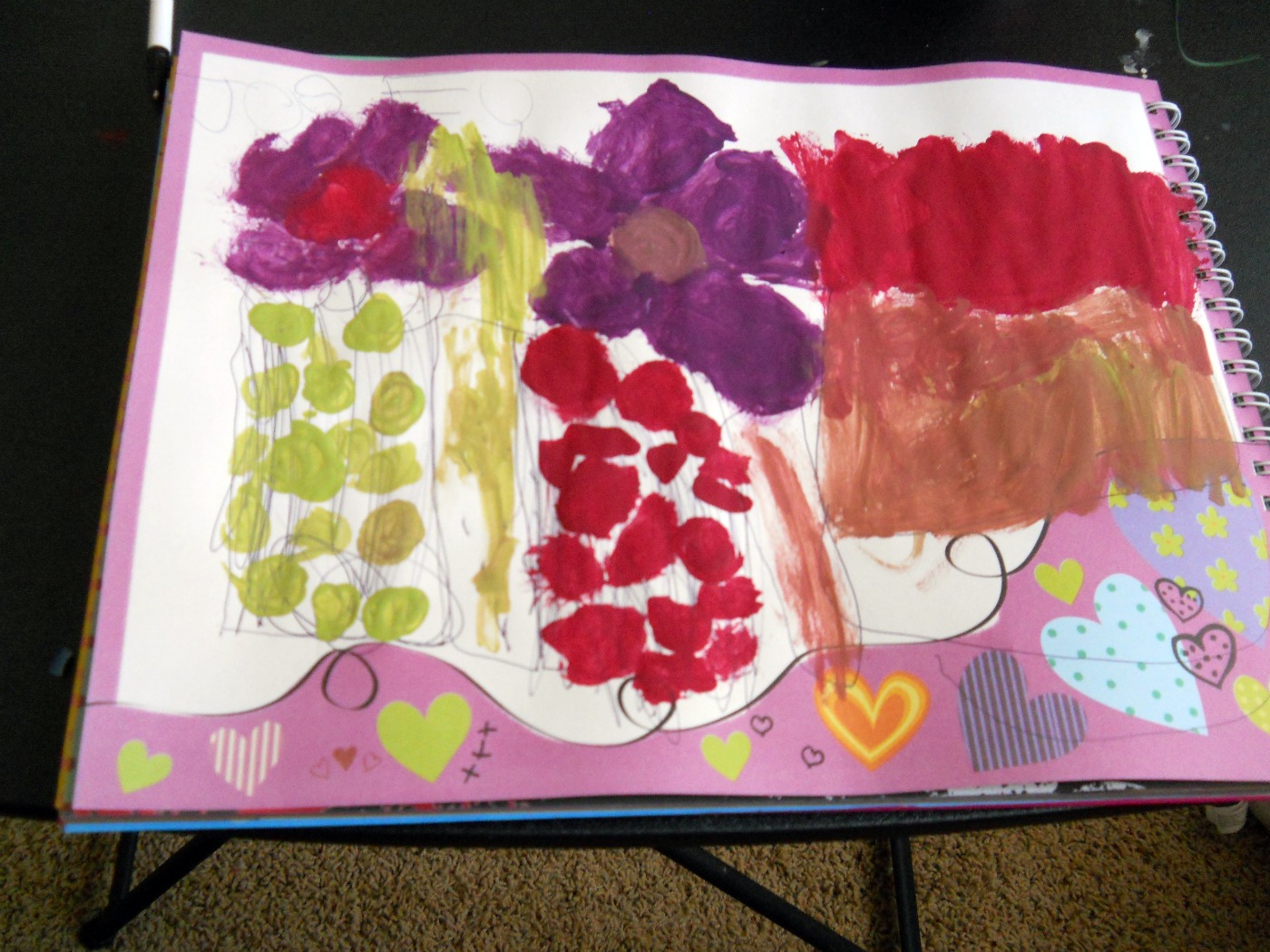
My girl set this display on her art table and asked, “Mom can I have some paint?”

And she began to paint…

The results…

This also gave Mama a chance to work on some new things…

What’s inspiring you (lately)…?

Monday Post ~ May 16, 2011

“Creative minds have always been known to survive any kind of bad training.”
~Anna Freud

What are your plans for creative practice this week? Given the specifics of your schedule, decide on a realistic goal or a milestone to reach for. A goal as simple as “I will be creative for 10 minutes every day” is what it’s all about. Share your goal(s) as a comment to this post, and let us know how things went with your creative plans for last week, if you posted to last week’s Monday Post.

Suggestion: When you’re deciding on your creative intentions, it’s a good idea to think about WHEN you’re going to write those 2,000 words or paint that canvas. Try to schedule the time slots in your calendar (if you keep one), understanding that flexibility may be required. If things don’t happen when you wanted them to, that’s OK. Give yourself a gentle push with one hand, but pat yourself kindly on the shoulder with the other if you don’t reach your goal for a given week. Sometimes it’s easier, sometimes it’s harder. Ride whatever you’ve got.

It’s also useful to have a sense of your minimum requirements (come hell or high water I’m going to write 100 words) while keeping a lookout for sudden opportunities to do more. You know, the day that the baby takes a monster nap or your partner takes the kids out to run errands and you find yourself with an unexpected “extra” half hour. Grab that time for yourself. You can catch up on the dishes and the laundry later. If you keep something creative in the back of your mind for those sudden opportunities, you’ll be more likely to use them to your advantage — rather than squandering your precious bonus moments on Facebook or vacuuming out the sofa cushions.

Intention Journaling

Not long ago, I became so overwhelmed with all of the things on my to-do list (and all of the many things that I really wanted to do) that I was no longer able to easily prioritize at the beginning of each day.

As a result, I’d flutter from item to item, getting a few things done, but forgetting something important that really had to be taken care of. I realized that I was so inundated that I needed to “talk” my way through to clarity. So I started “intention” journaling every morning.

Unlike Julia Cameron’s Morning Pages, I write a page every morning that specifically sets my intentions for the day. In conjunction with my planner, I outline what I’m going to do — but more than the specifics, I remind myself of the mindset of presence that I want to retain as much as possible; how I want to eat in order to nourish my body; priorities for my business, etc. It’s kind of like re-programming myself every morning. Intention journaling isn’t about re-hashing the past, although I wouldn’t want to limit myself if something really important seemed to be waving its arms in my face.

By clearing my mind and soothing anxieties, I make room for creativity. During this process, I often come up with new ideas for something I want to integrate into my coaching work or a new blog topic — I note them in my journal and then go back and highlight those items, so the journal is sort of a real-time workbook. It has been an enormous help to me in gaining clarity every morning, working though any perceived stressors, and reminding myself of what’s important before the day runs away form me.

If this approach appeals to you, give it a try. Art journaling would work here too! If you try it, let us know!

This piece was reprinted from the last issue of the Creative Times, our monthly newsletter. Click here to subscribe!

Monday Post ~ May 9, 2011

“You can’t use up creativity. The more you use, the more you have.” ~Maya Angelou

What are your plans for creative practice this week? Given the specifics of your schedule, decide on a realistic goal or a milestone to reach for. A goal as simple as “I will be creative for 10 minutes every day” is what it’s all about. Share your goal(s) as a comment to this post, and let us know how things went with your creative plans for last week, if you posted to last week’s Monday Post.

Suggestion: When you’re deciding on your creative intentions, it’s a good idea to think about WHEN you’re going to write those 2,000 words or paint that canvas. Try to schedule the time slots in your calendar (if you keep one), understanding that flexibility may be required. If things don’t happen when you wanted them to, that’s OK. Give yourself a gentle push with one hand, but pat yourself kindly on the shoulder with the other if you don’t reach your goal for a given week. Sometimes it’s easier, sometimes it’s harder. Ride whatever you’ve got.

It’s also useful to have a sense of your minimum requirements (come hell or high water I’m going to write 100 words) while keeping a lookout for sudden opportunities to do more. You know, the day that the baby takes a monster nap or your partner takes the kids out to run errands and you find yourself with an unexpected “extra” half hour. Grab that time for yourself. You can catch up on the dishes and the laundry later. If you keep something creative in the back of your mind for those sudden opportunities, you’ll be more likely to use them to your advantage — rather than squandering your precious bonus moments on Facebook or vacuuming out the sofa cushions.

Mother Writer Interviews: Jane Rusbridge

[This article is generously cross-posted from Alison Wells’s blog, Head above Water.]

Alison Wells: My four children are between 10 and 3 years old. As a novelist and short story writer, I was interested to find out how other women writers with young children manage their writing time and find creativity among chaos. In this series of interviews we hear from writers from Ireland, England, France, the US, and Australia who are at various stages in their writing careers.

Jane Rusbridge lives near in a tiny village in the South Downs, West Sussex. She has been Associate Lecturer of English at the university in Chichester for more than 10 years. Her debut novel, The Devil’s Music, was published by Bloomsbury in 2009 and was longlisted for this year’s International IMPAC Dublin Literary Award. Bloomsbury will publish a second novel, Rook, in 2012.

How many children do you have and in what age range?

I have three daughters: Katie, 28, Stephanie, 26 and Natalie, 22, and also a stepson, Sam (25) and a stepdaughter, Rose (22).

Had you established your writing regime before the children or did it happen alongside them?

I was a primary school teacher, but went back to university in my late thirties when my youngest started school because I’d always wanted to do an English degree. That’s when I started writing. I loved every aspect of the degree: books, books, books! It took 6 years, part-time; studying had to fit around work — I ran my own preschool group for four year olds — and the children. My divorce happened during that time, which was unsettling for the children, so I didn’t use any form of childcare. The children were all teenagers by the time I’d finished. The degree was something I was doing just for me, my dream, so everything else always took precedence.

What impact has having children had on your writing career?

To begin with, any writing had to fit into ‘spare’ time, squeezed in between work and family commitments. With 5 children this involved quite a bit of juggling and sometimes months went by when no writing got done. However, winning the university prize for creative writing was a big turning point which gave me enough confidence to start to send work out. Gradually, writing became more than a ‘hobby,’ more than just ‘fun.’ It got serious! All the same, writing was still something I did only for myself and so always came last on my list of priorities. The Devil’s Music took a very long time to write: 7-8 years at least.

How have you organised your writing time and space?

About 10 years ago, when the house was still filled with teenagers, my husband bought me a shed which we put at the bottom of the garden. I painted it blue. Having a special place away from the general hubbub of family life and allocated to my writing made a huge difference in two ways. Firstly, writing took on more importance — the blue shed was there for only one reason: for me to write. Secondly, the walk down the garden to my shed removed me, mentally, emotionally and physically, from the house where there was always washing to put in the machine, food to cook, family mess to tidy. Once I was in the shed, I was there to write and think; nothing else.

These days, with the children now adults and only Natalie living at home, I am able to devote much more time to writing and writing-related activities: research, organizing and travelling to events, social-networking. My writing career is pretty near the top of the priority list now. I teach much less, just the occasional freelance workshop and only part-time at the university. Nevertheless, it’s easiest to manage everything if I stick to a routine, so I set aside big chunks of time — whole days — for writing. A novel is a very big ‘thing’!

Is it possible to maintain a balance on a daily basis or do you find yourself readjusting focus from work to family over a longer time-span depending on your projects?

Family life is very important to me — my children all live close by and we see all lot of them. I do manage a balance but perhaps because writing is (mostly) unpaid work and it’s also work from home, there’s still that difficulty of writing not quite being considered a ‘proper’ career in other people’s eyes in the way a 9-5 office job would be. When I had small children at home I used to welcome anyone dropping in for tea or coffee at any time — not now! I’ve had to be firm with friends and make that clear. Not always easy! Quite a lot of compromise is necessary: there’s a tension between wanting to spend more time writing and the need to spend time with family and friends or to carry out practical tasks involved with running a home. I do much less housework than I used to. If I need a mental break from writing I’ll get the Hoover out or clean a bathroom — but writing takes precedence. That’s a reversal: writing used to be left until housework and everything else was done.

How do the children react to your writing or the time you spend on it?

They’ve always been supportive, even when they were tiny. We’ve always read to them a lot so they all value books and stories. They were very excited about my novel being published — I think they thought I’d suddenly become famous!

What do you find most challenging in juggling your role as a mother, your writing and university work?

The desire to write, to talk or think about my writing all the time, is very strong, but I’m aware it’s also pretty antisocial. I censor myself sometimes, so that my husband and the children don’t get bored with me wittering on. Luckily, because I teach creative writing, that’s a good outlet for lots of talk about books, reading and writing.

What was your proudest moment?

My proudest moment was a couple of weeks after I sent out the manuscript for The Devil’s Music to three agents: two of them phoned to say they were interested. I cried!

At what stage of your writing and family life did the agent representation for The Devil’s Music happen and what was the build up to it?

In 2006, I had a lucky year and I won prizes in several short story competitions. A chapter of The Devil’s Music was published in the Children’s Voices issue of Mslexia and editor Jill Dawson made some lovely comments about my writing. However, after almost 5 years, the 80,000 words I’d written of The Devil’ Music were still all over the place. I began to think maybe I couldn’t write a novel after all.

By coincidence, or perhaps synchronicity, one of the prizes I won was an Arvon course, tutored by Jill Dawson, with her friend Kathryn Heyman. On this course we were asked to set ourselves a series of goals to achieve within a certain timeframe. I gave myself one year to finish The Devil’s Music, or accept I was a short story writer, not a novelist. Kathryn Heyman liked what she saw of TDM at Arvon and offered to mentor me.

Gut instinct told me this might be my lucky break, that this could be the time to give writing priority in my life. By this time, two of our children were at university and, although the others were still at home, I was no longer tied to school runs and after school activities. My husband had started to do a lot of the cooking. I made two big decisions: to take six months off work (I’m an Associate Lecturer at Chichester University) and to spend a chunk of my savings on a mentor.

I’m so glad I did. In 2007, before my one year deadline was up, not only was The Devil’s Music finished, but two of the three agents I sent the manuscript to, phoned to say they were keen to take it on. This was my most joyous moment — and exciting beyond words! Every morning for weeks I woke up not quite believing it was true, and walked around with a big grin on my face.

Devil’s Music took almost 8 years to write. How did you hold onto the story of your novel and maintain the drive for that particular novel such a long period?

Working on something as large scale as a novel, with only squeezed-in bits and pieces of time for writing fitted between work and children and running a home, is undoubtedly hard in many respects, but I needed to take that long to write The Devil’s Music. Even when you’re doing something else and not consciously thinking about writing, what you’re working on never leaves you, does it? It’s always ticking over in your unconscious, at the back of your mind. I only discover what I am writing ‘about’, and the best way to tell a particular story, through a long, cyclical process of writing, redrafting, researching and redrafting — a slow process for me, whether I have time to write or not. I did sometimes think I wasn’t going to manage it, that life would be so much easier if I gave up trying to, but the initial desire to tell the story of the little boy at the centre of The Devil’s Music never went away; he haunted me.

Do you think women face particular challenges in career/family life balance or is it something that both men and women face in equal measure?

Certainly my generation of women, born in the 50s, faces more challenges than men when it comes to balancing writing and family commitments. Perhaps it’s a generalization, but there’s still the expectation that women should take the burden of responsibility for childcare and domestic chores.

Something has to give when wearing many hats, what is it for you?

I used to do a lot of gardening and decorating and cooking. Now I don’t! For the past 4 years or so my husband has done all the cooking — but then he is MUCH more interested in food than me. I’d eat boiled egg and toast every day to save valuable writing/thinking time. I do, when he’s away. When the children were younger, being a ‘good’ mother often seemed to include aeons of time revolving around food: I’m glad not to have that anymore!

What would you say to parents who want to write or further a writing career?

If writing is your passion, it’s very important to give it space in your life — important for you, and for everyone around you. If there are ‘sacrifices’ (money, time, friends even), only you can decide if they’re worth it.

More information on Jane and the Devil’s Music.

Jane’s novel the Devil’s Music was recently brought out on ebook. The book has received fabulous reviews.

Thank you so much to Jane. I wish her continued writing success. Find out more about Jane at her author site and about her novel The Devil’s Music. Facebook page: The Devil’s Music Facebook.
Writers: How Far Can You Get on Just 250 Words?

I’ve interviewed creative women with young children at home who are desperately unhappy because they can’t get their creative work done with any kind of regularity, or even at all. Probing more deeply, I often learn that so-and-so writer mother can’t consider working on her novel if she doesn’t have four hours to herself. When I suggest trying to be more flexible with work opportunities, she resists. So then the question becomes, gently: “Do you want to get your novel written on your own terms, or do you want to get your novel written?”

It’s important to remember that nothing lasts forever. Eventually, she will again be able to enjoy four-hour stretches of solitude for writing. But if that’s not feasible right now, and the creative work is how she makes meaning, it’s more important to loosen up on those ideals and develop skills that enable more spontaneous and flexible creativity.

It’s not terribly hard to write 250 words a day. With the exception of mothers with newborns, most of us can pull off 250 words without making a major time commitment or feeling like we’re neglecting our family. The four paragraphs you’re reading right now total exactly 250 words. If you wrote 250 words a day, you would have a full-length novel written in just over a year. Does that sound like a long time? It’s not. And if you don’t write those 250 words a day, the year will pass anyway, novel or no novel. Word by word!

This piece was reprinted from the last issue of the Creative Times, our monthly newsletter. Click here to subscribe!

Monday Post ~ May 2, 2011

“The good mother is a great artist, ever creating beauty out of chaos.” ~ Alice Randall

What are your plans for creative practice this week? Given the specifics of your schedule, decide on a realistic goal or a milestone to reach for. A goal as simple as “I will be creative for 10 minutes every day” is what it’s all about. Share your goal(s) as a comment to this post, and let us know how things went with your creative plans for last week, if you posted to last week’s Monday Post.

Suggestion: When you’re deciding on your creative intentions, it’s a good idea to think about WHEN you’re going to write those 2,000 words or paint that canvas. Try to schedule the time slots in your calendar (if you keep one), understanding that flexibility may be required. If things don’t happen when you wanted them to, that’s OK. Give yourself a gentle push with one hand, but pat yourself kindly on the shoulder with the other if you don’t reach your goal for a given week. Sometimes it’s easier, sometimes it’s harder. Ride whatever you’ve got.

It’s also useful to have a sense of your minimum requirements (come hell or high water I’m going to write 100 words) while keeping a lookout for sudden opportunities to do more. You know, the day that the baby takes a monster nap or your partner takes the kids out to run errands and you find yourself with an unexpected “extra” half hour. Grab that time for yourself. You can catch up on the dishes and the laundry later. If you keep something creative in the back of your mind for those sudden opportunities, you’ll be more likely to use them to your advantage — rather than squandering your precious bonus moments on Facebook or vacuuming out the sofa cushions.