Skip to content

Archive for

The Divided Heart: Art and Motherhood

dividedheartLast year, while trawling the web, I came across mention of Rachel Power’s The Divided Heart: Art and Motherhood. The book’s scope was clearly related to my own work, so I immediately ordered a copy even though I had to order it directly from Red Dog, the Australian publisher. The book arrived in good stead — fat and enticing — but it took me nearly a year before making the time to read it while on vacation this August. I only wish I hadn’t waited so long.

Rachel Power explores the painful dichotomy that is inherent in being both a mother and an artist: “A divided heart; a split self; the sense that to succeed at one means to fail at the other.” Through profiles of professional creative women — many of whom are familiar names to an American audience — Rachel explores how the divided heart manifests for each artist. While every situation is different, there are undeniable — and affirming — commonalities. Rachel’s book is not prescriptive; rather it is an intimate exploration of what it means to be an artist and a mother.

The profiles are fascinating, but the most compelling parts of the book are the author’s introduction, first chapter, and conclusion — which are all personal and expository. Rachel Power is a beautiful writer, and her prose is brilliant and honest. Ultimately, I wished the book had included more of her own thoughts and analysis.

Here is an excerpt that will sell the book to this particular audience more than any reviewer’s pontification:

“I looked at the other mothers in the part in the hope of recognising something. But we were smiling, smiling, all noble silence. Inside, are you crushed? I wanted to ask them. Are you gazing at the planes that fly overhead with a barely disguised yearning? Are your legs restless to run? And then, do you see your child grinning proudly at you from the top of the slide and does your heart lurch? Does love storm through your body and cuase you to run toward that darling face as if you’ve never wanted anything more in your life?” (p. 15)

This, dear reader, is the divided heart. I know that you know it well. Fortunately, the book rings with optimism without glossing over the author’s premise: being an artist and a mother is inherently painful, but you CAN turn the experience into something beautiful and successful, if you try hard enough — and surrender to the rocky landscape. Rachel quotes Susan Rubein Suleiman: “…Any mother of young children…who wants to do serious creative work — with all that such work implies of the will to self-assertion, self-absorption, solitary grappling — must be prepared for the worst kind of struggle, which is the struggle against herself.”

The Aussie writer and blogger MamaMia (Mia Freedman) described The Divided Heart as “A book that changed my life” and posted a terrific interview with Rachel. In-depth blogger reviews abound; my favorites include Loobylu, PickleMeThis, and You can now order the book in hardcover through third parties at amazon, or a paperback via the publisher.

Rachel Power has her own blog, The Rachel Papers, which continues the conversation.

Without question, The Divided Heart is an important resource in our discussion and contemplation of motherhood and art.

Kelly: Let the Crap Go

Spill It OOlivia created this canvas with me on Saturday. I was working on my Spill It! assignment for Carmen’s class, and Livvie decided she wanted to try along with me.  (Sarah chose to paint an “Open” and “Closed” sign for their room instead.)  She was following along with me for the most part when I looked over at her and realized she was crying. Oh goodness. I immediately went over to her with my paint covered hands, tried to give her a hug without getting paint all over her, and asked her what was wrong.

“I keep messing it all up, Mama!”  Livvie is a bit of a perfectionist.  The one thing she was doing differently than me was that she was using a paintbrush, not her fingers, because she didn’t want to get paint all over her fingers (which surprised me because the child has no issue getting completely covered with mud in the back yard). But I guess—maybe because of her art resource period at school?—she thought that painting with a paint brush was the “correct” way to paint. I quickly took her over to my laptop and showed her some of the canvases our class had posted in our ning group…to show her that, like mine, none of them were “perfect.”  (No offense to my Spill It! friends!)  After that, I asked her to consider putting her paintbrush down, and I helped her smush some paint around with her fingers. Then I showed her how we could take the opposite end of her paintbrush and draw smiley faces in the wet paint.  That got her. 🙂  From there, she tried a little of the bubble wrap method and then dipped the heart shaped cookie cutter I had given her into her pink paint and added the heart you see in the middle. After the addition of the stickers, she declared it done with a quiet smile on her face, remnants of tears still on her cheeks.

I’ve been thinking about that all week, particularly in regards to the expectations we put upon our children and our selves. I didn’t have any expectations for Livvie’s painting; I just wanted her to have fun. But because of her own expectations, she wasn’t having any fun at all at first. She’s been struggling a little at school, and we’ve had to meet with her teacher.  Boy, did that break my heart. I was heartbroken for her because she was struggling, and I know that she notices that Sarah hardly ever struggles with her schoolwork, and I was heartbroken for me because she wasn’t meeting the “standards.”  Terrible of me, huh. What standards? My standards? No, I guess they weren’t my standards, they were the school’s standards, but I realized my standards when it comes to academics are probably pretty high, too. She’s in first grade, for Pete’s sake! I have to admit, I never struggled in school. Not even through grad school. School just always came easy to me. But I see that it doesn’t come easy to Livvie just yet. She’ll get there; we’re committed to helping her at her pace, in whatever way she needs, providing mountains of encouragement and positive reinforcement along the way. We’re spending more one-on-one time with the two of them while they are doing their homework, so Livvie doesn’t have that in-your-face opportunity to compare herself with her sister.

Back to my expectations of myself…  I guess because I was always good in school, I expected that I’d be able to help my girls be good in school. I’m finding that that’s going to be a big learning process for me. And then I think about my expectations in regards to all this art stuff. I’ve always played with art. But when I started playing with mixed media, I realized I was definitely going to have to lower my expectations for myself.  The first mixed media piece I created with Wyanne taught me a big lesson. Like Livvie, I too, was a perfectionist! Wy sweetly told me that I was just going to have to let that “crap” go, just play, and not worry so much about the end result. Maybe that’s a really good life lesson too.  Let the crap go…just play…and maybe everything will fall into place as it’s meant to be. That’s definitely a good lesson for me right now.

Cathy: The Next Big Thing

crossposting from musings in mayhem

Why is it even when I have several projects I could be working on, narrowed to two that I am working on (read procrastinating) that I generally have at least part of my writer’s eye on The Next Big Thing?

This is also true in the home improvement arena, you should see what I’ve come up with for the addition now that we are paying a mortgage and have a yard of our own rather than renting a condo.

I mean I could also be focusing on getting those wonderfully folded piles from last week into dressers before starting this week’s loads. But I’m already a day late anyway, and have no earthly idea how it is that I wash the same five outfits per family member twice a week and there are still piles of folded and sorted laundry sitting from two weeks ago.

I’m planning next spring’s gardens while the plots are currently filled and continuing to fill with weeds. I really need to buy more sand to add to my clay soil which needs to be turned and covered, with compost, too, before I start plotting next year.

I am also dreaming baby names, when I know, logistics and physicality have set in stone that C is the last of my progeny. I am thinking of new baby names instead of being present with the three kids I have now.

I can use the baby names for characters, but that is the only technical resolve I have for this dilemma I have that the next thing is better than the present. It’s sparklier, it’s as tempting as a dessert sitting on the counter while I’m preparing dinner.

Something about the new, the imagined, the dreamed is much easier because I can keep my hands clean thinking about it while the dirty work of the present is a constant.

Maybe I just have trouble with finishing, with letting go, with saying finally, for the last time, that this version of the poem, the children’s novel, the article is good enough just the way it is.

I’m sure there is a psychological disorder with a big fancy name for this. It has conveniently slipped my mind.

London Evening Standard: Motherhood need not spell the end of literature

From the London Evening Standard‘s Sebastian Shakespeare:

There is no more sombre enemy of good art than the pram in the hall, wrote Cyril Connolly. Britain’s latest Nobel Laureate for Literature, Doris Lessing [at left], would doubtless agree. Lessing abandoned her two infant children (both under five) after leaving her first husband. “I had these two children and just couldn’t afford to keep them,” she said. Her two prams were not only enemies of promise but became emblematic of female poverty.

Some of the best female writers of the 20th century found it difficult to combine motherhood and creativity. Dame Muriel Spark walked out on her son when he was six to write novels and seek fame and fortune. She eventually cut her estranged son out of her multi-million pound will, leaving every penny of her assets to the female friend she lived with for 40 years.

Colette, who never wanted children, hardly ever saw her daughter, whom she left in the hands of an English nanny. She chillingly, albeit rather brilliantly, described children as “those happy unconscious little vampires who drain the maternal heart”. And as for Virginia Woolf, well, we all know what happened to her. The author of A Room of One’s Own, who argued that “a woman must have money and a room of her own if she is to write fiction”, ended up without children and committed suicide.

My wife, who is writing a book, recites this litany of names above as proof positive that motherhood and creativity do not go hand in hand — and the reason why she is putting procreation on hold. And Lessing’s Laureateship is now the icing on her anti-natal cake. Doris has set my breeding programme back by five years. However, for every bad egg there are plenty of examples of model literary mothers. What about Toni Morrison (1993 Nobel Prize winner), who continues to collaborate with her musician son Slade on children’s books?

Motherhood, far from being a hindrance, can be a spur to creativity. Look at JK Rowling, one of the most successful writers of the modern (or any) era, worth £500 million, who was a single mother when she embarked on writing her Harry Potter books.

Connolly’s maxim is not only out of date — in my block of flats I can’t keep a pram in the communal hallway — but plain wrong. The whole point of the perambulator is that you should push it around. JK Rowling took her baby out for a walk in the pram because it was the only way to get her child to fall asleep while she scribbled away in various Edinburgh cafés. You could argue that there is no better friend of good art than the pram in the mall. And, if you are lucky, the little blighter might actually get round to reading your book as well. At least that is what I’ll be telling my wife. Will my argument change her mind? I’ll get back to you.

Sebastian seems to be trying to convince himself, doesn’t he? I don’t feel comforted. Is this little piece uplifting, or just depressing?

Kristine: My Love Affair

When anyone asks me why I stay up until all hours of the night writing fiction when I could be sleeping or getting a number of domestic duties done around the house, I tell them it’s because (a) I have insomnia, (b) I hate cleaning just about as much as I hate exercising, and (c) I love it.

Yes, I have a love affair with my writing. I believe all writers do. It’s what keeps our butts in our chairs crafting scenes, wrestling with the demands of our characters, and spending an hour trying to think up the perfect metaphor for how our characters are feeling when we could be watching Dancing With The Stars or clipping grocery store coupons. (Okay, I do clip coupons—we’re still in a recession, after all.)

As any serious writer will tell you, building a career as a novelist is hard. It will break your heart most days. You can spend years on a project only to have it hidden in a drawer after having it rejected by every agent in the country.  You can go broke if you don’t have a supplemental form of income (i.e., a day job). You can read every how-to book and attend every workshop out there and still sit in front of a blank computer screen feeling lost.

So why do we do it? Why do we suffer through the frustration and the angst and the tears in pursuit of the cherished published novel boasting our byline on the cover?

It’s the dream of someday breaking through the barrier and emerging into the inner circle of published authors. It’s the hope that one day our words will reach the masses and make a difference, perhaps even change the world. It’s the feeling of having achieved our life’s mission—to write a novel and prove to ourselves that yes, we can do it and yes, we are good enough.

At least, that’s how it is for me.

I’m closing in on the last part of my rewrite on a book that has taken me two years so far to write. Yes, I could tackle the piles of laundry sitting in my basement or the dust balls hidden underneath the bed, but not yet. As with anyone involved with a love affair, I’m going to follow my heart, and my heart tells me that the only place I need to be at this moment is at my computer. Writing.

Miranda: For the love of books

Warning. This post contains an unusually intense degree of navel-gazing and otherwise raving on and on about one’s home library and related minutiae. If you find such material nauseating, turn away now. I warned you!

On Friday, I posted this on Facebook:

Miranda Hersey Helin is staging a serious overhaul of the home library/office today, with Mom’s help. The question is — and please don’t cringe, fellow bibliophiles — shelve the books by author last name, or by jacket color? I know, I know….but I peruse and admire many design blogs and must admit that books shelved by color look fabulous. Although I’m not sure I can bring myself to mix genres…..help!

I was amused by the considerable volume of responses. People feel VERY strongly about how to organize their books — as well they should. This is serious business, people!

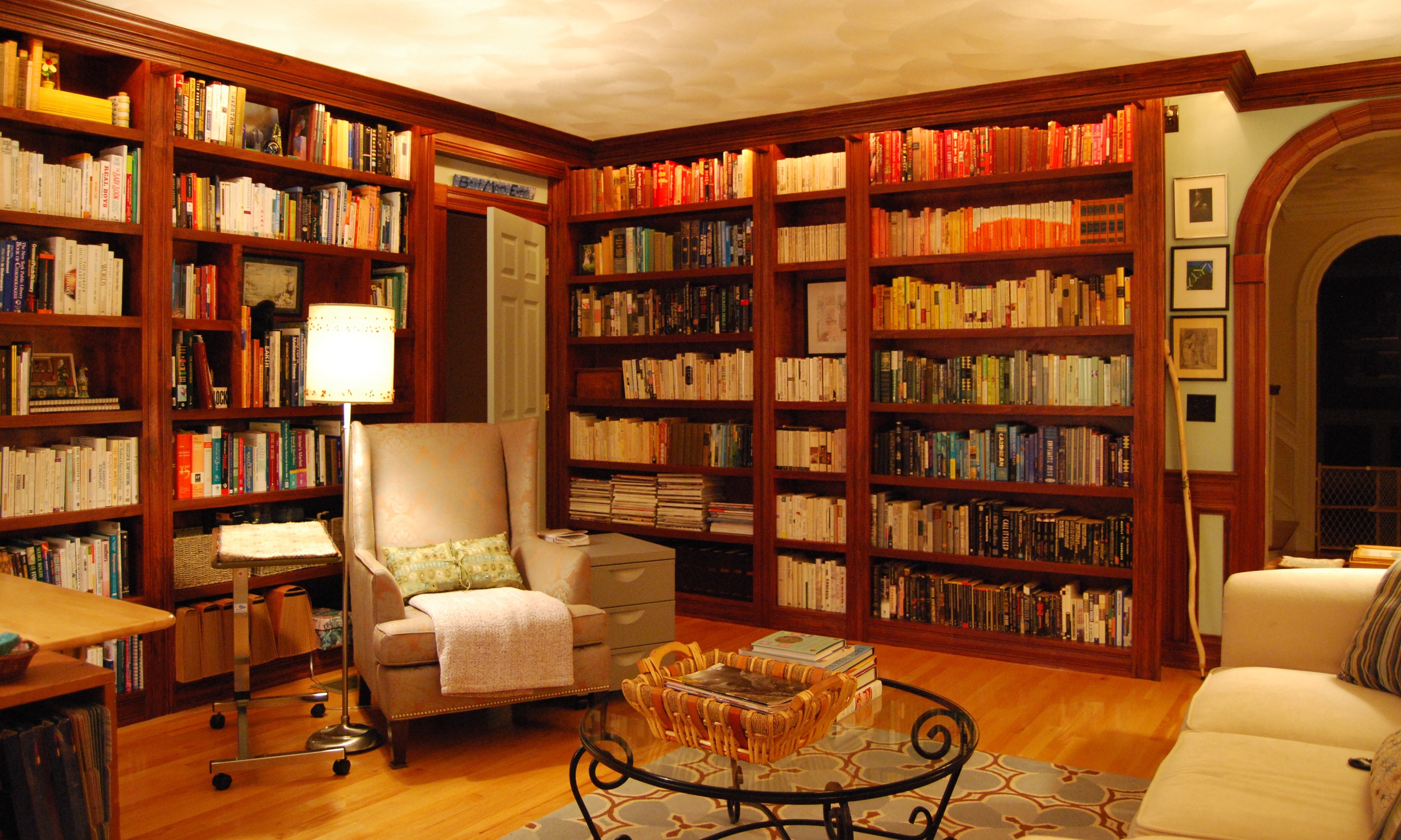
rainbowWhen I first heard of organizing books by color, I thought the premise was among the most ridiculous things I’d ever heard of. Not to mention sacrilegious. The whole idea sounded like “book as prop,” in the way that a professional decorator might buy small decorative things for a client’s room simply because they look nice against the wallpaper; nothing whatsoever to do with the item’s meaning or symbolism or its emotional value to the owner. Just “stuff.” Books, of course, are not “stuff.” Ew.

But over time, I came across more instances of books organized by color that really looked beautiful. Not just a stack of three yellow books next to a yellow vase, but shelves organized wholesale by color. Still, how would you ever find anything if you didn’t organize all of your books by genre and then by author last name?

When we moved into our new home in February of this year, I was thrilled to unpack my books and various possessions into our new library. I very vaguely segregated the books by nonfiction and fiction, intending to properly sort out the shelves, alphabetize my collection, and arrange all of my non-book items in the near future. Eight months later, the time finally arrived. My mother had given me a birthday coupon for a day’s worth of organizational help (and, most importantly, moral support) so I booked my sitter for an extra day, and on Friday my mother and I tackled the library. (It seemed indulgent to pay for babysitting in order to overhaul my library/home office, but considering that my mother and I worked all day long on Friday, and then I spent the better part of the weekend finishing the job myself, I know that this never would have happened if I hadn’t paid for the extra help.)

So, alphabet or color? I was intrigued by the color principle, and I had to try it. (Obviously, by the photo I ran above, there isn’t much question about which way I went.) I can’t believe HOW LONG it took to sort all the books, but we did it. (All those “taupe” books — are they gray? Are they brown? Are they off-white?) It was a LOT of fun, I have to admit. And I came to realize fairly early on that finding a specific book was not going to be a problem. But more on that later.

I also went through ever drawer and bin, sorting out all of my office supplies. I weeded out tons of stuff I don’t need or want. I filed every stack of paper. I found (or created) logical homes for all those little things that you pick up and say “what do I do with THIS?”

I now have a desk that I can actually use! I paid bills sitting at the desk last night, and everything I needed was in arm’s reach. My art supplies are organized in the hall closet around the corner, as there just isn’t room for everything in one place. But it all works.

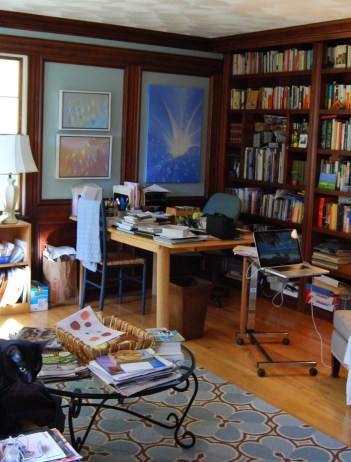
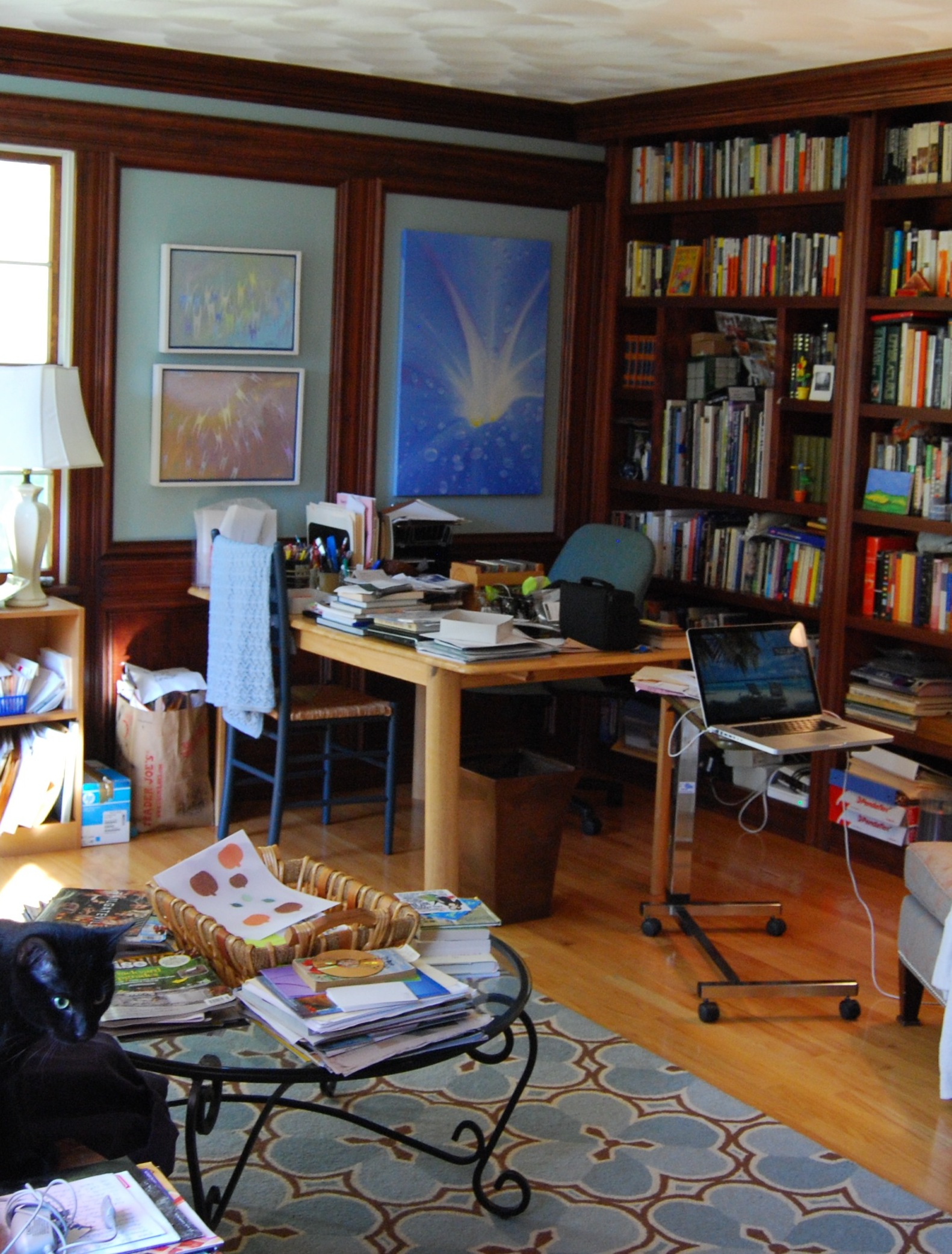
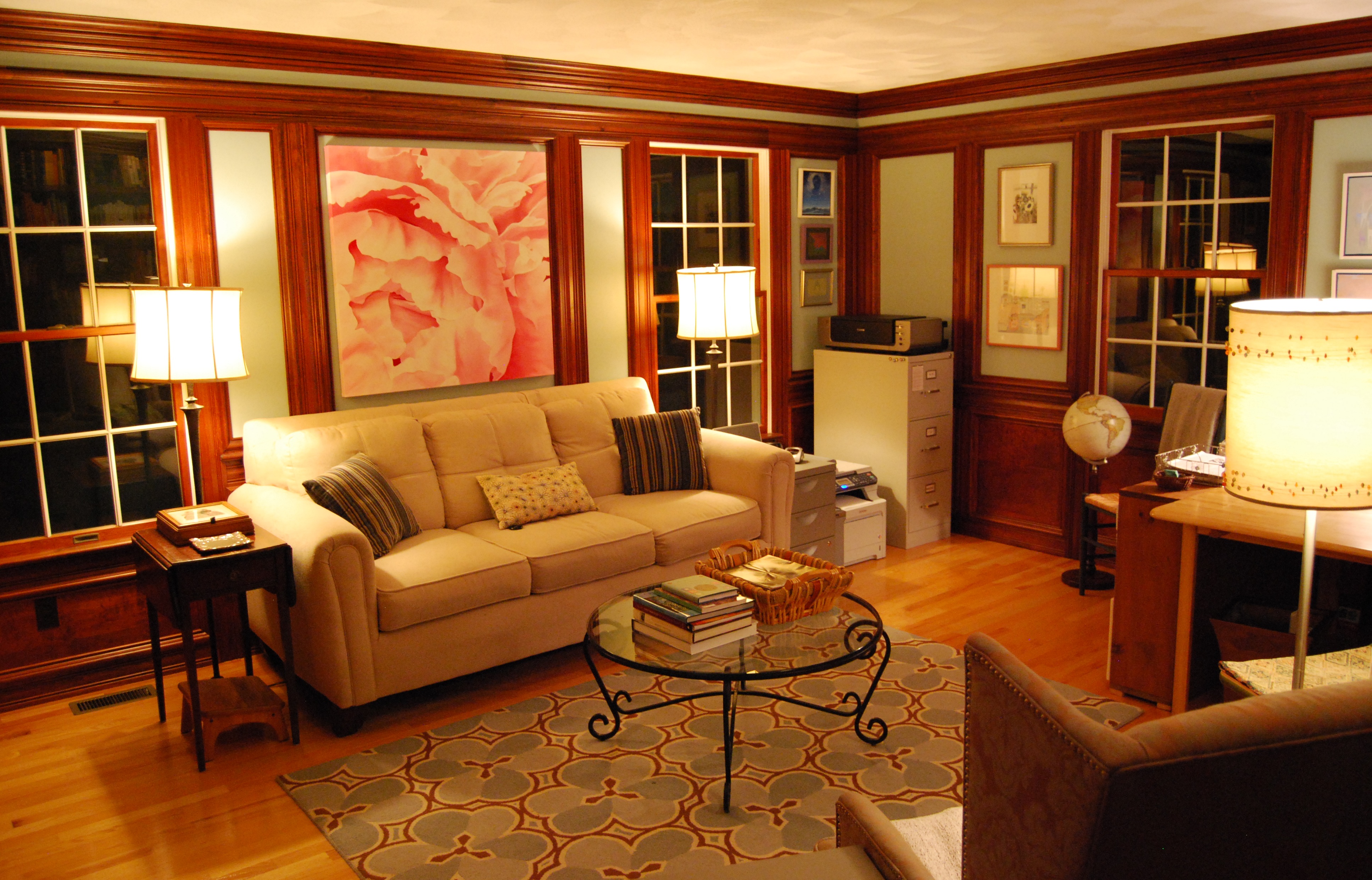
The basic footprint of the room hasn’t changed (months ago, we tried many different arrangements of the furniture, but nothing else worked). I did change out a yucky fiberboard bookshelf for a marginally better, longer bookshelf made by my ex-husband. (No, you can’t have it back!) Please ignore the hospital-style table on wheels (it’s one of the most practical things I own, and I use it all the time).

BEFORE

B_before

AFTER

B_after

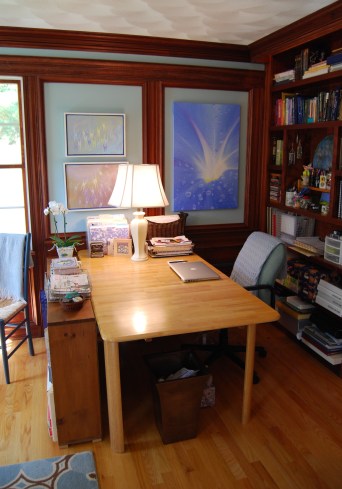
Desk corner before:

Desk_before

Desk corner after:

Desk_after

Considering that relatively little actually changed, aside from clearing out all the clutter, I can’t entirely explain the magic that this room now holds. I FREAKING LOVE IT. I want to be in here all the time. Yes, I’m in here now, typing on my laptop at my desk. I swear, it’s as if Mr. Roy G. Biv turned the room into a bowl of M&M’s. Very cozy at night, too:

night1

night2

So here’s my case for organizing books by color. In the first “after” photo above, fiction comprises the vertical shelf on the far right and the white shelf up the middle. That’s not really so many books. If I’m looking for a particular title, it’s not going to be hard to find even if I can’t remember the color of its spine. This is the only place I have adult fiction aside from my “to read” shelf on the other wall. The books to the left in the same photo are general nonfiction (biography, autobiography, and history). Again, these are mixed together, but it’s not a lot of shelf space for me to peruse if I need something. The fifth shelf is poetry.

On the other wall, books are broken down by genre. I have a shelf for editorial reference, a shelf for art reference, a shelf for books about writing, a shelf for books about creativity, a shelf for parenting, a shelf for self-help & metaphysical (yes, I have that many self-help and metaphysical books). There’s another shelf of semi-mixed nonfiction; a little chunk of current political books, a chunk of animal-related training books, a chunk of sports-related books, a section for gardening. Then there is the to-read shelf, as well a short fiction and plays. And so on.

For each of these subsections, I organized books by color and shape, depending on what looked best for each shelf. Again, I’m not going to have trouble finding anything because I know what each subsection is, and no single subsection is more than a shelf long.

So, now that I’ve dealt with the question of “how will you find anything?” I’ll get to why I think this is such a fabulous way to organize your books. First, a book is so much more than words on a page, or the author’s position in an alphabet. A book is a piece of art — even an old Bantam mass-market paperback — and to my mind, organizing books this way is something that honors each book as art. Positioning each book on a shelf in a way that maximizes its beauty (almost as “paint”) rather than by the name of the person who wrote it seems to me a more potent way to celebrate the beauty of a personal library. The shelves are pleasing and peaceful, without losing the vaguely chaotic and cozy look that is inherent in any library. The color progression is so eye-catching that I think it actually calls more attention to the books, not less — without dominating. What do you think?

The downside to having a dream library/work environment is this: There is pretty much no excuse left on the planet for not coming up with something brilliantly creative. I seem to have run out of excuses. And I DID just use an entire weekend’s worth of “free” moments to finish the room. Time to get to back to the writing 🙂