Skip to content

Archive for

Your Creative Intentions: The Monday Post ~ April 29, 2013

George Bernard Shaw quote

If you aren’t doing your creative work as often as you’d like, recommit to a regular creativity practice. Regularity — a daily practice, if possible — is one of the best ways to stay in touch with how you make meaning.

What are your plans for creative practice this week? Given the specifics of your schedule, decide on a realistic intention or practice plan — and ink that time in your calendar. The scheduling part is important, because as you know, if you try to “fit it in” around the edges, it generally won’t happen. An intention as simple as “I will write for 20 minutes every morning after breakfast” or “I will sketch a new still life on Wednesday evening” is what it’s all about. If appropriate, use time estimates to containerize your task. (Time estimates can make a daunting project feel more accessible.)

Share your intentions or goals as a comment to this post, and let us know how things went with your creative plans for last week, if you posted to last week’s Monday Post. We use a broad brush in defining creativity, so don’t be shy. We also often include well-being practices that support creativity, such as exercise and journaling.

Putting your intentions on “paper” helps you get clear on what you want to do — and sharing those intentions with this community leverages the motivation of an accountability group. Join us!

:::::::

If you’re an artist or writer with little ones, The Creative Mother’s Guide: Six Creative Practices for the Early Years is the essential survival guide written just for you. Concrete strategies for becoming more creative without adding stress and guilt. Filled with the wisdom of 13 insightful creative mothers; written by a certified creativity coach and mother of five. “Highly recommended.” ~Eric Maisel. 35 pages/$11.98. Available for download here.

Meme of the Week

Roald Dahl quote

Wisdom from Roald Dahl. Happy Friday.

:::::

Zoë: Breaking the Silence

Many of you will resonate with this moving portrait from guest blogger Zoë Purdy, a freelance writer and editor. Zoë lives with her husband and three children in Toronto, Canada.

Zoe Purdy

“I’ve been thinking, and I don’t want to be a mother when I grow up,” Sofie announced gravely one day when she was about three years old. “Oh, yeah?” I answered. “Well, you get to decide, of course, but you don’t have to make up your mind until you’re an adult.” She nodded, the relief evident on her face. Sofie is my middle child, cheerful and smart, stubborn and quirky.

“Babies are cute and stuff,” she went on, “but if I have one of my own then I’ll have to take care of it.” “True enough,” I agreed. “And you don’t think you’d enjoy taking care of a baby?” Sofie has always been gentle and empathetic, and of my three children I think of her as the most nurturing. She is the one who wants to bring every ailing insect and earthworm home to be nursed back to health. When our youngest was a baby, Sofie eagerly suggested ways to soothe her when she cried: nursing, cuddling, feeding her an ice-cream sundae, covering her in stickers. It surprised me to hear that she didn’t find the idea of motherhood attractive. “It’s just that there are so many other things that I want to do and if I’m a mother, I won’t get to do them,” she explained in a matter-of-fact tone.

I protested, of course, forcing myself to sound enthusiastic despite the ache I felt gathering in my chest. I told her that being a mother is only one part of who I am, albeit a very important part. There was absolutely no reason why she couldn’t do all those incredible things she imagined and have a baby. I believed what I was saying, but I know that it fell flat. This is why: as a parent, how I engage with life and who I am fundamentally as a person have far more impact on my children than anything I actively try to teach them.

Over the next days and weeks I returned to that conversation again and again. Something bothered me and it wasn’t that my daughter’s vision of her adult life didn’t include children. If she ultimately decides that parenthood isn’t for her, I won’t object. No, what really bothered me was this: my daughter found my life unappealing and I really couldn’t fault her for it. I had let myself be swallowed whole by motherhood and I had barely noticed. When had I given up on doing gratifying and important work myself? When had I decided that it was enough to raise other people who might grow up to do interesting things, to make their own valuable contributions to the world?

Three-year-olds are fickle creatures. You could ask Sofie what she wants to do when she grows up and get a different answer every day of the week. I’m sure that I too entertained a variety of career fantasies as a child, but one thing has remained constant throughout my life: my love of the written word. I have been devoted to writing and books for as long as I can remember.

My mother tells me that I dictated stories to her before I could read and write. Later I took to carrying around a small notebook just like one of my favourite storybook heroines, Harriet the Spy. As we rode the bus I would jot down notes about the other passengers and then spin off into wild speculations about their lives. At school I was known as a daydreamer — I was always busy putting together stories in my head, making up characters and sticking them into different scenarios to see what would happen.
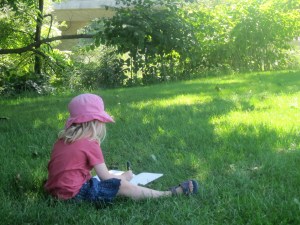
Sofie writingI was a shy child who was constantly told to speak up at school. Whenever a teacher read my writing for the first time, they always remarked with surprise that my voice was so strong and clear. In writing, I was able to try out other lives, to get out of my own head and inhabit someone else’s. It’s not that I was unhappy with my particular circumstances or with who I was; I simply wasn’t content to experience everything through only one set of eyes when books and my imagination gave me the ability to live and to feel so much more broadly and deeply.

I felt a kinship with the protagonist of Roald Dahl’s children’s novel Matilda. I almost cried in recognition when I read these lines: “So Matilda’s strong young mind continued to grow, nurtured by the voices of all those authors who had sent their books out into the world like ships on the sea. These books gave Matilda a hopeful and comforting message: You are not alone.”

As I got older, I never gave any thought to whether I could make my living as a writer. I always assumed that I would find a different way to support myself, but I never doubted that I would continue to write. It was a part of who I am, as basic and incontrovertible as the colour of my eyes.

When I graduated from university with a degree in English literature, I had no firm plan for what would come next. My boyfriend Erik was working on his PhD in chemical engineering at the time, and he spent his days in the lab developing a novel method of aerosol sampling. We joked that our relationship represented the meeting of Arts and Science. While there are plenty of good things to be said about a liberal arts program, it doesn’t prepare you for any specific occupation. Engineering majors become engineers, while English majors become… Englishologists? Baristas? My fellow graduates were all heading off to teacher’s college and law school in droves, but I hadn’t applied to either. I already had a full-time job at a bookstore. While I didn’t envision myself in retail forever, selling books certainly beat selling coffee. I decided to take a year to work and figure out what to do next.

I cast a wide net, sending out resumes and applications to anything that looked remotely appealing. I was particularly interested in a Master of Fine Arts in writing and literature. Spending a couple of years in an MFA program doing nothing but writing and reading was incredibly appealing. Even better, for the first time in my life I would be in the company of other people who thought that these activities were not only legitimate but also important. It was a way to put off adult life and its responsibilities a while longer. There was scholarship money available, and undergraduate teaching or editorial internships could offset the costs further while providing work experience. It wasn’t entirely impractical. I put together my portfolio, rustled up some reference letters, and summoned the courage to send in my applications.

The acceptance letter came that spring, the day after I found out that I was pregnant. Erik and I had agreed that we wanted children, but in that vague way you talk about things that are too far away to feel real. This, however, was real. When the shock wore off, we welcomed the idea of a baby. The timing wasn’t perfect: we weren’t married, we had no money, and Erik was still a student himself. The MFA would have necessitated moving across the country — so for now, school and motherhood were mutually exclusive. I turned down the offer. I told myself that I was postponing it rather than giving up on the idea entirely, but then, as if on cue, I stopped writing. As my belly grew, I imagined my creativity being channeled into the new life within it.

That autumn just after the new school year started, I gave birth to our son. Max entered the world in dramatic fashion, an accidental homebirth. Erik remembered only one thing from our prenatal class and it turned out to be highly relevant: newborns are extremely slippery, and you must keep a firm grasp on them if you don’t want to drop them onto the floor. So on that sunny fall afternoon we went from being two individuals to being a family of three. The world turned upside down. Read more
Your Creative Intentions: The Monday Post ~ April 22, 2013

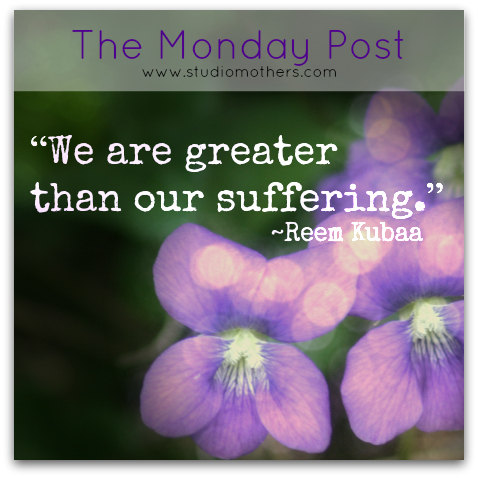
We are greater than our suffering

If you aren’t doing your creative work as often as you’d like, recommit to a regular creativity practice. Regularity — a daily practice, if possible — is one of the best ways to stay in touch with how you make meaning.

What are your plans for creative practice this week? Given the specifics of your schedule, decide on a realistic intention or practice plan — and ink that time in your calendar. The scheduling part is important, because as you know, if you try to “fit it in” around the edges, it generally won’t happen. An intention as simple as “I will write for 20 minutes every morning after breakfast” or “I will sketch a new still life on Wednesday evening” is what it’s all about. If appropriate, use time estimates to containerize your task. (Time estimates can make a daunting project feel more accessible.)

Share your intentions or goals as a comment to this post, and let us know how things went with your creative plans for last week, if you posted to last week’s Monday Post. We use a broad brush in defining creativity, so don’t be shy. We also often include well-being practices that support creativity, such as exercise and journaling.

Putting your intentions on “paper” helps you get clear on what you want to do — and sharing those intentions with this community leverages the motivation of an accountability group. Join us!

:::::::

If you’re an artist or writer with little ones, The Creative Mother’s Guide: Six Creative Practices for the Early Years is the essential survival guide written just for you. Concrete strategies for becoming more creative without adding stress and guilt. Filled with the wisdom of 13 insightful creative mothers; written by a certified creativity coach and mother of five. “Highly recommended.” ~Eric Maisel. 35 pages/$11.98. Available for download here.

Your Creative Intentions: The Monday Post ~ April 15, 2013

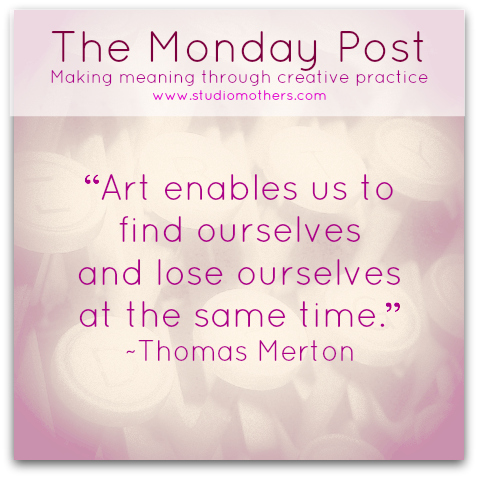
Monday Post Thomas Merton quote

If you aren’t doing your creative work as often as you’d like, recommit to a regular creativity practice. Regularity — a daily practice, if possible — is one of the best ways to stay in touch with how you make meaning.

What are your plans for creative practice this week? Given the specifics of your schedule, decide on a realistic intention or practice plan — and ink that time in your calendar. The scheduling part is important, because as you know, if you try to “fit it in” around the edges, it generally won’t happen. An intention as simple as “I will write for 20 minutes every morning after breakfast” or “I will sketch a new still life on Wednesday evening” is what it’s all about. If appropriate, use time estimates to containerize your task. (Time estimates can make a daunting project feel more accessible.)

Share your intentions or goals as a comment to this post, and let us know how things went with your creative plans for last week, if you posted to last week’s Monday Post. We use a broad brush in defining creativity, so don’t be shy. We also often include well-being practices that support creativity, such as exercise and journaling.

Putting your intentions on “paper” helps you get clear on what you want to do — and sharing those intentions with this community leverages the motivation of an accountability group. Join us!

:::::::

If you’re an artist or writer with little ones, The Creative Mother’s Guide: Six Creative Practices for the Early Years is the essential survival guide written just for you. Concrete strategies for becoming more creative without adding stress and guilt. Filled with the wisdom of 13 insightful creative mothers; written by a certified creativity coach and mother of five. “Highly recommended.” ~Eric Maisel. 35 pages/$11.98. Available for download here.

Meme of the Week

10 things that should never be said to artists

Happy Friday.

:::::

When Do Ideas Happen?

The Canadian painter Robert Genn writes a terrific, twice-weekly newsletter. While Genn writes primarily about painting, his thoughts apply to any creative pursuit, including writing — and we’ve reposted his letters here several times before. The gem below, which looks at the situations that generate ideas, is reprinted by permission.

Recent research, aimed at finding specific triggers that result in good ideas, better solutions and bouts of creativity, has confirmed my own favourite times when stuff happens. Here are a few:

When we step away: Focusing at your workstation doesn’t always work, particularly if you do too much of it. Leave your cubicle or studio and step into a new environment. Great stuff is ready to grab out there, floating in the ether.

When we’re in transition: Waking up, falling asleep, showering, tubbing, or going to the bathroom are hot times for new ideas. We need to trust the possibilities of fleeting brain waves at these times and take the trouble to knock them down for further study.

When we’re drinking: Moderate drinking gives confidence and gusto. A 2012 study at the University of Illinois at Chicago found that students who drank enough to raise their blood-alcohol level to 0.075 performed better on tests of insight than sober students.

When we’re doing chores: This may be one of the reasons why so many artists prefer to have their studios at home. I absolutely don’t want this sort of information passed around, but I personally find stimulation in washing cars, taking out the garbage, and helping our gardener move bags of manure.

When we’re satisfied: A relatively fulfilled life calms the mind and enriches the ground for idea growth. I’ve tried frustration, anger, disappointment, tiredness and misery, and they all work to a degree, but joyous satisfaction and a sense of élan work best.

When we’re daydreaming: It turns out that daydreaming is one of the most valuable things that creative people do. Even the fantasizing of chicks that bedevils a lot of men apparently hastens bubble-up ideas from the subconscious that have nothing to do with women. What women need to fantasize, I’m not sure.

When we see green: Green surroundings, whether green-painted walls or the green outdoors, suggest new growth, rebirth, fertility, and renewal — just one of the reasons why a walk in the park can be so fruitful. Feeling non-creative in the studio? Squeeze out some green.

Best regards,

Robert

PS: “When students were given creativity tests, those whose test-cover pages had a green background gave more creative answers than those whose pages were white, blue, red or grey.” (Sue Shellenbarger, reporting in the Wall Street Journal)

Esoterica: Personal and unique fetishes can be useful as well. For a steady flow of creativity, easel-time foot-massage has been recommended, as has military marching music played loudly. I notice slight rises when I consult or share minor triumphs with Dorothy the Airedale. She is non-confrontational, always eager, never critical, and I know she’s quite fond of me. Sometimes she likes my creativity so much she sleeps on it. In other words, she’s a low-maintenance muse. ‘Scuse me, she just came in, and now she wants out.

:::::

Don’t miss the treasure trove of Genn’s letters here.

Your Creative Intentions: The Monday Post ~ April 8, 2013

Melissa Jean quote

If you aren’t doing your creative work as often as you’d like, recommit to a regular creativity practice. Regularity — a daily practice, if possible — is one of the best ways to stay in touch with how you make meaning.

What are your plans for creative practice this week? Given the specifics of your schedule, decide on a realistic intention or practice plan — and ink that time in your calendar. The scheduling part is important, because as you know, if you try to “fit it in” around the edges, it generally won’t happen. An intention as simple as “I will write for 20 minutes every morning after breakfast” or “I will sketch a new still life on Wednesday evening” is what it’s all about. If appropriate, use time estimates to containerize your task. (Time estimates can make a daunting project feel more accessible.)

Share your intentions or goals as a comment to this post, and let us know how things went with your creative plans for last week, if you posted to last week’s Monday Post. We use a broad brush in defining creativity, so don’t be shy. We also often include well-being practices that support creativity, such as exercise and journaling.

Putting your intentions on “paper” helps you get clear on what you want to do — and sharing those intentions with this community leverages the motivation of an accountability group. Join us!

:::::::

If you’re an artist or writer with little ones, The Creative Mother’s Guide: Six Creative Practices for the Early Years is the essential survival guide written just for you. Concrete strategies for becoming more creative without adding stress and guilt. Filled with the wisdom of 13 insightful creative mothers; written by a certified creativity coach and mother of five. “Highly recommended.” ~Eric Maisel. 35 pages/$11.98. Available for download here.

Meme of the Week

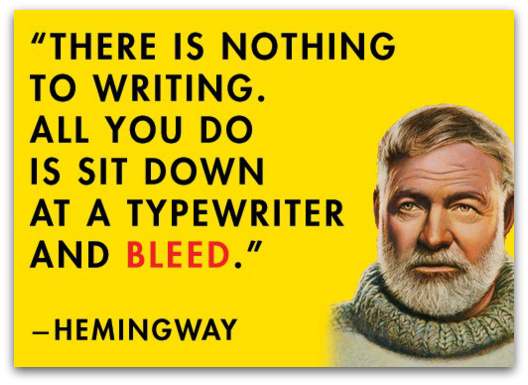
Hemingway_meme

Happy Friday.

:::::

From the Archives: The Creative Family Bathroom

This piece, which was originally published in 2010, is one of the most accessed posts in the Studio Mothers archives. We’re dusting it off today for those of you who haven’t seen it before — and those of you who have a soft spot for before-and-afters, like we do.
 

Let’s face it. When you add up all the minutes, most of us spend quite a lot of time in the bathroom. Especially when you have young children who need help wiping and washing, the bathroom can be a busy place.

Here’s a glimpse of what our little half-bathroom looked like when we bought our house:

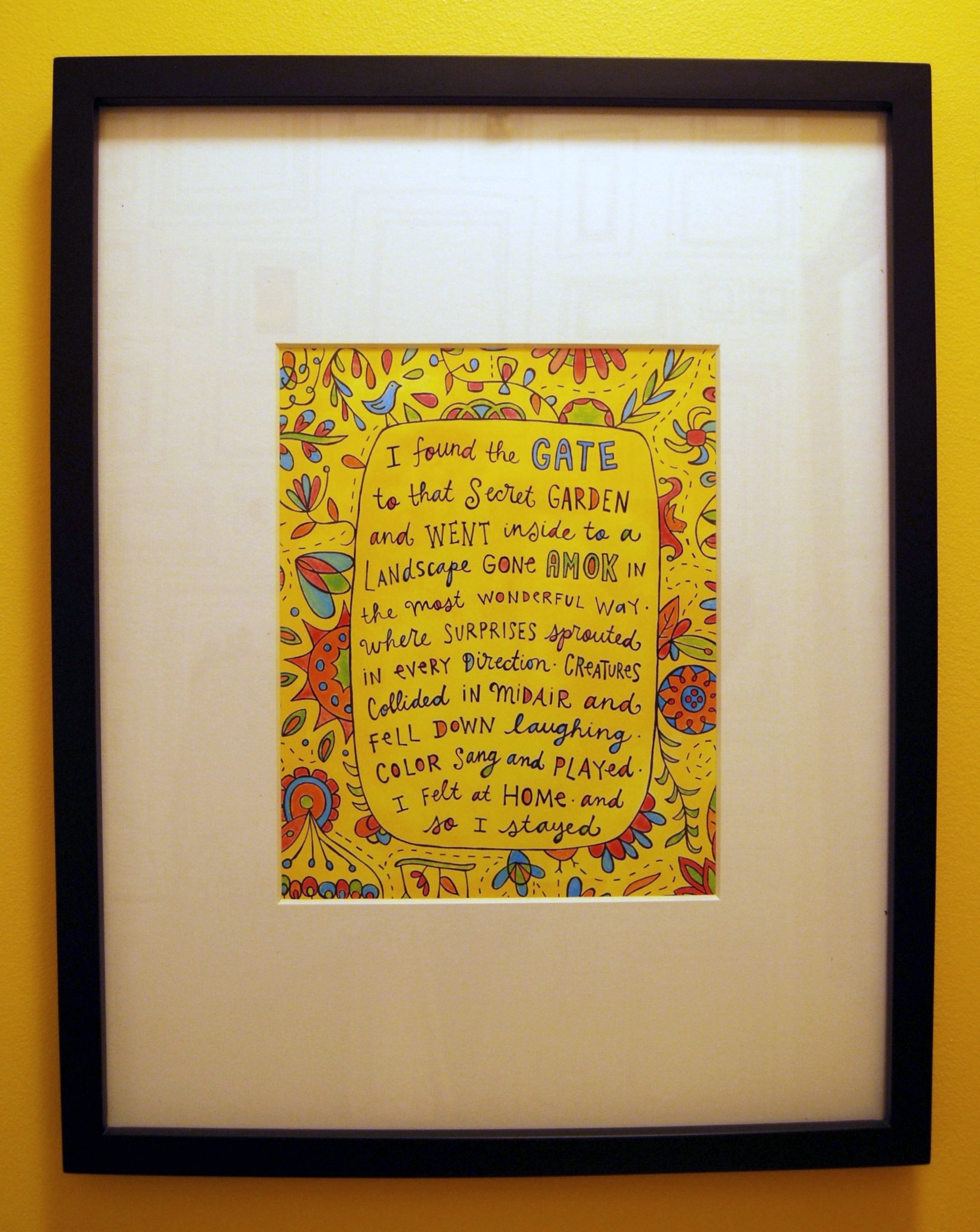
And this is what it looks like now:

When I stumbled across this wallpaper last year, I had to have it. And I don’t even like wallpaper. But the idea of being able to write on the walls — permanently — filled me with excitement. One wall of paper would do it. (I trash-picked the mirror hanging above the sink, so that added a few dollars to the budget.) Bright paint would go on the other walls. The only “rule” for writing on this wall is not to create anything obscene. (I have teenagers, so a rule like this is actually necessary.) Other than that, anything goes. I’ve added a few collage pieces, and I look forward to creating a few mini paintings. The wall has become something of a guest book, too. We encourage guests to add something to the wall as a remembrance of their visit. And of course, all ages are welcome to contribute. (Yesterday I overhead one of my 14-year-old daughter’s friends exclaim: “You mean you can just come in here and write on the walls any old time you feel like it??” And my daughter’s response — slightly smug — “Yup!”)

You’ll see that this little room features two of my recent acquisitions from Aimee Myers Dolich of Artsyville. I love her work — and I especially love how the “doodles” and black frames (inexpensive frames from Target) echo the intention and inspiration of our create-it-yourself wallpaper, as well as the color of the painted walls. (And per the doodle, there ARE stacks of books in this room too — well, a shelf full, anyway!) A beautiful fit.

Future owners of our house will either love the wall and embrace it for themselves, or rip it all off (and God forbid, return it to the original, boring off-white). I imagine that wherever I live, I’ll always want to have a wall like this somewhere in my house.

So there you have it — the creative family bathroom. Any of you who ever come for a visit are eagerly encouraged to add your creative signature to our bathroom wall!

Your Creative Intentions: The Monday Post ~ April 1, 2013

Maritza Burgos quote

If you aren’t doing your creative work as often as you’d like, recommit to a regular creativity practice. Regularity — a daily practice, if possible — is one of the best ways to stay in touch with how you make meaning.

What are your plans for creative practice this week? Given the specifics of your schedule, decide on a realistic intention or practice plan — and ink that time in your calendar. The scheduling part is important, because as you know, if you try to “fit it in” around the edges, it generally won’t happen. An intention as simple as “I will write for 20 minutes every morning after breakfast” or “I will sketch a new still life on Wednesday evening” is what it’s all about. If appropriate, use time estimates to containerize your task. (Time estimates can make a daunting project feel more accessible.)

Share your intentions or goals as a comment to this post, and let us know how things went with your creative plans for last week, if you posted to last week’s Monday Post. We use a broad brush in defining creativity, so don’t be shy. We also often include well-being practices that support creativity, such as exercise and journaling.

Putting your intentions on “paper” helps you get clear on what you want to do — and sharing those intentions with this community leverages the motivation of an accountability group. Join us!

:::::::

If you’re an artist or writer with little ones, The Creative Mother’s Guide: Six Creative Practices for the Early Years is the essential survival guide written just for you. Concrete strategies for becoming more creative without adding stress and guilt. Filled with the wisdom of 13 insightful creative mothers; written by a certified creativity coach and mother of five. “Highly recommended.” ~Eric Maisel. 35 pages/$11.98. Available for download here.