Brittany: Unkeeping a Journal
Crossposted from my personal blog.
 I’m the sort of writer whose ideas are in a constant state of percolation. I’ll be driving my mini-van, listening to the Wiggles, answering a constant stream of “whys” from the backseat, and all of a sudden a snippet of conversation will pop into my head, where it will sit until I’m in the grocery store, and I imagine a dialogue around that snippet of conversation, where it will sit until I’m in the middle of a debate with Tom about what to have for dinner, when the setting for the dialogue with the snippet of conversation will pop into my head. Then I’ll let it percolate some more while I work out all the sensory details and plot points. And then, when everything finally starts to come together in my own mind, I *try* to write it all down.
It’s not the most effective means of novel writing. Invariably, I lose my momentum halfway through and end up wracking my brain trying to remember what I’d been stewing over.
In this month’s Writer’s Digest, there’s an article that caught my attention about “unkeeping” a journal, and using it as a repository for all those snippets that fall into your head and end up lost to time. Since there are no rules, because technically, you aren’t *keeping* a journal, you can use it to play around with your writing, brainstorm out loud, and amuse yourself by transcribing the conversations around you, funny things children say, and any interesting stories that interest you. All excellent ideas.
Some of the suggestions didn’t really appeal to me. I’m not going to interview myself, pretending I’m a bestselling author, for example. And I don’t see the point in brainstorming titles for a children’s book about two dogs. But a couple of pages into the article, one of the suggestions really caught my eye.
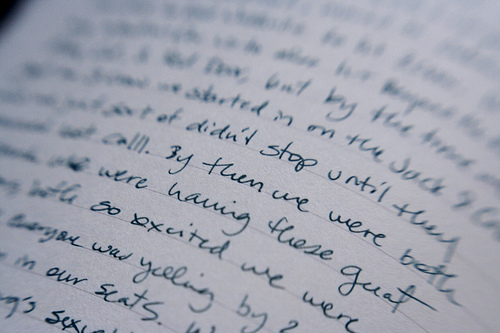
It’s an exercise called Outrunning the Critic. What you’re supposed to do is write 100 short sentences about a character, central concept, or scene in a story, and write those sentences without lifting your pen from the paper. I read that and went, “Huh. I should try that.”
I had a scene percolating in my head — a very pivotal, very long scene that I didn’t want to start yet. It was just too daunting. It takes place at a square dance and it had already taken three hours of watching square dance and clogging videos on You Tube to get the first page of the scene started. But the boys were playing trains in the playroom, and they wanted me in there with them, so I grabbed my new journal, numbered the lines from 1 to 100 and jotted down thoughts as they came to me.
Even though there were times that John was leaping on me and literally swinging off my pen-wielding arm (in danger of getting his little eyes stabbed out, by the way, which I suppose is an occupational hazard when your mother is a novelist) I got my 100 short sentences written in pretty short order. It was surprising to see how truly fleshed out that portion of the chapter already was in my head, and how little I really needed to fill in.
Since I don’t like to “write” until the scene is complete in my head, but 100 sentences feels like a substantial amount of ideas for getting started, I was able to subvert that part of myself that says “Sorry. Not enough here to write it down.” The best part is, in transcribing those 100 sentences into the body of my text, I see it is a hugely substantial piece of writing after all. It didn’t feel like I was making progress because it was too easy, but even so, I was.
This is definitely a technique I’ll try again (there’s a lot of scene left to write, and I still dread writing it).
[Photo courtesy the8rgrl]





 Studio Mothers: Life & Art